
Executive Overview
For the average full-time employee operating on a standard 40-hour workweek, labor consumes roughly one-third of adult waking hours. When factoring in daily commutes, administrative overhead, professional correspondence, and the pervasive psychological overflow of workplace stress, the modern employee effectively surrenders more than half of their conscious life to the demands of their vocation.
Despite the overwhelming portion of human existence consumed by work, societal discourse frequently dismisses the routine workday as mundane—a repetitive background noise to "real life." However, contemporary and historical literature tells a vastly different story. Behind the facade of corporate monotony lies a complex ecosystem of micro-dramas, systemic inequities, psychological warfare, and long-standing power dynamics.
This investigative analysis examines the mechanics of workplace literature, exploring how prominent authors dissect the daily grind across diverse sectors—from the corporate cubicle and academic lecture hall to the hyper-commodified entertainment industry and speculative post-human future. Drawing upon the sociological frameworks of emotional labor, institutional erosion, and economic precarity, this study highlights how fiction exposes the uncanny realities of modern employment.
Read Also
Supporting Context & Labor Metrics: The Socioeconomic Backdrop
To understand the cultural resonance of workplace fiction, one must first examine the quantitative landscape of modern labor. The systemic structures governing employment have undergone radical shifts over the past several decades, intensifying worker alienation and blurring the boundaries between personal identity and professional duty.
+-----------------------------------------------------------------------+
|                       THE HUMAN LABOR FOOTPRINT                       |
+-----------------------------------------------------------------------+
|  Average Lifetime Work Hours           | ~90,000 Hours                |
|  Conscious Life Dedicated to Work      | > 50% (Including Commute)    |
|  U.S. Higher Ed Adjunct Workforce Ratio| ~70% Non-Tenure Track         |
|  Core Driver of Workplace Alienation   | Uncompensated Emotional Labor|
+-----------------------------------------------------------------------+
Key Trends Shaping Workplace Narrative Tropes:
- The Proliferation of Uncompensated Emotional Labor: First conceptualized by sociologist Arlie Russell Hochschild, emotional labor—the requirement to manage feelings and expressions to fulfill the emotional requirements of a job—has transitioned from service-sector expectations to universal corporate standard.
- The Precarization of Professional Roles: The steady erosion of tenure in higher education and the rise of contract/gig labor have replaced stable career ladders with systemic vulnerability, forcing workers into perpetual side-hustles.
- Capitalist Inertia and Institutional Habituation: The psychological phenomenon where workers remain trapped in harmful or unfulfilling employment due to financial dependency, fear of status loss, or structural muscle memory.
Case Studies in Literary Labor: Deconstructing the Workplace Spectrum
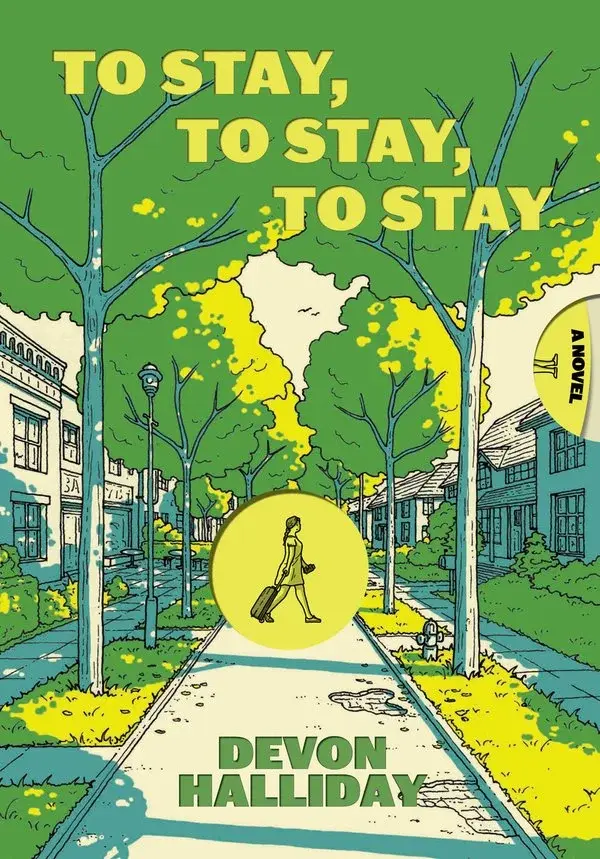
In the debut novel To Stay, To Stay, To Stay, the narrative takes an omniscient, minute-by-minute approach to small-town labor in Appalachian Ohio. By shadowing an ensemble cast through the micro-interactions of bakery counters, counseling sessions, and administrative desks, the text captures the existential weight of choosing—and being trapped by—a vocation.
Beyond this frame, eight landmark literary works offer obsessive, detailed examinations of modern labor, turning daily routine into a subject of critical investigation.
                  LITERARY WORKPLACE TAXONOMY

    Surveillance & Bureaucracy       Precarity & Gig Economy
    --------------------------       -----------------------
    * Easy Job (Tsumura)            * The New Me (Butler)
    * Severance (Ma)                * The Adjunct (Adelmann)

    Parasocial & Retail Micro-Econ   Institutional & Speculative
    ------------------------------   ---------------------------
    * Superfan (Zhang)              * Stoner (Williams)
    * The Assistant (Malamud)       * The Employees (Ravn)
1. Surveillance, Bureaucracy, and Emotional Labor
There’s No Such Thing as an Easy Job by Kikuko Tsumura (trans. Polly Barton)
Following a debilitating episode of professional burnout, the unnamed protagonist seeks what seems like an impossibility: employment devoid of narrative drama, high stakes, or psychological pressure. Managed by an employment agency, she rotates through seemingly passive jobs—surveilling a reclusive writer, writing bus advertisements, and hanging promotional posters.
However, Tsumura exposes the paradox of modern labor: total detachment is impossible. Emotional labor is an inherent condition of employment. The protagonist inevitably becomes entangled in the obsessive subcultures and emotional dynamics of each workplace, illustrating that even the most trivial job demands a psychological toll that exceeds its wage compensation.
The New Me by Halle Butler
Butler’s novel delivers a portrait of administrative precarity through its protagonist, Millie—an educated yet profoundly disengaged millennial trapped in a cycle of temporary secretarial work. The narrative dismantles corporate promises of professional mobility, contrasting Millie’s internal alienation with the performative enthusiasm required by modern office environments.
The New Me highlights the psychological weight of temp labor, where workers are caught between the humiliation of performative effort and the existential void of administrative irrelevance.
2. Corporate Inertia and Parasocial Commodification
Severance by Ling Ma
While structurally framed around a global pandemic, Severance serves primarily as a critique of modern corporate inertia and supply-chain capitalism. The protagonist, Candace Chen, coordinates the offshore printing of specialized bibles in New York City. As the fatal "Shen Flu" spreads and society collapses, Candace continues reporting to her empty office, driven by a lucrative retention bonus and sheer corporate habituation.
   [Systemic Collapse] ----> [Corporate Contract] ----> [Routines Persist]
          |                                                   |
          +-----------------> CANDACE CHEN <------------------+
                                  |
                      (Inertia & Survival Capital)
Ma captures the absurdist reality of institutional muscle memory: the compulsion to maintain inbox management, commute schedules, and corporate compliance even as the socioeconomic foundation crumbles around the worker.
Superfan by Jenny Tinghui Zhang
Zhang’s novel turns its lens on the entertainment industry, deconstructing the hyper-curated existence of a global boy band to reveal the industrial labor underlying pop stardom. The text details the mechanical realities of the profession: brutal choreography schedules, managed rest cycles, controlled movements, and script-driven media appearances.
Crucially, Superfan frames the fan-celebrity dynamic not as glamorous romance, but as reciprocal, high-intensity labor. Band members must continuously package their authentic selves into bite-sized content, while fans invest massive amounts of time analyzing media to find authentic human connection.

3. Institutional Erosion and Academic Precarity
Stoner by John Williams
Williams’ classic academic novel traces the lifetime of William Stoner, a Midwestern farm boy who becomes an assistant professor of English. The narrative maps the institutional politics, personal rivalries, and quiet disappointments of higher education.
Far from an idealized ivory tower, Stoner presents academia as an embattled institution defined by bureaucratic warfare, fading cultural relevance, and systemic compromise. Yet, amidst the professional friction, the novel documents the enduring power of pedagogy—demonstrating how genuine devotion to craft can survive institutional erosion.
The Adjunct by Maria Adelmann
Providing a modern counterpoint to Stoner, Adelmann’s The Adjunct explores the reality of contemporary higher education: the gig-economy academic. Protagonist Sam navigates the grueling routine of an underpaid adjunct professor, balancing five class sections across multiple institutions while managing mounting personal debt, parking fees, and endless grading cycles.
Adelmann exposes how modern universities rely on contingent faculty, dangling the elusive promise of tenure-track security to extract maximum labor from an overqualified, undercompensated workforce.
4. Micro-Economics and Speculative Post-Human Labor
The Assistant by Bernard Malamud
Set within a struggling neighborhood grocery store, Malamud’s novel provides a detailed study of small-business micro-economics. When a mysterious young man named Frank joins the store as an assistant, the business experiences a modest financial revival through fresh ideas and intense physical labor.
Malamud focuses on the granular financial realities of daily commerce. The narrative creates high dramatic tension out of tiny monetary fluctuations—turning daily revenues of $1.25 versus $1.50 into existential victories or defeats. In doing so, it reveals how small enterprise transforms human relationships into transactional balances.
+------------------------------------------------------------------------+
|              THE MICRO-ECONOMIC CYCLE IN *THE ASSISTANT*               |
+------------------------------------------------------------------------+
| Daily Revenue ($1.25 vs $1.50)  ---> Micro-Margin Survival             |
| Personal Guilt / Past Secrets   ---> Uncompensated Physical Labor      |
| Transactional Relationships     ---> Moral & Financial Indebtedness    |
+------------------------------------------------------------------------+
The Employees by Olga Ravn
Ravn’s speculative novel, structured as a series of workplace witness statements, takes place aboard a futuristic spaceship crewed by both humans and engineered humanoids. Tasked with maintaining mysterious alien artifacts, both groups slowly experience a breakdown in operational efficiency as the objects trigger buried memories, nostalgia, and existential questioning.
Because the speakers are anonymous, the distinction between human worker and artificial unit blurs. The Employees operates as an allegory for contemporary workplace alienation, where corporate language reduces human consciousness to mere metrics of productivity and compliance.
Comparative Analysis of Workplace Dynamics
The literary works analyzed share common thematic threads regarding how labor reshapes the human experience. The table below outlines how these texts portray distinct structural mechanisms of workplace control:
| Work | Primary Sector | Structural Conflict | Mode of Alienation |
|---|---|---|---|
| To Stay, To Stay, To Stay | Service / Therapy | Micro-interactions vs. identity | Vocation fatigue |
| There’s No Such Thing… | Variable / Gig | Emotional labor expectations | Over-engagement burnout |
| The New Me | Corporate Temp | Administrative irrelevance | Performative enthusiasm |
| Superfan | Entertainment | Parasocial commodification | Hyper-scheduled selfhood |
| Severance | Publishing | Systemic capitalistic inertia | Habitual compliance |
| Stoner | Academia (Classic) | Departmental political warfare | Institutional erosion |
| The Adjunct | Academia (Modern) | Gig-economy precarity | Structural debt exploitation |
| The Assistant | Small Retail | Micro-financial survival | Transactional morality |
| The Employees | Speculative Space | Human vs. Humanoid metrics | Post-human productivity |
Authoritative Statements & Critical Perspectives
Literary critics and workforce theorists emphasize that workplace fiction functions as both a socio-economic warning system and a record of daily human experience.
"At every job I’ve ever held, my workday has been filled with tiny bursts of drama, ferocious irritations, minor victories, and long-standing power struggles… Modern literature turns the daily grind into something uncanny, absurd, and deeply worth studying."
— Excerpt from To Stay, To Stay, To Stay design notes
Sociological research reinforces these narrative portrayals. Studies indicate that as traditional markers of identity (community, civic organizations, long-term employment stability) have declined, workplaces have claimed an increasingly large share of individual identity—often without offering long-term economic security in return. Consequently, workplace literature serves a vital diagnostic function, exposing the human cost of modern operational efficiency.
Future Outlook: The Evolution of Workplace Narratives
As the global labor market faces unprecedented structural shifts, the nature of workplace literature is evolving. Key emerging trends that will shape future narratives of labor include:
- Algorithmic Management and Automated Oversight: Literature is increasingly grappling with software-driven management, where automated metrics, keystroke tracking, and algorithmic efficiency targets replace human supervisors.
- The Dissolution of the Physical Workplace: The transition to remote and hybrid work models has shifted workplace alienation from cubicle-bound isolation to digital surveillance and blurred home-life boundaries.
- Artificial Intelligence and Creative Labor: Following the themes of Ravn’s The Employees, future narratives are actively questioning the boundary between human creative expression and automated output—examining how workers preserve their humanity when intellectual and creative tasks are commodified.
Ultimately, these literary investigations remind us that work is far more than an economic necessity. By meticulously recording the daily grind—the micro-victories, systemic frustrations, and quiet struggles—workplace fiction reveals the complex reality of the lives we build within the half of our conscious existence we sell to others.




Comments
Facebook App ID not configured. Please add it in the Customizer.