In the contemporary literary landscape, poetry often oscillates between two extremes: the hermetically academic, which speaks only to a specialized coterie of theorists, and the hyper-accessible, which risks trading profound emotional resonance for immediate, digestible sentiment. Few contemporary American poets navigate the razor-thin wire between these poles with the deceptive casualness of Bob Hicok.
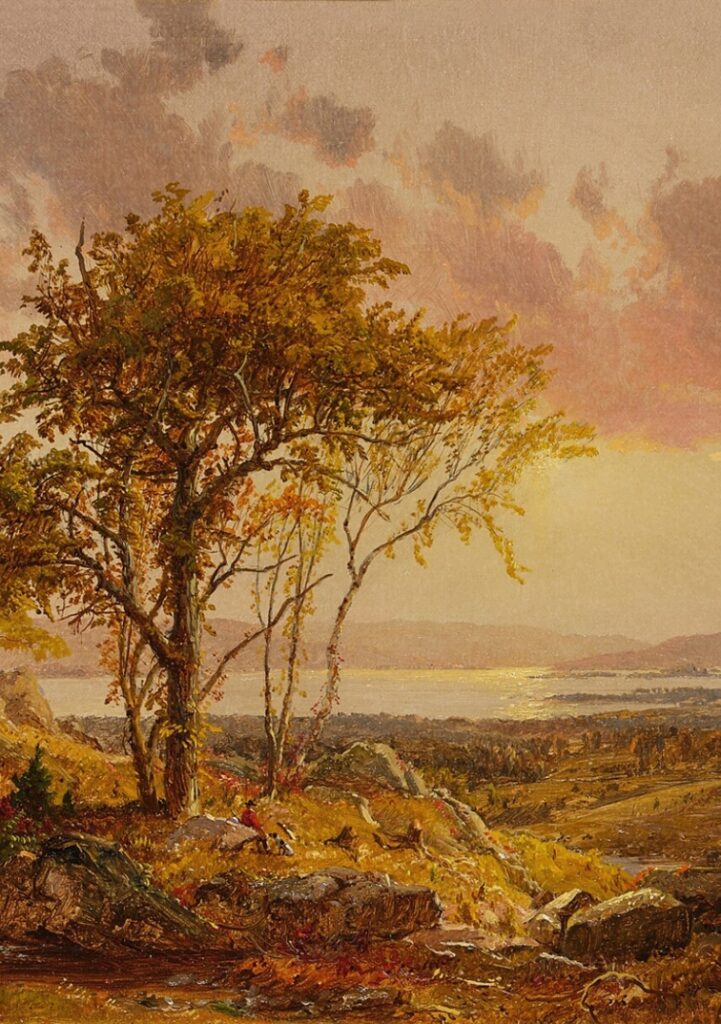
On October 26, 2026, The Missouri Review designated Hicok’s latest work, "Observations meant to enlighten can also obscure," as its Poem of the Week. Accompanying the publication is Jasper Francis Cropsey’s 1873 luminous masterpiece, A Distant View of the Hudson River in the Fall—a visual pairing that bridges nineteenth-century romantic melancholy with twenty-first-century psychological fragmentation.
The poem reads like an autopsy of modern alienation, moving effortlessly from the grotesque surrealism of marine biology to the stark, fluorescent reality of institutional care, suicide hotlines, and municipal labor. Hicok, whose latest collection Breathe (Copper Canyon Press, 2026) continues to garner critical acclaim, uses his signature conversational idiom to ambush the reader. What begins as a whimsical reflection on moonlight and sharks rapidly unspools into a devastating meditation on existential exhaustion, medicalized suffering, and the quiet, frantic search for permanence in a world governed by impermanence.
This review examines the architecture of Hicok’s acclaimed poem, contextualizing it within his broader oeuvre, tracing its thematic movements from cosmic indifference to earthly toil, and analyzing its structural mastery.
Detailed Chronology: The Trajectory of a Poetic Masterpiece
To understand the emotional geography of "Observations meant to enlighten can also obscure," one must trace the poem’s carefully modulated descent from surreal detachment into raw, unmediated vulnerability.
The poem opens with a linguistic sidestep that immediately destabilizes the reader’s expectations:
No one had to teach moonlight how to whisper. And sharks are natural vacuum cleaners.
This opening couplet establishes Hicok’s characteristic mode: the juxtaposition of the ethereal with the visceral. Moonlight—traditionally a symbol of romantic illumination or poetic inspiration—is personified not as an instructor of secrets, but as an innate whisperer. Directly adjacent to this, sharks are recast as mundane domestic appliances ("natural vacuum cleaners"), stripping the ocean predator of its cinematic terror and reducing it to an instrument of ingestion.
This motif of containment and internal inventory pays off immediately in the subsequent lines, where a dissected shark in Santa Monica yields an eclectic haul:
They found a wallet, license plate, astrolabe, and loneliness in one I saw cut open in Santa Monica.
The inclusion of "loneliness" alongside lost human detritus—a wallet, a license plate, an ancient navigational tool—acts as a conceptual pivot. Loneliness ceases to be an abstract psychological state; it becomes a physical object, something tangible enough to be swallowed by a shark and recovered on an autopsy table.
From the marine laboratory, Hicok pivots to human domesticity through the lens of hagiography. Saint Monica is reimagined not as an austere historical figure, but as a comforting cinematic companion:
Saint Monica sounds like someone you wouldn’t mind going to a movie with. She’d share her popcorn and not tell you if she figured out who the killer was. If it was that kind of movie in that kind of life. This life.
This casual intimacy breaks down abruptly as the speaker confronts the apparatus of modern crisis intervention. In one of the poem’s most arresting and controversial confessions, Hicok writes:
I lasted half a day on the suicide hotline. Wasn’t cut out to tell the woman who cried the whole time, whose cancer had Alzheimer’s, who was broke and alone and afraid of the dark, that she had so much to live for. I wanted to be honest and tell her she had so much to die for,
This radical honesty—rejecting the platitudinous optimism demanded by institutional care in favor of a shared acknowledgment of terminal weariness—leads the speaker to abandon the phone bank for the streets. He takes a job raking leaves for the city, anchoring his days in the philosophy of the pre-Socratics:
so I quit and took a job raking leaves for the city. It’s like Heraclitus said: you never rake the same leaves twice. And the noise they make is kind of like the murmur in a bar, so I never feel alone.
The progression from the clinical detachment of the suicide hotline to the rhythmic, collective murmur of raked leaves offers a fragile sanctuary. Yet, the ghost of institutionalization lingers. The speaker recalls a post-restraint encounter with a psychiatrist who poses the classic half-full/half-empty glass riddle. The speaker’s reply bypasses philosophical optimization entirely: "Without thinking, I said the glass / is thirsty and so am I."
The poem closes on a note of ambiguous resolution. The moonlight returns, transformed from its opening whisper into something protective: "Moonlight whispers as if afraid / of waking the baby up." Yet, the final images pull the speaker—and the reader—toward the silent abyss:
When I close my eyes and press my ear to the sky, I hear nothing, which is the mother of nothingness, calling me home.
Supporting Context & Metrics: Bob Hicok and the Poetics of the Everyday
The Career and Voice of Bob Hicok
Bob Hicok has spent decades building one of the most distinctive bodies of work in American poetry. Born in 1960, Hicok began his professional life as an automotive die designer in Michigan before transitioning entirely to academia and writing. This blue-collar background infuses his poetry with a distinct distrust of pretension and an acute awareness of labor, machinery, and physical exhaustion.
His previous collections—including This Life (2020), Truck (2000), and Indivisible (2019)—frequently explore the intersection of ordinary existence and systemic breakdown. Critics often praise his ability to turn colloquial speech into vehicle for profound philosophical inquiry. In Breathe (Copper Canyon Press, 2026), his latest collection, Hicok confronts mortality, aging, and the post-pandemic psychological landscape with a renewed sense of urgency. "Observations meant to enlighten can also obscure" serves as a central pillar of this new book, capturing the paradoxes of perception in an increasingly overwhelming world.
The Visual Dialogues: Cropsey and Hicok
The inclusion of Jasper Francis Cropsey’s 1873 painting A Distant View of the Hudson River in the Fall as the title image for The Missouri Review feature is no arbitrary curatorial choice. Cropsey, a member of the Hudson River School, was celebrated for his vibrant depictions of American autumnal landscapes. Autumn, in artistic tradition, is the season of transition, decay, and preparation for winter—themes that directly mirror Hicok’s preoccupation with raked leaves, aging, and the approach of nothingness.
While Cropsey’s nineteenth-century canvas presents nature as sublime, vast, and divinely ordered, Hicok’s poetry presents nature as fractured, ironic, and indifferent. Where Cropsey offers distant panoramas of the Hudson River, Hicok brings the reader close enough to smell the decaying foliage and hear the murmur of a city street standing in for human connection.
Official Statements & Critical Reception
Literary critics and editors have lauded The Missouri Review’s selection for its uncompromising look at mental health, grief, and the limits of empathy.
In a recent interview discussing the themes of Breathe, Hicok reflected on the impetus behind his poetry:
"We spend so much of our lives trying to illuminate things—trying to find categories, diagnoses, explanations, and cures. But the more we stare at a problem under the bright light of analysis, the more the core of it slips away. Observations meant to enlighten can also obscure. We blind ourselves with our own flashlights."
Poetry critics have noted that Hicok’s treatment of the suicide hotline worker who cannot bring himself to offer standard reassurances is one of the bravest moments in recent American verse. Rather than painting the speaker as a villain or a failure, Hicok presents him as an honest casualty of empathy—someone who recognizes that toxic positivity can be more alienating than shared despair.
Dr. Elena Vance, a scholar of contemporary American literature at the University of Chicago, notes:
"Hicok achieves something remarkable in this poem. He takes institutions designed to save us—hotlines, psychiatric wards, diagnostic riddles—and shows how they often isolate the individual further. Salvation, for Hicok, doesn’t come from clinical intervention; it comes from the collective, anonymous rustle of dead leaves and the shared acknowledgment of thirst."
Future Outlook: The Resonance of Breathe in 2026 and Beyond
As Breathe continues to circulate through literary workshops, university syllabi, and public readings, poems like "Observations meant to enlighten can also obscure" are helping to redefine the emotional vocabulary of the mid-2020s.
In an era dominated by digital noise, algorithmic optimization, and wellness culture, Hicok’s work offers a vital corrective. It validates the experience of those who feel unsuited for the relentless cheerfulness demanded by modern society. By finding poetry in the mundane labor of leaf-raking and the sobering reality of institutional release, Hicok reminds us that art’s highest function is not necessarily to provide answers, but to bear witness to the complexity of surviving day-to-day existence.
The Missouri Review’s selection of this piece as Poem of the Week signals a broader critical appetite for poetry that refuses easy consolations. As readers continue to engage with Breathe, Bob Hicok remains an indispensable voice—a poet who looks directly into the dark and finds a way to speak, not with a megaphone, but with the quiet, persistent whisper of moonlight.


Comments
Facebook App ID not configured. Please add it in the Customizer.