
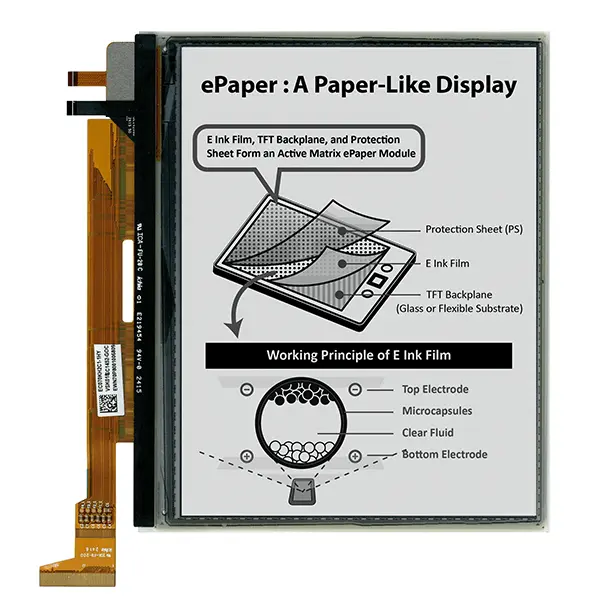
Executive Overview
The evolution of electronic paper technology is experiencing an unexpected speed bump. While early industry speculation and consumer rumors pointed toward a late-year commercial debut for E-Ink’s highly anticipated Carta 1400 display technology, exclusive supply chain intelligence reveals a different timeline. According to manufacturing and component sources, mass production for the Carta 1400 panel will not scale until late 2027.
This delay is more than a minor scheduling shift; it represents a significant bottleneck for the entire global e-reader ecosystem. Major hardware manufacturers—including Foxconn (the primary assembler for Amazon Kindle lines), Netronix (the manufacturing backbone for Kobo and Barnes & Noble NOOK devices), and Linfiny (specializing in enterprise-grade B2B e-paper solutions)—have reportedly received preliminary sample batches of the Carta 1400 technology. These partners are currently evaluating how the new displays will integrate into upcoming product architectures.
However, because E-Ink’s black-and-white monochrome panels serve as the foundational bedrock for its color platforms, the ripple effects of this delay are profound. Next-generation color technologies, namely Kaleido 4 and Gallery 4, are currently locked in prototyping phases. Because these color layers are built directly on top of modern monochrome substrates, their commercialization is inextricably linked to the mass production timeline of Carta 1400. Consequently, consumers waiting for the next quantum leap in reading devices—whether monochrome or color—will need to exercise patience as the supply chain reorganizes around a 2027 release window.
Read Also
Detailed Chronology: From Carta 1200 to the 2027 Bottleneck
To understand the weight of the Carta 1400 delay, it is essential to trace the historical lineage of E-Ink’s dominant monochrome architectures. E-Ink’s technological leaps do not happen in a vacuum; they follow a carefully orchestrated cycle of major structural redesigns followed by iterative refinements.
The Architectural Milestone: Carta 1200
Years ago, the e-paper industry was defined by incremental updates that offered minor boosts to refresh rates and contrast. That paradigm shifted dramatically with the introduction of Carta 1200. Widely recognized as a ground-up architectural overhaul, Carta 1200 completely restructured the underlying electronic and chemical properties of the microcapsule layer.
By optimizing the voltage response times and refining the electrical field configurations within the display, Carta 1200 introduced a massive leap in refresh speeds. This advancement effectively eliminated the sluggishness that had historically plagued e-readers, making smooth scrolling, faster menu navigation, and responsive note-taking a reality on devices like the Kindle Scribe and modern Paperwhite iterations.
The Iterative Evolution: Carta 1300
Following the massive success of Carta 1200, E-Ink introduced Carta 1300 as a targeted, generation-on-generation refinement. Interestingly, despite its widespread adoption across flagship Kindle and Kobo hardware over the past few years, E-Ink never officially published comprehensive white papers or marketing product listings for Carta 1300 on its corporate website.
Instead, Carta 1300 was treated as a silicon-and-chemistry tune-up. It leveraged the solid foundation laid by Carta 1200 to squeeze out marginal improvements: slightly higher contrast metrics, marginally lower latency, and tighter control over pixel switching. It was an evolution, not a revolution.
The Arrival (and Delay) of Carta 1400
Industry watchers initially anticipated that Carta 1400 would follow this predictable trajectory, hitting the market shortly after Carta 1300 matured. Yet, internal supply chain audits and reports from component manufacturers indicate that shifting technological goals have forced E-Ink to extend its development cycle.
Rather than rushing an incremental update, E-Ink appears to be engineering Carta 1400 to achieve more ambitious performance thresholds. Because these manufacturing parameters require rigorous testing to ensure durability, high yields, and seamless integration with complex system-on-chips (SoCs), mass production has been pushed back to late 2027.
[Carta 1200: Ground-Up Architectural Overhaul]
                   │
                   ▼
[Carta 1300: Iterative Tune-Up & Minor Refinements]
                   │
                   ▼
[Carta 1400: Advanced Performance Goals (Delayed to Late 2027)]
                   │
                   ▼
[Kaleido 4 & Gallery 4: Dependent Color Technologies (Delayed)]
Supporting Context & Performance Metrics
While E-Ink has maintained a tight-lipped stance regarding the official specifications of Carta 1400, industry insiders, patent filings, and supplier briefings have painted a clear picture of what the technology aims to achieve. The delay is widely attributed to the engineering challenges of crossing several critical performance thresholds.
1. Pushing the Optical Contrast Ratio Past 20:1
One of the primary engineering goals for Carta 1400 is to push the standard optical contrast ratio past the 20:1 benchmark. Traditional e-paper has always excelled in direct sunlight due to its reflective nature, but low-light and indoor reading often demanded front-lights that could wash out contrast. By achieving a cleaner, higher-contrast ratio, text will appear sharper against the background, mimicking high-grade print media more closely than ever before.
2. Eliminating Latency for iPad-Like Responsiveness
User experience in modern e-reading has shifted from passive page-turning to active interaction—including heavy PDF annotation, stylus-based note-taking, and rapid document scrolling. Carta 1400 aims to dramatically reduce latency. Industry sources suggest that the technology will narrow the responsiveness gap, making page turns, scrolling, and digital handwriting feel significantly closer to the fluid, instantaneous feedback found on traditional tablet displays like the Apple iPad, all while maintaining the zero-eyestrain benefits of reflective e-paper.

3. Achieving "Truer" Blacks and Ultra-Bright Whites
Visual fidelity on e-readers depends heavily on particle migration efficiency within the microcapsules. Carta 1400 introduces optimized pigment mobility, designed to deliver crisp, "truer" blacks alongside ultra-bright whites. This optimization maximizes outdoor legibility and enhances low-light contrast when paired with modern adjustable color-temperature front lights.
4. Advanced Waveform Technology and Ghosting Reduction
A perennial annoyance for e-reader users is text ghosting—the faint remnants of previous pages lingering on the screen—which traditionally required a full-screen, high-voltage flash (often called the "black flash") to clear. Carta 1400 implements refined waveform technology designed to drastically minimize text ghosting. By intelligently managing partial refreshes at the micro-pixel level, the display reduces the frequency and disruptiveness of the full-screen black flash, providing a smoother, more continuous reading experience.
Official Statements and Industry Impact
The postponement of Carta 1400 is not happening in isolation; its impact is echoing through the boardrooms of the world’s largest consumer electronics companies.
Industry analysts tracking the supply chain note that original design manufacturers (ODMs) are having to adjust their product roadmaps. Foxconn, which handles manufacturing for Amazon’s massive Kindle ecosystem, relies heavily on predictable component pipelines to hit holiday release windows. Similarly, Netronix—the manufacturing force behind Kobo and Barnes & Noble—must coordinate its firmware development alongside E-Ink’s panel availability.
"When a foundational display technology like Carta experiences a multi-quarter delay, it forces a domino effect across the entire product lifecycle," notes a supply chain analyst familiar with electronic paper manufacturing. "Brands cannot market a ‘next-generation’ monochrome device without the underlying panel upgrades to justify the marketing narrative. Consequently, product refreshes that brands had penciled in for late 2025 or 2026 are being re-evaluated."
Furthermore, Linfiny—the joint venture between E-Ink Holdings and Sony Semiconductor Solutions focused heavily on B2B digital paper notebooks and enterprise solutions—requires the ultra-low latency and high contrast of Carta 1400 to compete against conventional tablets in corporate and educational sectors. For enterprise clients, reducing stylus latency down to paper-like levels is the holy grail of digital transformation; any delay in achieving this stalls enterprise adoption curves.
The Color Domino Effect: Kaleido 4 and Gallery 4
Perhaps the most significant consequence of the Carta 1400 delay is its direct impact on E-Ink’s color technology roadmap.
For years, consumer demand has aggressively pivoted toward color e-paper. Technologies like Kaleido 3 (which overlays a color filter array on top of a monochrome Carta panel) and Gallery 3 (which uses ACeP technology for full-color particle mixing) have successfully introduced color to the mainstream market. However, color e-paper has always faced inherent compromises: reduced brightness, lower contrast in color modes, and muted color saturation compared to traditional LCD or OLED screens.
The next evolutionary steps in E-Ink’s color portfolio—Kaleido 4 and Gallery 4—are currently restricted to the prototyping stage. Crucially, E-Ink’s engineering philosophy dictates that color technologies cannot advance independently of the underlying monochrome substrate. A color filter or advanced particle system is only as good as the black-and-white panel driving its foundational resolution, contrast, and reflectivity.
Because Kaleido 4 and Gallery 4 are architecturally dependent on the performance baselines established by Carta 1400, they cannot enter mass production until Carta 1400 is fully operational and deployed in high-volume black-and-white e-readers—such as future iterations of the Amazon Kindle Paperwhite, Kobo Clara, and Kobo Libra lines. As a result, consumers hoping for vibrant, high-contrast, fast-refresh color e-readers will similarly have to wait until the 2027 production pipelines begin to churn.
Future Outlook: What This Means for Consumers and the Market
As the industry digests the 2027 timeline for Carta 1400, what should current e-reader owners and prospective buyers do?
- Current Devices Remain Safe Investments: Because Carta 1400 and its dependent color technologies are still years away from mass market retail shelves, current-generation devices powered by Carta 1200 and Carta 1300—as well as existing Kaleido 3 color devices—will remain the gold standard for the foreseeable future. There is little risk of immediate obsolescence.
- Refined Feature Sets in the Interim: With hardware refreshes delayed, brands are likely to focus on software innovation, build-quality enhancements, larger internal storage capacities, and battery optimization to maintain sales momentum over the next twenty-four months.
- The 2027 Turning Point: When Carta 1400 finally clears the supply chain and hits mass production in late 2027, it promises to bridge the final gap between digital and physical media. By cracking the 20:1 contrast barrier, eliminating stylus latency, and pairing with next-gen color filters, the late-decade e-reader market will offer a viewing and writing experience fundamentally indistinguishable from physical paper.
Until then, the supply chain bottlenecks serve as a reminder of the complex chemistry and microscopic precision required to manufacture electronic paper—a medium that continues to defy conventional display physics in pursuit of the ultimate reading experience.




Comments
Facebook App ID not configured. Please add it in the Customizer.