In the remote, hummock-spotted bogs outside Beluga, Alaska, researchers are unlocking the biological secrets of one of the planet’s most extraordinary yet imperiled fauna: migratory shorebirds. Flagship species such as the Hudsonian godwit (Limosa haemastica) and the Bar-tailed godwit (Limosa lapponica) undergo non-stop transoceanic migrations that stretch nearly 10,000 miles, defying traditional aerodynamic and metabolic models. Flying continuously for up to eleven days without eating, drinking, or landing, these avian athletes represent a marvel of evolutionary engineering.
Yet, these remarkable birds face a mounting crisis. Since 1980, nearly half of all migratory shorebird species populations have declined by more than 50 percent. As ecological sentinels, shorebirds reflect the health of fragile coastal mudflats, estuarine systems, and northern peatlands. Their collapse portends broader ecological unraveling, from unchecked coastal erosion to trophic imbalances in global food webs.
Recent field research led by conservation biologists from the University of Massachusetts Amherst, the University of Western Ontario, and Princeton University combines satellite telemetry, internal physiological loggers, and long-term demography studies to determine how these birds accomplish the mathematically "impossible." Concurrently, international efforts—ranging from land reclamation bans in East Asia to habitat restoration initiatives across the Americas—are racing against climate change and coastal development to secure the critical flyways that sustain these long-distance travelers.
Detailed Chronology: From Mythical Moon Flights to Satellite Tracking
For millennia, the seasonal arrival and disappearance of migratory birds remained wrapped in natural philosophy and myth. The evolution of human understanding regarding long-distance avian travel has moved from ancient speculation to precise satellite tracking and internal physiological diagnostics.
[4th Century BCE]  Aristotle proposes transmutation (e.g., redstarts morphing into robins).
[16th Century]      Olaus Magnus posits sub-aquatic hibernation in ponds.
[17th Century]      Charles Morton theorizes 60-day journeys to the Moon.
[1822]              Discovery of the 'Pfeilstorch' in Germany proves trans-continental flight.
[1918]              U.S. passes the Migratory Bird Treaty Act following Passenger Pigeon extinction.
[1976]              Robert Gill begins baseline shorebird surveys in Alaska for USFWS.
[1987]              Radar dome collision at Cold Bay reveals godwit hyper-fattening ("greaseballs").
[1998]              Piersma & Gill publish "Guts Don't Fly," documenting organ atrophy.
[2007]              Female Bar-tailed Godwit 'E7' completes historic 7,000-mile non-stop satellite flight.
[2018–2019]         China bans Yellow Sea land reclamation; UNESCO designates mudflats.
[2024]              Guglielmo, Senner & Stager perform internal surgical logger implants in Alaska.
Historical Foundations and the "Arrow Stork"
The inquiry into bird migration traces back to Aristotle, who famously theorized that birds transformed into different species seasonally—positing that redstarts mutated into robins in winter. In the sixteenth century, the Swedish archbishop Olaus Magnus asserted that barn swallows did not migrate but instead hibernated clustered at the bottoms of frozen ponds. By the seventeenth century, English minister Charles Morton published a popular hypothesis asserting that birds flew to the Moon for the winter, spending sixty days aloft by drawing on body fat.
The empirical breakthrough occurred in 1822 near Klütz, Germany, when a hunter brought down a white stork bearing a wooden spear driven through its neck—an artifact identified as hailing from Central Africa. This famous Pfeilstorch (arrow stork) provided physical proof that birds undertook seasonal, intercontinental journeys.
The Discovery of Organ Atrophy and the "Greaseball" Paradigm
In 1976, biologist Robert Gill joined the U.S. Fish and Wildlife Service (USFWS) in Anchorage to perform biological inventories on public lands slated for resource development. Gill discovered that Alaska’s expansive mudflats were massive summer staging grounds for millions of shorebirds, though their flight pathways remained unknown.
A pivotal clue surfaced in October 1987, when nine Bar-tailed godwits collided with a radar dome near Cold Bay, Alaska. Autopsies revealed that 55 percent of the birds’ total body mass consisted of fat. Gill observed that the birds resembled "greaseballs," far exceeding the fat ratios of any domestic poultry.
In 1992, the seizure of forty godwit carcasses from a poacher in New Zealand provided a comparison point for a different stage of the flight cycle. Collaborating with Dutch biologist Theunis Piersma, Gill analyzed the internal organs of both sets of birds. In their groundbreaking 1998 paper, "Guts Don’t Fly: Small Digestive Organs in Obese Bar-Tailed Godwits," Piersma and Gill demonstrated that prior to long-distance flight, godwits deliberately atrophy their digestive organs—gizzard, liver, kidneys, and gut—to minimize dead weight and metabolic demand, dynamically regrowing them upon arrival.
Satellite Telemetry and the Landmark Journey of E7
Direct proof of continuous transoceanic flight arrived in 2007. Utilizing newly miniaturized satellite transmitters, Gill fitted sixteen Bar-tailed godwits in New Zealand with tracking units.
On March 17, 2007, a female godwit designated E7 departed New Zealand, flying more than 6,000 miles non-stop to the Yalu River estuary on the China-North Korea border. After a month-long refueling stop, she flew to nesting grounds in Alaska. On August 29, E7 embarked on her return leg: a continuous, nine-day, direct flight across the open Pacific Ocean. She covered more than 7,000 miles without a single pause for food, water, or rest, landing back at the mouth of the Piako River on September 7. E7’s track shattered previous flight records, demonstrating a physiological capacity that mechanical engineers likened to operating a commercial airliner far past its maximum designed fuel capacity.
Modern Field Biology: Surgical Tracking in Alaska
Building on satellite telemetry, contemporary research focuses on the real-time metabolic dynamics of flight. In the summer of 2024, an interdisciplinary team led by Dr. Nathan Senner (UMass Amherst), Dr. Maria Stager (UMass Amherst), and Dr. Chris Guglielmo (Western University) established a field station in Beluga, Alaska.
Veterinarian Dr. Beverly Chua and researchers implanted ten Hudsonian godwits with micro-data loggers under general anesthesia. These internal devices record continuous heart rates and core body temperatures throughout the birds’ 10,000-mile flight to Chiloé Island, Chile, and back, offering unprecedented data on how these creatures maintain extreme physical output over extended periods.
Supporting Context & Metrics
The Aerodynamic and Metabolic Paradox
According to traditional physiological and aerodynamic models, long-distance flapping flight requires high-intensity metabolic expenditure that should burn through available energy reserves rapidly.
+-------------------------------------------------------------------------+
|                  THE GODWIT FLIGHT PARADOX                              |
+-------------------------------------------------------------------------+
| Standard Aerodynamic Energy Model  | Actual Observed Flight Capability    |
+------------------------------------+------------------------------------+
| • Maximum calculated range:        | • Observed non-stop range:         |
|   ~2,500 miles                     |   6,000 to 7,000+ miles            |
| • Fuel depletion time: 4-5 days    | • Flight duration: 7 to 11 days    |
| • Primary fuel assumed: Glycogen/  | • Primary fuel: Lipid stores with  |
|   Gels                             |   extreme metabolic efficiency     |
+-------------------------------------------------------------------------+
Dr. Chris Guglielmo’s wind tunnel simulations and energetic equations highlight a major physiological paradox:
Calculated Energy Ceiling: Based on known energy densities of fat mass and muscle protein, a godwit’s maximum theoretical flight distance should be approximately 2,500 miles (lasting 4 to 5 days).
Observed Reality: Godwits routinely perform non-stop flights spanning 6,000 to 7,000+ miles over 7 to 11 days.
Hypothesized Mechanism: Researchers suspect godwits enter a specialized physiological state akin to airborne torpor—down-regulating core body temperature and heart rate while flying—or utilize unihemispheric slow-wave sleep (sleeping with one half of the brain at a time) to sustain prolonged physical performance without collapse.
Nesting Vulnerability and Population Collapse
Despite their endurance, Hudsonian godwits face high mortality rates during the reproductive phase rather than during migration itself.
Demographic Decline: Overall migratory shorebird populations have dropped by >50% since 1980.
Fledging Success Rates: In long-term breeding studies in Beluga, Alaska, less than 25% of hatched chicks typically survive to fledging.
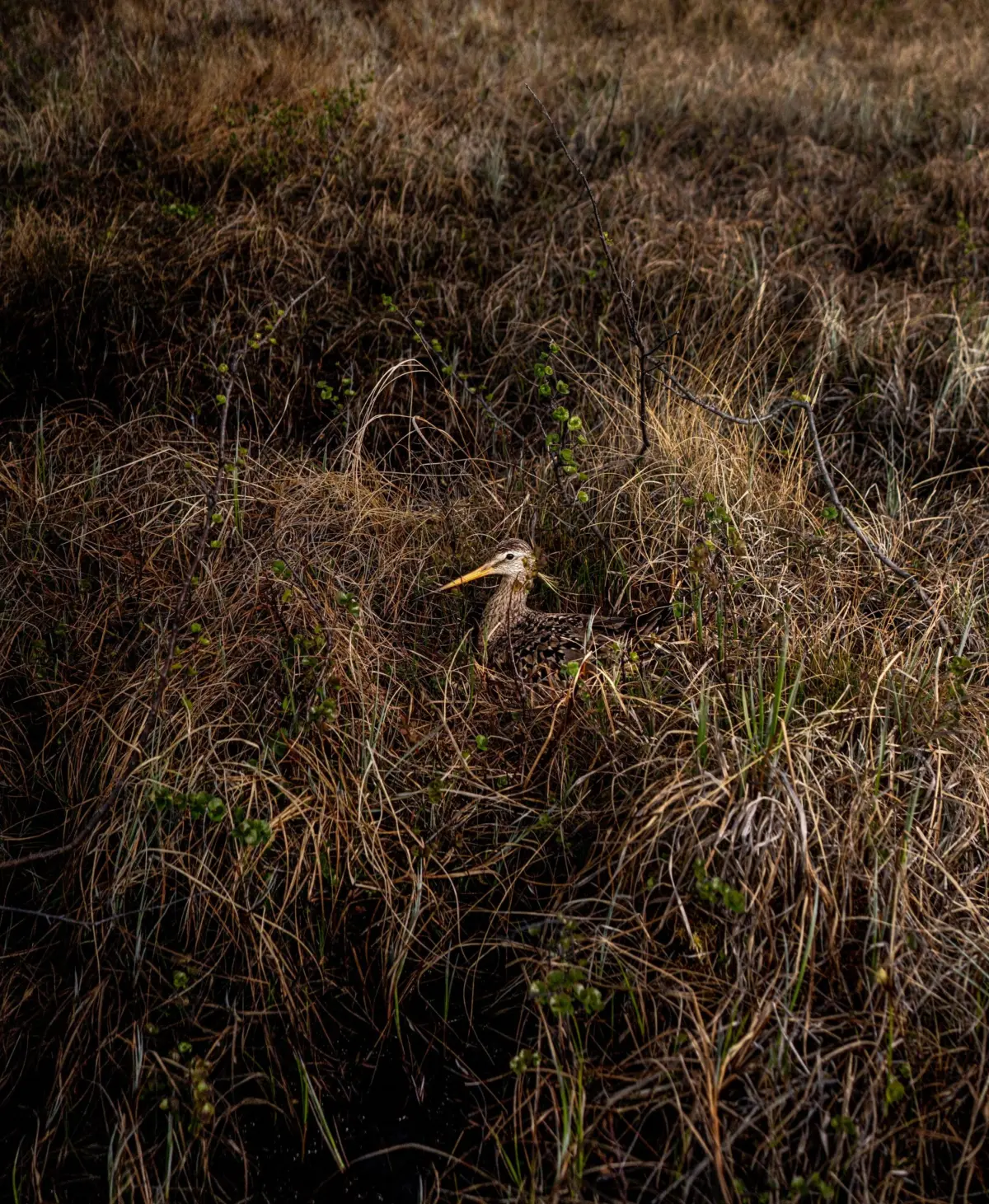
Predation and Nest Crypticity: Godwits lay a single annual clutch of 4 eggs. Nests are hidden within sedge hummocks, making them difficult to locate but vulnerable to predators like coyotes, sandhill cranes, and northern harriers.
Reproductive Shifts: Historical records show godwit arrival dates shifted up to 9 days earlier between 1974 and 2010 due to spring warming. However, between 2011 and 2023, arrival times shifted up to 6 days later, creating a dangerous mismatch between chick hatching and peak insect abundance caused by drying boreal peatlands.
Nutrient Transport: Shorebirds redistribute crucial organic nutrients across thousands of miles between northern subarctic biomes and southern temperate estuaries.
Trophic Regulation: In ecosystems like the Yellow Sea, migrating shorebirds regulate mudflat crab and invertebrate populations. Depletion of shorebirds leads to crab overpopulation, overgrazing of native sediment-stabilizing vegetation, accelerated coastal erosion, and reduced blue-carbon sequestration capacity.
Official Statements and Expert Perspectives
The research community emphasizes that saving these species requires looking beyond migration routes to address threats across their entire life cycle.
Dr. Nathan Senner, Director of the Senner Lab at UMass Amherst: "We have this persistent idea that migration is dangerous and that a lot of birds die en route. But what we’ve been finding with migratory shorebirds suggests that migration is not necessarily the most dangerous time of the year. When we think about conservation, we need to determine precisely where in their life cycle they are most vulnerable—it is fundamentally an optimization problem."
Stanley Senner, Veteran Avian Conservationist: "Birds are sentinels. The ecosystems they rely on are ecosystems we rely on as well, though it can take time to convince people of that. Back in the 1970s, no one was even talking about climate change; now, we are seeing wholesale changes in the ecological stability of our key staging sites."
Dr. Chris Guglielmo, Director of the Centre for Animals on the Move at Western University: "According to mathematical models, they shouldn’t be able to fly for seven, nine, or eleven days non-stop. They look diminutive, fragile, and delicate. But biologically, they are high-performance Ferrari machines operating at the absolute limits of vertebrate physiology."
Dr. David Wilcove, Professor of Ecology and Evolutionary Biology at Princeton University: "Tidal mudflats have suffered from not being perceived as beautiful. The degradation of a tidal flat is not as apparent as the clear-cutting of a forest. It just looks like a place where you could sink down to your waist. It’s hard for people to imagine that it’s an incredibly vibrant and important habitat for wildlife."
Dr. Tong Mu, Conservation Researcher at Princeton University: "You spend Arctic summers watching individual pairs travel thousands of kilometers just to nest. You see their nests depredated or destroyed by extreme weather. But when you witness policy changes—like the protection of the Yellow Sea—you realize that combining rigorous field science with policy intervention can genuinely reverse population collapses."
Future Outlook: Conservation Strategy Across Global Flyways
Ensuring the survival of migratory shorebirds requires synchronized, international conservation efforts spanning multiple jurisdictions, governments, and ecosystems.
                 GLOBAL FLYWAY CONSERVATION MATRIX
+-------------------------------------------------------------------+
| Region        | Threat Focus          | Conservation Strategy      |
+---------------+-----------------------+---------------------------+
| Arctic/Boreal | Drying bogs, climate  | Nesting habitat tracking  |
| (Alaska)      | mismatch, predation   | & predator monitoring     |
+---------------+-----------------------+---------------------------+
| East Asia     | Land reclamation,     | UNESCO protected mudflats,|
| (Yellow Sea)  | coastal development   | Commercial build-out bans |
+---------------+-----------------------+---------------------------+
| South America | Aquaculture overlap,  | Indigenous observatories, |
| (Chiloé)      | habitat disturbance   | Sustainable farming pacts |
+-------------------------------------------------------------------+
Navigating Climate Instability in Boreal Nesting Grounds
As subarctic ecosystems warm, the hydrology of northern bogs is shifting rapidly. The drying of peatlands around Beluga, Alaska, directly threatens the insect bursts required to feed newly hatched godwit chicks.
Researchers are expanding long-term demographic monitoring to track how climate shifts impact chick survival over time. Understanding these dynamics is essential to managing boreal habitats and protecting critical nesting grounds from habitat loss and industrial development.
Transnational Habitat Preservation and the "String of Pearls"
Historically, global conservation strategies focused on establishing a "string of pearls"—a series of isolated, protected wetlands along flyways, such as Alaska’s Copper River Delta. Modern conservation strategies, however, recognize that point-source protection is insufficient without broader landscape management:
[Historical Strategy]                 [Modern Integrated Strategy]
Protected Wetland A                   Protected Wetland A
        |                                     |
        v                                     v
   (Gaps in Path)                      [Incentivized Ag-Lands] (e.g., flooded rice fields)
        |                                     |
        v                                     v
Protected Wetland B                   [Industrial Coastal Pacts] (e.g., Ecuador salt ponds)
                                              |
                                              v
                                      Protected Wetland B
Agricultural Integration: In California’s Central Valley, conservation programs compensate rice farmers to flood their fields during peak migration windows, creating crucial surrogate mudflats for passage shorebirds.
Industrial Collaborations: Across Latin America, the Western Hemisphere Shorebird Reserve Network (WHSRN) collaborates with salt-pond operations in Ecuador, shrimp farms in Honduras, and cattle ranches in Uruguay to balance commercial operations with shorebird habitat needs.
Community-Led Conservation: On Chiloé Island, Chile, local Indigenous communities and the aquaculture sector partnered with researchers to establish dedicated bird observatories and protect tidal foraging zones from human disturbance.
Intergovernmental Policy Success: Following decades of scientific advocacy, the Chinese government enacted a comprehensive ban on commercial land reclamation along Yellow Sea tidal flats in 2018, followed by UNESCO World Heritage designations for key mudflats in 2019. This policy shift proved that targeted scientific research can drive major international conservation decisions.
The fight to safeguard species like the Hudsonian godwit is ultimately a test of global ecological stewardship. Preserving these long-distance travelers requires an international commitment to protecting the interconnected habitats that span our planet’s flyways.







Comments
Facebook App ID not configured. Please add it in the Customizer.