
Executive Overview
In his recent memoir, Communion, Vice President JD Vance articulated a sentiment that is quietly gaining traction across the American political and cultural spectrum: a profound, unsettling sadness for today’s youth attempting to navigate contemporary romance. "Hookup culture wasn’t good in a lot of ways," Vance writes, reflecting on a bygone era. "It wasn’t exactly a perfect example of Christian sexual ethics. But the mistakes you saw people make were normal mistakes. The kind of things you learned from, talked to your friends about, maybe cried over."
That familiar, albeit messy, era of interpersonal friction has vanished, supplanted by the clinical horrors of algorithmic dating apps, an endless and numbing buffet of online pornography, and algorithmically amplified gender-war content designed to monetize resentment. Vance is far from alone in harboring a begrudging nostalgia for the errors of yesteryear. Across the cultural landscape, a growing consensus suggests that contemporary dating has hit a profound dead end.
Enter One Night Only, a provocative new film currently playing in theaters nationwide that offers a wildly subversive take on what has gone wrong. The film dares to ask an unfashionable question: What if a world entirely devoid of rules and restrictions around sex is, in fact, drastically less sexy—and infinitely less fulfilling—than a world that treats sex as something powerful, volatile, and deeply consequential?
Read Also
Part love letter to New York City, part broadside against Big Tech overreach, and part sly satire of public health mandates, One Night Only occupies a unique space in modern cinema. It functions either as the most red-blooded apologia for traditional sexual ethics or the most subtly reactionary depiction of urban romance since HBO’s Girls concluded its run. In short, it is the defining sex comedy for an era of post-liberal exhaustion.
Detailed Chronology: The World of One Night Only
The premise of One Night Only is as straightforward as it is high-concept. Set in a near-future United States, the film’s narrative is built around a singular, disruptive legislative earthquake: three years prior to the events of the story, Congress passed a sweeping "mandate" criminalizing non-marital sex for 364 days of the year.
The entirety of the film unfolds over the course of a single, chaotic, Bacchanalian night—the solitary calendar date when the federal ban is temporarily lifted.
Act I: The Compliance Economy
As the film opens, we are introduced to a city that has adapted with unsettling ease to its new reality. Cutesy corporate advertisements from ubiquitous brands like Dunkin’ Donuts, Equinox, and Duolingo cheerfully endorse the government’s abstinence policy. Society has absorbed biometric tracking and mandate enforcement with barely a whimper of organized resistance. Public health bureaucracy has colonized the urban landscape; CDC-produced pictographic warnings and austere slogans warning against the perils of non-sanctioned intimacy proliferate across billboards, subway cars, and bodegas.
It is a world that feels uncomfortably close to the real-world public health emergencies of recent memory. Yet, the film utilizes this authoritarian backdrop not as a dystopian tragedy, but as the framing device for a romantic comedy about the paradoxical value of limits.
Act II: The Analog Chase
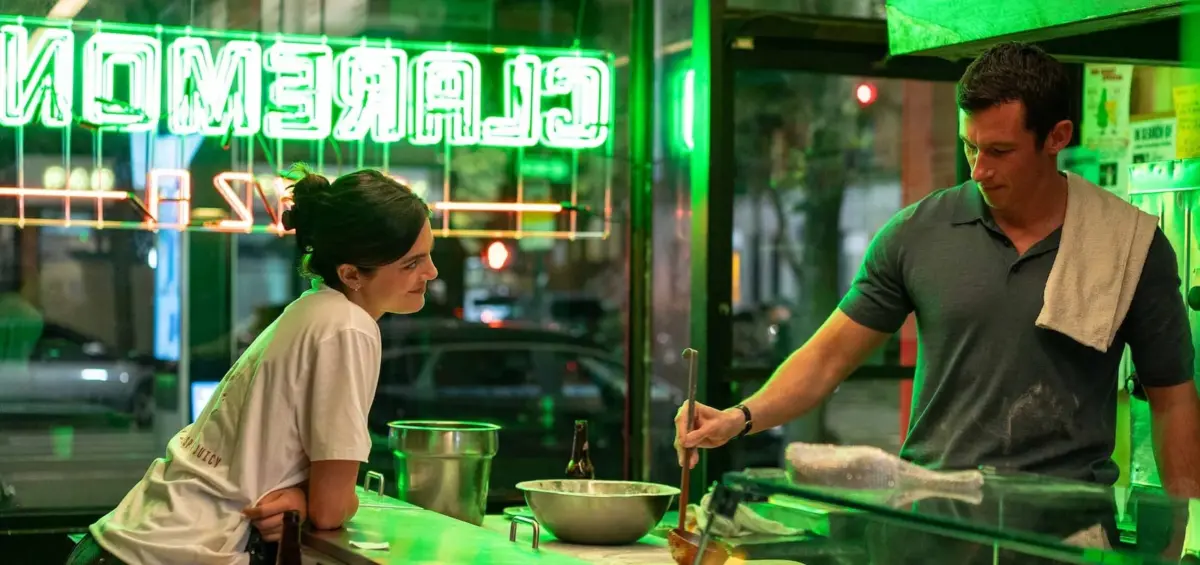
Against this backdrop of hyper-regulated sterility, the protagonists—played by Monica Barbaro and Callum Turner—attempt to make sense of the one night they are legally permitted to pursue romance.
Barbaro’s character, skeptical of the empty promises of the modern dating economy, articulates a disillusionment shared by many real-world critics of contemporary feminism. Reflecting on the mathematical bleakness of modern hookup culture, she tells a friend that the probability of achieving genuine satisfaction from a random one-night stand hovers around a depressing 2.8 percent. "Of course I want sex," she admits. ". . . but not sex that just leaves me feeling empty."
Her counterpart, played by Turner, is an amiable, grounded New York City pizzeria owner. Their chance encounters throughout the night build organically toward a late-night slice. The film deliberately contrasts the frantic, disembodied swipe-culture of the past with the tactile, sensory-rich experience of physical presence. Turner’s expertise and the sensual care he brings to his craft—making pizza—captures a level of romance that no algorithmic matching platform could ever replicate. It is the unhurried, face-to-face friction of navigating the city streets that allows them to break through the noise and discover authentic human connection.
Act III: The Defiance of Patience
In the waning moments of the permitted night, the couple arrives at a crossroads. Rather than rushing into a mechanical, mandated encounter to beat the federal clock—a move that would risk bringing their developing arc to a premature conclusion—they make a radical decision.
They consciously choose to wait. They "can’t let the mandate win" by reducing their humanity to a quick, government-sanctioned release. Instead, they prefer to wait a full year to truly get to know one another, stripping away the artificial pressure of the calendar. In doing so, One Night Only subverts its own premise: the restriction designed to control them ultimately forces them to reclaim their freedom of choice.
Supporting Context & Metrics: The Crisis of Modern Intimacy
To understand the cultural resonance of One Night Only, one must examine the empirical reality of the modern dating marketplace. The utopian promises of the mid-20th-century sexual revolution—championed by figures ranging from Hugh Hefner to Gloria Steinem—envisioned a wide-open landscape of liberating, no-strings-attached intimacy.
However, the 21st-century reality has diverged sharply from that optimistic blueprint.
+-------------------------------------------------------------------------+
|                  THE EVOLUTION OF THE ROMANTIC LANDSCAPE                 |
+---------------------------+---------------------------------------------+
| Era                       | Primary Driver / Ethos                      |
+---------------------------+---------------------------------------------+
| Traditional Christendom   | Institutional/Religious Chastity            |
| Mid-to-Late 20th Century  | Liberation, Playboy/Feminist Autonomy       |
| 2010s Digital Boom        | Algorithmic Swiping, Hookup Culture         |
| Present Post-Digital      | Anomie, Burnout, and Post-Liberal Nostalgia |
+---------------------------+---------------------------------------------+
Statistical Indicators of Romantic Decline
- The Loneliness Epidemic: Public health authorities have repeatedly noted historic highs in reported feelings of isolation among Gen Z and Millennials, correlating directly with the decline of offline social institutions.
- The Sex Recession: Multiple sociological studies over the past decade have documented a sustained drop in the frequency of sexual activity among young adults, paradoxically occurring alongside the proliferation of accessible online pornography and dating apps.
- Algorithmic Disillusionment: Studies indicate that heavy dating app users report significantly higher levels of body dissatisfaction, anxiety, and dating burnout compared to those who meet partners through organic, community-based networks.
The sexual utopia has been displaced by a marketplace where the lowest common denominator is increasingly solitary, solipsistic, and sexless. When you systematically dismantle the social guardrails, institutions, and cultural taboos that once hemmed in young people’s romantic lives, you do not unlock a paradise of pure, unbridled freedom. Instead, you remove the very signposts required to navigate the human landscape, leaving behind a wilderness of anxiety and neurosis.
Official Statements and Critical Reception
Mainstream film critics have predictably struggled to evaluate One Night Only. Aggregator platforms like Rotten Tomatoes reflect a mixed-to-hostile reception from establishment reviewers who are deeply unsettled by the film’s ideological subtext.
The core discomfort among mainstream critics stems from the film’s willingness to entertain conservative propositions—specifically, that sex is a force of such profound magnitude that it requires cultural and social norms to structure it. Reviewers have balked at the film’s satirical framing of "the fascists" and their "mandate," recognizing it as a thinly veiled, highly irreverent satire of real-world public health overreach and COVID-era emergency governance.
Yet, despite the critical hand-wringing, the film has struck a powerful nerve among audiences seeking narrative art that reflects their own exhaustion with the digital status quo.
"When a society removes all barriers to personal liberty, it frequently discovers it has also removed the pathways to human connection," notes one cultural analyst. "What One Night Only understands—and what mainstream critics miss—is that voluntary and even societal restrictions on our impulses can act as scaffolding rather than cages."
Future Outlook: The Post-Liberal Turn in Entertainment and Culture
As One Night Only continues its theatrical run, its cultural footprint extends far beyond the box office. It serves as a bellwether for a broader intellectual and artistic shift among a generation of creators who came of age during the height of the digital revolution and are now tallying the human costs.
- The Fatigue of Hyper-Individualism: The cultural appetite for narratives celebrating radical autonomy is rapidly giving way to stories that explore the stabilizing value of commitment, tradition, and local community.
- Re-Evaluating the Digital Ecosystem: As public skepticism toward Big Tech, algorithmic profiling, and digital isolation intensifies, media that champions analog experiences—face-to-face conversation, physical craftsmanship, and un-networked romance—will likely see a resurgence.
- The Rise of Post-Liberal Art: We are entering an era where artists on both the traditional right and the disillusioned left are willing to question the foundational assumptions of the 1960s sexual revolution without necessarily returning to the rigid legalism of the past.
Ultimately, One Night Only suggests that the path to a genuinely fulfilling romantic life does not lie in an endless, frictionless swipe across a glowing glass screen. Rather, it requires the recovery of mystery, patience, and the recognition that some things—because of, not in spite of, their difficulty—are worth waiting for.





Comments
Facebook App ID not configured. Please add it in the Customizer.