
Executive Overview
The American publishing landscape is undergoing a profound structural evolution, characterized by a renewed consumer appetite for physical print formats alongside sustained, double-digit growth in digital audiobooks. According to the latest comprehensive data released by the Association of American Publishers (AAP) via its StatShot tracking program, the industry is experiencing a bifurcated economic reality where traditional paper-based formats—particularly paperbacks and hardbacks—are reclaiming significant market share, even as e-books experience a slight, persistent contraction.
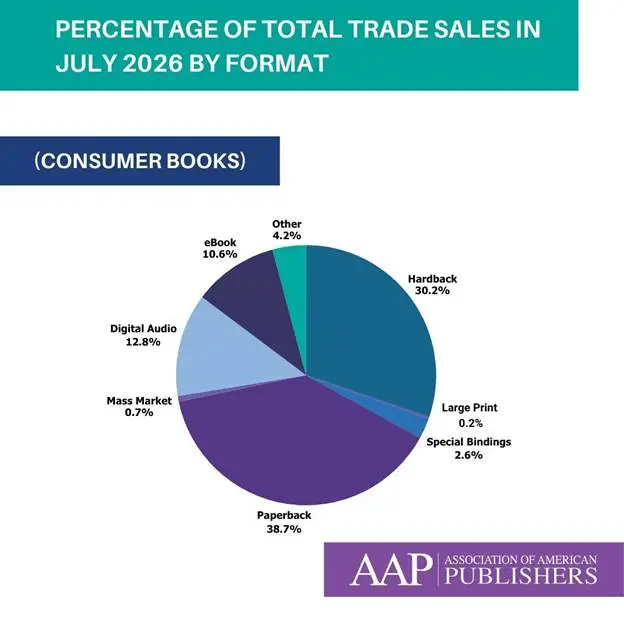
The report, which aggregates net revenue metrics from more than 1,416 participating publishing houses across diverse distribution channels including bookstores, wholesalers, direct-to-consumer platforms, and online retailers, highlights a major demographic and economic realignment. For the month surveyed in mid-2026, consumer preferences heavily favored tangible reading and listening experiences. Paperbacks emerged as the undisputed revenue leader on a monthly basis, commanding over $311 million, while hardbacks followed closely behind with robust double-digit growth. Simultaneously, digital audiobooks continued their meteoric rise, cementing spoken-word audio as an indispensable pillar of modern literary consumption.
Conversely, legacy digital formats like e-books saw a moderate decline, extending a year-to-date downward trend that has baffled some industry analysts who previously predicted total digital dominance. Mass market paperbacks also continued their steep, secular decline, nearing near-obsolescence as consumer habits pivot decisively away from pocket-sized pulp toward trade paperbacks, premium hardcovers, and immersive digital audio.
Read Also
This in-depth analysis explores the nuances of the mid-2026 AAP StatShot data, dissecting monthly performance metrics, year-to-date trajectories, format shifts, and the broader macroeconomic implications for publishers, authors, and retailers alike.
Detailed Chronology and Monthly Performance Analysis
To fully comprehend the trajectory of the U.S. publishing market in 2026, one must examine the granular monthly performance figures that underpin the broader annual trends. The mid-2026 reporting cycle revealed stark contrasts between how consumers purchase and consume stories depending on the medium.
Print Dominance: Hardbacks and Paperbacks Surge
Physical books captured the lion’s share of consumer spending during the surveyed month. Paperback editions demonstrated staggering momentum, surging 25.2% year-over-year to hit a remarkable $311.6 million in monthly net revenue. This performance underscores the enduring appeal of trade paperbacks, which offer a sweet spot of affordability, portability, and tactile satisfaction for modern readers.
Hardback editions performed similarly well, posting an 18.5% increase to reach $242.5 million for the month. This spike in hardback revenue can be attributed to a robust slate of high-profile fiction and non-fiction releases, as well as the continued influence of "BookTok" and other social media reading communities that drive demand for aesthetically pleasing, collectible special editions and first-run hardcovers.
The Divergence of Digital: Audio Soars While E-Books Recede
In the digital arena, the narrative of mid-2026 is one of stark contrast between reading on screens and listening on the go.
Digital audiobooks continued their triumphant multi-year streak, registering a 12.4% revenue increase to hit $103.1 million for the month. The medium has successfully transitioned from a niche alternative to a primary consumption format, buoyed by subscription services, smart home integration, and the multitasking lifestyle of contemporary consumers. Physical audio, though representing a much smaller slice of the pie at $400,000, managed a surprising 36.7% monthly bounce, though long-term indicators suggest this is a minor eddy in a digital-first current.
On the other end of the digital spectrum, e-book revenues contracted by 3.4% to $85.3 million for the month. While e-books remain a multi-million-dollar pillar of the industry, the monthly dip reflects a cooling period following years of pandemic-era saturation. Readers appear to be actively trading screen time for physical pages, resulting in a temporary squeeze on digital text revenues.
The Fading Legacy Formats
Not all segments shared in the mid-2026 prosperity. Mass market paperbacks—once the ubiquitous staple of grocery store checkouts and airport kiosks—plummeted 43.7% for the month, generating a meager $5.8 million. This downward spiral reflects a structural shift away from low-cost, low-durability mass-market editions in favor of trade paperbacks and digital alternatives. Special bindings also experienced a slight dip of 1.0%, pulling in $20.6 million for the month, though this category maintains a healthier long-term profile.
Supporting Context and Metrics: Year-to-Date Financial Health
While monthly snapshots capture immediate consumer reactions to seasonal releases and retail promotions, year-to-date (YTD) metrics provide a clearer, more stable picture of the American publishing industry’s underlying economic health.
The Cumulative Print Triumph
Looking at the cumulative data for the first several months of 2026, physical print remains the undisputed king of book publishing revenue:

- Hardback YTD: Up 1.4%, accumulating a massive $1.8 billion in net revenue. The stability of hardback sales demonstrates that core readers remain willing to invest in premium physical formats.
- Paperback YTD: Up an impressive 10.8%, crossing the $2.0 billion threshold ($2.0 billion total). Paperbacks are currently the primary growth engine for physical retail, driving volume across independent bookstores, big-box chains, and online giants.
- Special Bindings YTD: Up 16.3%, totaling $132.1 million. This strong growth highlights a booming collector’s market, where fans eagerly purchase deluxe, sprayed-edge, and illustrated editions of popular fantasy, romance, and classic titles.
- Mass Market YTD: Down 62.7%, sinking to just $20.7 million. This catastrophic drop confirms that the mass-market format is rapidly nearing the end of its commercial viability.
Digital Audio’s Unstoppable Momentum
The digital audio sector continues to outpace nearly every other category in terms of relative growth velocity:
- Digital Audiobook YTD: Up 12.6%, soaring to $700.9 million.
- Physical Audio YTD: Down 8.0%, settling at $3.1 million.
The widening chasm between digital and physical audio underscores a permanent consumer migration toward cloud-based libraries, smartphone apps, and subscription streaming models. With nearly three-quarters of a billion dollars generated year-to-date, digital audiobooks have fundamentally reshaped publishing house profit margins, given their high digital profit margins relative to physical manufacturing costs.
E-Book Realities
- E-Book YTD: Down 3.1%, totaling $601.4 million.
While a 3.1% decline is not catastrophic, it signals a plateau for digital reading devices and apps. Publishers are no longer seeing the explosive digital text growth experienced during the early 2020s. Instead, e-books have settled into a mature, stable market share, heavily favored by avid genre readers (particularly romance, sci-fi, and fantasy) but facing stiff competition from both physical books and audiobooks.
Official Statements and Industry Perspective
The AAP StatShot report serves as a critical barometer for the health of the American literary economy. By compiling data from over 1,416 publishing houses—ranging from global "Big Five" conglomerates to agile independent university presses and specialized houses—the dataset offers an authoritative view of commercial realities.
Industry stakeholders analyzing the mid-2026 figures point to several key behavioral shifts among consumers. Speaking on background, trade analysts note that the renaissance of physical paperbacks and hardbacks is deeply intertwined with the "aesthetic reading movement." Modern book consumers—particularly Gen Z and Millennial cohorts—view books not merely as vessels for stories, but as lifestyle accessories, collectible items, and identity markers. The physical bookshelf has become a status symbol proudly displayed on social media platforms like TikTok, Instagram, and YouTube.
At the same time, the extraordinary expansion of digital audiobooks reflects a profound transformation in how busy modern consumers consume information and entertainment. Audiobooks are no longer viewed merely as accessible formats for visually impaired readers; they are mainstream cultural products consumed during commutes, workouts, and household chores. Authors and publishers are increasingly commissioning bespoke audio productions, featuring full-cast voice acting, immersive sound design, and high-profile celebrity narration, further driving listener engagement.
The decline in e-book revenues, while notable, is interpreted by most publishing executives as a natural correction rather than an existential crisis. E-books retain a fiercely loyal base and offer exceptional margins, but they are currently sharing consumer attention with a booming audio market and a hyper-attractive physical print sector.
Future Outlook: Navigating the Next Era of Publishing
As the publishing industry looks toward the remainder of 2026 and into 2027, the strategic implications of the StatShot data are clear. Publishers must navigate a multi-format ecosystem where consumer loyalty is divided across distinct channels, each demanding specialized marketing, pricing, and distribution strategies.
1. Reinvesting in Print Innovation and Design
Given the stellar performance of paperbacks (up 10.8% YTD) and special bindings (up 16.3% YTD), publishers are expected to double down on physical book design. Investing in premium cover art, specialized finishes, collector-grade box sets, and sprayed edges is no longer reserved for niche collector markets; it has become a baseline expectation for breakout fiction hits. Independent bookstores and major retailers alike will continue to prioritize merchandising that highlights these tactile qualities.
2. The Audio-First Strategy
With digital audiobooks marching steadily toward the billion-dollar annual mark, publishing houses are increasingly adopting "audio-first" or simultaneous multi-format release strategies. The friction of audiobook production has dropped significantly with advancements in studio workflows, though consumer demand for premium human narration remains paramount. Publishers will likely continue experimenting with pricing models, windowing strategies, and subscription integrations to maximize the long-tail value of their spoken-word catalogs.
3. Managing the E-Book Plateau
E-book publishing will require renewed innovation to reverse the slight downward drift. While standard text reflowable e-books will remain a staple for backlist fiction and non-fiction, publishers may explore enhanced e-book formats, interactive multimedia elements, and bundled pricing models (such as pairing a digital audio or e-book purchase at a discounted rate with a physical copy) to capture consumers who value cross-format flexibility.
4. Navigating Supply Chain and Economic Pressures
Despite positive revenue growth in core print categories, publishers continue to monitor paper costs, printing capacity, and freight logistics. The ability of paperbacks and hardbacks to absorb inflationary pressures through strategic pricing will be a crucial test for profit margins in the quarters ahead.
Conclusion
The mid-2026 AAP StatShot report paints a portrait of a resilient, adaptable publishing ecosystem. Far from succumbing to digital homogenization, the market is thriving on variety. Consumers are embracing the tangible comfort of physical books while enthusiastically adopting the immersive convenience of digital audio. For publishers, authors, and retailers willing to embrace this multi-format reality, the horizon is rich with opportunity.





Comments
Facebook App ID not configured. Please add it in the Customizer.