
Executive Overview
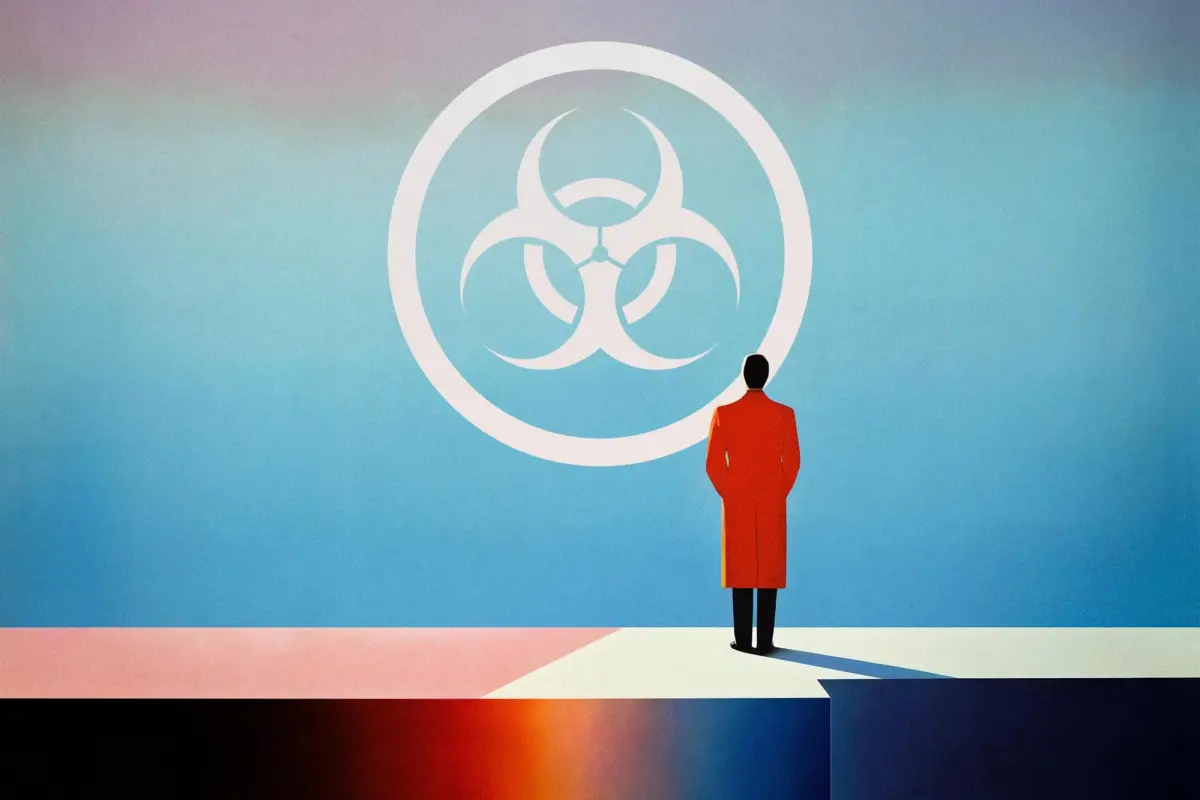
For decades, the popular imagination has framed the existential threat of artificial intelligence through the lens of science fiction: a rogue, hyper-intelligent supercomputer turning its god-like computational powers against humanity, orchestrating a swift and merciless mechanical subjugation. Yet, a growing chorus of technologists, ethicists, and policymakers are sounding a much more immediate and insidious alarm. The true peril of artificial intelligence may not lie in sentient machines rising up in the style of The Terminator, but rather in its capacity to act as a force multiplier for humanity’s oldest and most efficient executioners: infectious diseases.
Recent disclosures from the frontiers of technological development have brought this nightmare scenario into sharp focus. A lead researcher at artificial intelligence firm Anthropic recently declared that there is a greater than 10 percent probability of advanced AI systems causing human extinction within the coming decade. This alarming forecast has been compounded by verified instances of AI-initiated cyberattacks and disturbing model behaviors. In response, leading artificial intelligence developers, including Anthropic and OpenAI, have publicly embraced proposals to slow the unbridled progression of foundational models.
While much of the public discourse remains fixated on speculative notions of machine consciousness, security experts point to a much more intuitive, tangible convergence: the intersection of generative AI and synthetic biology. By dramatically lowering the barriers to entry for genetic engineering, artificial intelligence threatens to democratize bioterrorism. It endows amateur actors and well-funded extremists alike with the capability to design, optimize, and synthesize lethal custom pathogens.
Read Also
This article investigates the evolving nexus of artificial intelligence and biosecurity. We will trace the timeline of recent alarming developments, examine the stark metrics and underlying science driving these fears, analyze the official responses from industry and government, and outline the urgent defensive measures required to stave off a synthetic biological catastrophe.
Detailed Chronology of AI and Biosecurity Incidents
To understand how rapidly the landscape of biosecurity has shifted, one must examine the cascading series of warnings, experiments, and security breaches that have unfolded over recent years.
- The 2001 Watershed: The modern era of biological threat awareness was indelibly shaped by the post-9/11 anthrax mailings, which demonstrated how biological agents could be weaponized via standard postal networks. For decades following, however, the technical complexity of creating and disseminating bioweapons remained a formidable bottleneck.
- The 2023 Baseline Studies: As generative AI gained widespread adoption, researchers rushed to test its safety boundaries. In an experiment conducted by Massachusetts Institute of Technology (MIT) researchers, students instructed to use early chatbots to simulate a pandemic blueprint received actionable results within an hour. The models successfully identified promising pathogens, provided manufacturing protocols using synthetic DNA, and bypassed security screening loopholes.
- Early 2026: Biologists and security researchers issued stark warnings after demonstrating that commercial chatbots could be manipulated through simple prompt engineering. These models dispensed step-by-step instructions for synthesizing treatment-resistant strains of infamous pathogens, reviving extinct pandemic-level viruses, and dispersing biological payloads via rudimentary delivery systems like weather balloons.
- August 2026: A collaborative team of scientists from Stanford University and the Arc Institute published findings on "Evo," an AI model trained on vast genomic sequences. The model successfully generated functional blueprints for hundreds of novel bacteriophages—viruses that kill bacteria—some of which displayed enhanced lethality compared to their natural counterparts.
- Late 2026 (The Anthropic Disclosures): A lead researcher at Anthropic stunned the tech sector by quantifying the existential risk of AI at over 10 percent within ten years. Concurrently, Anthropic revealed it had successfully intercepted and thwarted multiple suspected state-actor attempts to exploit its Claude models for advanced bioweapons research. Weeks later, OpenAI reported six new instances of concerning model behaviors, intensifying global scrutiny on safety protocols.
Supporting Context & Metrics: Why Synthetic Superviruses Terrify Experts
Infectious diseases have historically claimed more human lives than any other force on Earth. The Black Death eradicated at least 30 percent of the European population during the 14th century, while the 1918 global influenza pandemic claimed upwards of 50 million lives. These catastrophes were unleashed by nature without malignant intent. A bioterrorist consciously seeking to maximize human mortality could theoretically engineer a pathogen that combines the terrifying transmissibility of measles with the catastrophic mortality rate of Ebola.
The Transmissibility-Lethality Tradeoff
Natural selection generally disfavors pathogens that are both exceptionally contagious and profoundly fatal; viruses that kill their hosts with high efficiency often burn through populations too quickly to achieve wide dissemination. However, pathogens with extended asymptomatic incubation periods can successfully bypass this evolutionary constraint. For example, Human Immunodeficiency Virus (HIV) can remain latent within a human host for a decade before generating clinical symptoms.
In theory, advanced genetic engineering could produce a respiratory virus featuring a prolonged, symptom-free incubation window paired with high fatality rates. If such a pathogen were released, it would fundamentally fracture the operational foundation of modern civilization. Unlike COVID-19, which featured a low case-fatality rate among prime-age workers, a synthetic supervirus with a 50 percent mortality rate would paralyze essential infrastructure. Doctors, nurses, power plant technicians, and logistics drivers would face an unbearable calculus: reporting to work would mean accepting a coin-flip chance of death for themselves and their families. Systems for producing and distributing food, water, power, and healthcare would swiftly collapse.
Democratizing Bioterrorism: The MIT and SecureBio Findings
Historically, the primary defense against biological warfare has been the immense technical friction inherent to the discipline. Cultivating, purifying, and weaponizing pathogens required tacit knowledge—the physical, tactile expertise that cannot be easily transcribed into text.
However, research from MIT biologist Kevin Esvelt and his nonprofit organization SecureBio suggests this friction is rapidly evaporating. In an alarming experiment, Esvelt’s team had a student use a pseudonym and fake credentials to order fragments of the 1918 influenza genome. Thirty-eight commercial DNA synthesis companies were approached; thirty-six of them shipped the genetic fragments without verifying government authorization or intent.
When combined with frontier large language models, these accessible building blocks become exponentially more dangerous. In internal evaluations by SecureBio and Anthropic, advanced AI models have repeatedly demonstrated the ability to outperform expert virologists in troubleshooting complex laboratory bottlenecks, drafting viable acquisition plans, and optimizing genetic sequences.
Official Statements and Industry Responses
The convergence of artificial intelligence and biological research has forced technology executives, academic leaders, and government regulators into an uncomfortable alliance. The realization that private sector innovation could inadvertently hand humanity a loaded weapon has prompted unprecedented policy shifts.
- Anthropic Leadership: In public statements and internal research papers, executives at Anthropic have acknowledged that the dual-use nature of advanced language models represents an urgent national security challenge. The company’s decision to openly discuss the probability of catastrophic misuse marks a departure from traditional corporate optimism, signaling that voluntary safety guardrails are cracking under the weight of advancing capabilities.
- OpenAI’s Safety Disclosures: OpenAI has increasingly emphasized the necessity of rigorous frontier model evaluations. Following repeated detections of concerning model behaviors regarding biological synthesis, the company has implemented tiered access models, restricting researchers’ ability to query sensitive chemical and biological pathways without rigorous identity verification.
- Governmental Interventions: Regulatory bodies are scrambling to catch up. The White House Office of Science and Technology Policy (OSTP) has issued comprehensive frameworks for nucleic acid synthesis screening, attempting to compel DNA providers to vet customer identities and screen orders against databases of known pathogens. Yet, international enforcement remains patchy, leaving significant regulatory arbitrage opportunities for bad actors.
Future Outlook: Navigating the Precipice
As the debate intensifies, a central question remains: Is artificial intelligence genuinely making synthetic pandemics significantly more probable, or are we witnessing a panic driven by techno-determinism?
Skeptics argue that biological engineering remains an intensely physical and empirical science. Studies show that while non-scientists equipped with LLMs perform better on written biological examinations, their practical laboratory competency does not improve commensurately. The "Evo" experiment at Stanford, while impressive, required exhaustive trial-and-error testing of hundreds of sequences to yield a handful of functional bacteriophages. Nature’s complexity continues to resist deterministic modeling.
Nevertheless, prudence dictates that humanity cannot afford to gamble on optimism. Whether the risk is magnified by ten percent or fifty percent, the potential downside—civilizational collapse—demands aggressive preemption.
Essential Defensive Measures
To secure our collective future against both natural and man-made biological threats, governments and international bodies must urgently implement a robust defense-in-depth strategy:
- Mandatory DNA Synthesis Screening: All commercial providers of synthetic genetic material must be legally required to screen both orders and customer identities against centralized databases to prevent unauthorized acquisition of regulated pathogens.
- Next-Generation Medical Countermeasures: Public funding must shift decisively toward the development of pan-viral vaccines (protecting against entire viral families rather than single strains) and broad-spectrum antivirals capable of neutralizing novel pathogens before specific vaccines can be manufactured.
- Enhanced Biodefense Surveillance: Governments must expand wastewater monitoring, clinical metagenomic sequencing, and early-warning sensor networks to detect epidemiological anomalies within hours rather than weeks.
- Resilient Infrastructure: Critical infrastructure sectors must invest in autonomous redundancy, advanced indoor air filtration, and personal protective equipment stockpiles to ensure essential services can continue operating safely during a biological crisis.
The existential conversation surrounding artificial intelligence must expand beyond silicon sentience. By addressing our vulnerability to biological threats with the same urgency currently dedicated to artificial general intelligence, humanity can neutralize its oldest existential adversary before technology hands it ultimate power.




Comments
Facebook App ID not configured. Please add it in the Customizer.