
Executive Overview
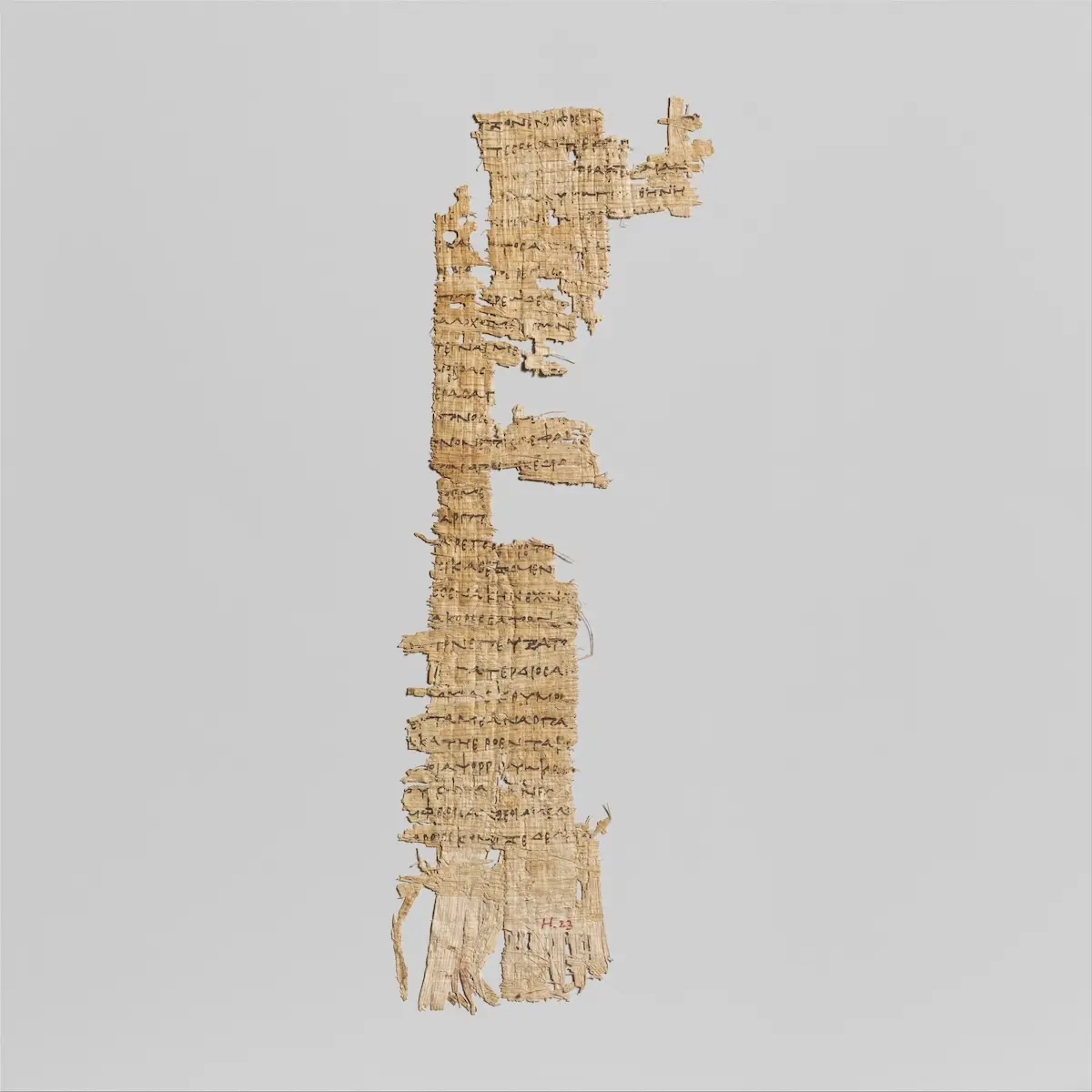
Capitalizing on a surging cultural interest in classical antiquity—spurred in part by major cinematic projects dominating the summer box office—the Metropolitan Museum of Art has brought one of its most prized literary treasures back into the public eye. The museum has officially returned the oldest known preserved fragment of Homer’s The Odyssey to its permanent exhibition circuit. Now safely ensconced within Gallery 162, dedicated to the museum’s world-renowned Greek and Roman Art collection, the delicate artifact offers modern viewers a tangible, breathtaking link to the foundational roots of Western literature.
Dating back to the early Ptolemaic period (approximately 285–250 BCE) and originating in Egypt, the papyrus fragment is much more than a rare historical curiosity. It is a textual time capsule containing three distinct lines that have long since vanished from standard modern editions of the ancient Greek epic. These enigmatic variants provide scholars, classicists, and literature enthusiasts with an unprecedented window into the fluid, oral-formulaic traditions of antiquity, illustrating how epic poetry evolved before being permanently codified into the standardized canons taught in classrooms today.
Following a lengthy hiatus from public display, the artifact’s re-installation is accompanied by a robust digital outreach campaign. Led by Sean Hemingway, the curator in charge of the Met’s Department of Greek and Roman Art, the institution has leveraged platforms like Instagram to pull back the curtain on conservation efforts, offering both virtual and physical access to a text that encapsulates the wandering, mutable nature of Odysseus’s legendary journey.
Read Also
Detailed Chronology: From Ancient Egypt to Fifth Avenue
To understand the immense significance of the Metropolitan Museum of Art’s newly displayed papyrus fragment, one must trace a historical arc spanning more than two millennia—from the bustling scribal workshops of Hellenistic Egypt to the climate-controlled vitrines of a major Manhattan cultural institution.
The Ptolemaic Genesis (c. 285–250 BCE)
During the early third century BCE, following the death of Alexander the Great and the establishment of the Ptolemaic Dynasty, Egypt—and specifically Alexandria—became the intellectual epicenter of the Mediterranean. It was within this vibrant intellectual melting pot that an anonymous scribe meticulously inked lines of Homeric verse onto a sheet of prepared papyrus.
Using a specialized reed stylus and an aqueous mixture of charcoal and water, the scribe recorded passages of The Odyssey. At this point in history, Homeric poems were not yet fixed uniform texts. Instead, they existed in a dynamic interplay between written manuscripts and the living memories of traveling bards, theatrical performers, and professional reciters known as rhapsodes. The resulting artifact captured a specific, localized iteration of Book 3 or a closely related movement of the epic, featuring minor narrative deviations and poetic embellishments that reflect the living oral tradition of the Hellenistic age.
Discovery and Acquisition
Though the exact archaeological excavation site and the precise date of its modern discovery remain part of the specialized lore of papyrology, the fragment eventually found its way into the antiquities market and subsequently into the Met’s collection. Papyrus, while remarkably durable in the arid climate of the Egyptian desert, is notoriously fragile when exposed to modern humidity, light, and mechanical stress. Upon acquisition, the museum’s conservators faced the formidable challenge of stabilizing the degraded organic material, employing advanced archival mounting techniques to prevent further structural degradation while ensuring the delicate ink remained legible.
The Modern Re-Installation (Summer 2026)
For years, the fragment spent the vast majority of its time safeguarded within the Met’s climate-controlled paper conservation and study storage rooms, protected from the ambient light that inevitably degrades ancient organic media. However, the cultural zeitgeist of mid-2026—marked by a notable resurgence of mainstream public fascination with classical mythology and heroic epics—prompted the curatorial staff to re-evaluate exhibition priorities.
Recognizing an educational imperative to meet public curiosity, the Department of Greek and Roman Art spearheaded the artifact’s return to the galleries. Today, the fragment rests securely in Gallery 162, illuminated by specialized low-lux fiber-optic lighting designed to protect the ancient papyrus fibers while granting museum visitors an intimate, close-up encounter with the origins of storytelling.
Supporting Context & Metrics: The Science and Significance of Homeric Papyrology
The recovery and exhibition of early Ptolemaic papyri offer far-reaching implications for textual criticism, paleography, and the history of literature. To contextualize the scale of this discovery, several historical and scientific dimensions must be examined.
The Materiality of Antiquity: Papyrus and Ink
Papyrus (Cyperus papyrus) was the premier writing substrate of the ancient Mediterranean world, utilized extensively throughout Egypt, Greece, and Rome. Manufactured by harvesting the pith of the papyrus reed, slicing it into thin strips, laying them in orthogonal overlapping layers, and pressing them together under immense pressure, the resulting sheet offered a smooth, durable surface.
The Met’s fragment demonstrates the classic tools of the Hellenistic scribe:
- The Stylus: A finely cut reed used with precise dexterity.
- Carbon Ink: A mixture of finely ground charcoal, gum arabic, and water, which chemically binds to the papyrus surface rather than deeply penetrating it, allowing the ink to remain distinctly dark even after nearly 2,300 years.
The Mystery of the "Missing" Lines
What elevates this specific fragment from a standard archaeological artifact to a literary Holy Grail is its divergence from the traditional text popularized by medieval manuscripts. As Sean Hemingway and visiting classicists have pointed out, the papyrus features three consecutive lines that do not exist in modern standard editions of The Odyssey.
In the ancient world, before the scholars of the Library of Alexandria undertook massive editorial projects to establish an authoritative text of Homer, poems were fluid. Bards and rhapsodes frequently improvised, drawing from a vast mental repository of traditional themes, epithets, and episodic variations. These three extra lines are believed to be the distinct fingerprints of an individual performer’s oral improvisation—a remnant of a time when The Odyssey was not a static book on a shelf, but a living, breathing performance art that shifted slightly with every telling.
| Feature | Ptolemaic Fragment (c. 285–250 BCE) | Standard Modern Editions |
|---|---|---|
| Medium | Hand-inscribed Papyrus | Printed books and digital archives |
| Textual Consistency | Fluid; includes unique, non-standard variants | Standardized by centuries of editorial consensus |
| Performance Context | Tied to living oral traditions and regional bards | Fixed literary canon |
| Physical Preservation | Highly fragile organic fragment requiring specialized display | Mass-produced typography |
The Cinematic Catalyst
The timing of the exhibition’s refresh is far from accidental. Museums increasingly recognize the importance of aligning institutional programming with broader cultural touchstones. With a major blockbuster adaptation of classical epic themes dominating global box offices earlier this year, museum attendance metrics have demonstrated a measurable spike in visitor interest regarding ancient Greek culture, mythology, and archaeology. By bridging contemporary pop culture phenomena with foundational academic heritage, the Met has successfully channeled blockbuster enthusiasm into meaningful, scholarly engagement with primary source history.
Official Statements and Curatorial Insights
In conjunction with the gallery re-installation, the Metropolitan Museum of Art has rolled out a comprehensive multimedia campaign designed to democratize access to the fragile artifact. Through a detailed online feature on the museum’s official Perspectives portal and an accompanying high-engagement video reel across its social media channels, leadership has provided deep insights into the philosophy behind the display.
Sean Hemingway, the curator in charge of the Department of Greek and Roman Art, utilized the Met’s digital platforms to break down the technical and historical nuances of the fragment for a global audience. In the featured video, Hemingway deftly handles the object’s conservation mount, demonstrating how the double-sided framing allows viewers to appreciate both the recto (front) and verso (back) of the papyrus.
Focusing on the historical reality of the text, Hemingway explained the nature of the three anomalous lines:
"These variations remind us that in the ancient world, before texts were rigidly standardized, storytelling was an active, fluid enterprise. Different bards across the Mediterranean occasionally embellished, adapted, and maintained unique versions of these epic tales."
Complementing Hemingway’s curatorial commentary, the Met’s official online collection overview draws a poetic parallel between the physical journey of the artifact and the narrative arc of its protagonist:
"Like the Greek warrior, this object reminds us that the telling of The Odyssey itself has taken its own distinct journey through history—surviving shipwrecks, the decay of time, and the shifting tides of human memory to finally rest before us today."
Future Outlook: Preservation, Digital Integration, and Public Engagement
As the Metropolitan Museum of Art looks toward the future of its antiquities programming, the re-integration of the Odyssey papyrus serves as a case study in balancing rigorous material preservation with modern public accessibility.
Conservation Challenges in the Digital Age
Exposing organic papyrus to gallery environments—even under optimal conditions—requires constant scientific monitoring. Conservation scientists at the Met utilize advanced multispectral imaging and continuous environmental controls to track relative humidity, temperature, and light exposure. These measures ensure that the artifact can be safely viewed by the public without accelerating the slow, inevitable oxidation of the plant fibers.
Expanding Educational Outreach
Building on the success of the recent Instagram feature and online collection round-up, museum leadership plans to develop supplementary educational programming. Future initiatives may include digital high-resolution gigapixel scans accessible via the Met’s online open-access portal, allowing students, paleographers, and amateur classicists worldwide to zoom in and study the scribe’s individual pen strokes down to the microscopic level. Furthermore, upcoming academic lectures and gallery talks led by visiting fellows will explore the broader implications of Hellenistic book production and the transmission of epic poetry.
A Timeless Legacy
Ultimately, the return of the oldest preserved fragment of The Odyssey to Gallery 162 represents a triumph of cultural stewardship. It offers museum-goers an encounter with the raw, imperfect, and profoundly human origins of literature. In an era dominated by instantaneous digital communication, standing before a fragile scrap of reed paper inscribed with charcoal ink more than two millennia ago offers a humbling reminder of humanity’s enduring compulsion to tell stories, preserve memory, and voyage into the unknown.


Comments
Facebook App ID not configured. Please add it in the Customizer.