
Executive Overview
In a remarkable archaeological breakthrough that bridges more than four millennia of history, a joint Spanish-Egyptian archaeological mission has uncovered a remarkably well-preserved tomb dating back to the Fifth Dynasty of Egypt’s Old Kingdom (2494–2345 BCE). Announced officially by the Egyptian Ministry of Tourism and Antiquities, the discovery was made during the mission’s active 2026 excavation season within the historic Mariette Necropolis, situated just north of the world-renowned Saqqara archaeological site.
The find centers on a sophisticated mastaba—a flat-roofed, rectangular ancient Egyptian tomb structure with slanted sides—housing dual funerary chapels dedicated to a father and son who operated at the pinnacle of Old Kingdom bureaucracy. The primary chapel belonged to Yunmen, a high-ranking official serving under Pharaoh Djedkare Isesi during the late 25th to mid-24th century BCE. Yunmen’s titles, meticulously recorded within the stone architecture of his final resting place, paint a vivid picture of a trusted state administrator who wielded considerable judicial and executive authority. Adjacent to Yunmen’s monument lies the chapel of his father, Iti, an agricultural administrator and clerical official whose presence underscores the familial continuity of elite state service during the pyramid-building era.
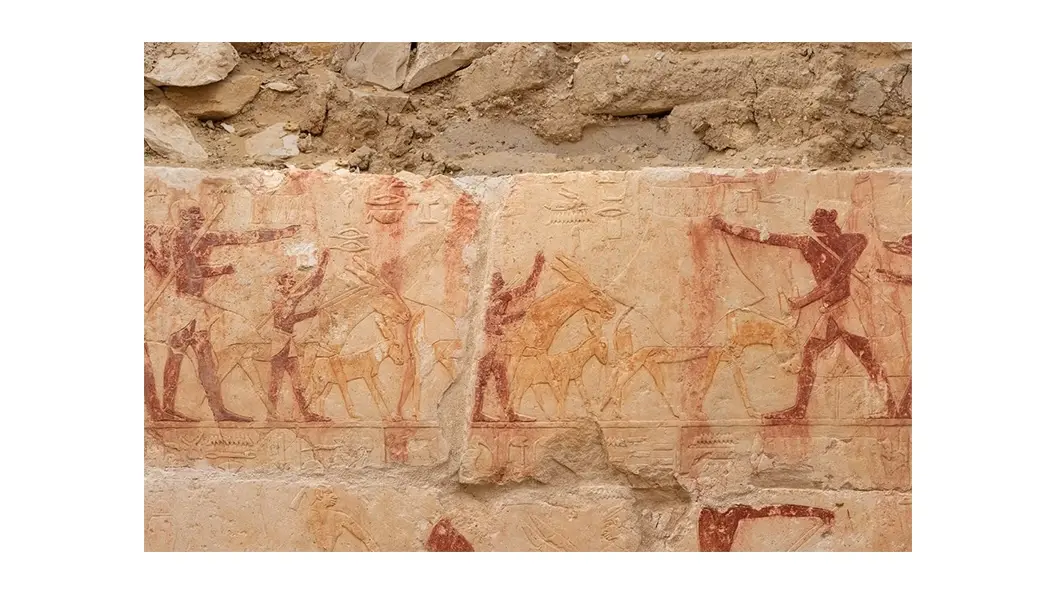
Beyond its historical occupants, the tomb has generated intense excitement among Egyptologists due to the survival of delicate painted reliefs that retain traces of their original pigments after more than 4,000 years. While the architectural footprint of the mastaba was initially documented in the 19th century by pioneering French archaeologist Auguste Mariette, the interior chambers had never undergone modern, systematic scientific excavation or documentation. This collaborative venture, spearheaded by the Autonomous University of Barcelona (UAB) and Egypt’s Supreme Council of Antiquities (SCA), offers unprecedented clarity regarding the social hierarchies, administrative networks, and artistic achievements of the late Fifth Dynasty—a transformative era that witnessed profound shifts in Egyptian religion, statecraft, and mortuary architecture.
Read Also
Detailed Chronology and Archaeological Context
The Historical Milieu of the Fifth Dynasty
To understand the weight of the Saqqara discovery, one must look closely at the Fifth Dynasty of Egypt’s Old Kingdom. Spanning roughly from the mid-25th century BCE to the mid-23rd century BCE, the Fifth Dynasty followed the monumental age of the Fourth Dynasty—the era that saw the construction of the Great Pyramids at Giza. While Fifth Dynasty pharaohs continued to build pyramids, such as those at Abusir and Saqqara, their reigns marked a distinct decentralization of royal power, the growing influence of provincial nomarchs and royal officials, and the elevation of the sun god Ra to the center of the state religion.
Pharaoh Djedkare Isesi, under whom Yunmen served, reigned for approximately thirty years during the latter half of the dynasty. Djedkare’s reign is notable for administrative reforms, increased trade expeditions to the southern borders and Sinai, and a stylistic evolution in private tomb decoration. It was an age where literate bureaucrats, scribes, and viziers accumulated enough wealth and prestige to construct elaborate, stone-carved eternal homes for themselves and their families in the shadow of the royal necropolis.
Rediscovering the Mariette Necropolis
The newly explored mastaba rests in the Mariette Necropolis, an area named after the legendary 19th-century French archaeologist Auguste Mariette, who founded the Egyptian Antiquities Service and the Egyptian Museum in Cairo. In the 1800s, Mariette mapped and partially exposed numerous structures across Saqqara and surrounding zones, noting their surface layouts and basic architectural outlines.
However, 19th-century archaeology operated vastly differently from modern scientific excavation. Early explorers often focused on clearing monumental structures to recover portable antiquities or map large footprints, frequently leaving intricate underground chambers, delicate wall reliefs, and stratified archaeological deposits unrecorded or vulnerable to environmental decay.
The joint Spanish-Egyptian mission recognized the immense potential of returning to these historical footprints with 21st-century technology. By applying meticulous stratigraphic excavation, digital photogrammetry, and advanced conservation techniques, the team systematically peeled back layers of windblown sand and debris that had blanketed the site for generations. This rigorous approach not only exposed the structural integrity of the mastaba but also safeguarded fragile plaster, pigments, and organic remains that would have disintegrated under less controlled excavation conditions.
Architectural Breakdown: Yunmen and Iti
The structure itself is a classic archetype of Old Kingdom elite architecture, divided into two distinct yet interconnected realms of memory and worship:
- The Chapel of Yunmen: As a high-ranking state official, Yunmen commanded a spacious, elaborately decorated chapel designed to honor his status in both life and the afterlife. The interior walls feature stunning painted reliefs depicting classic Old Kingdom scenes: agricultural operations, the harvesting of crops, the fattening of cattle, and long, rhythmic processions of offering-bearers carrying bounties from the estate to sustain the deceased eternally. Crucially, fragments of these reliefs retain their vibrant original colors—minerals and vegetable dyes including Egyptian blue, carbon black, ochre reds, and yellows—providing modern art historians with rare data on Fifth Dynasty palette techniques.
- The Chapel of Iti: Situated adjacent to his son’s monument, Iti’s chapel reflects the administrative sphere of agricultural management and religious offerings. While less grand than his son’s chamber, Iti’s chapel features a traditional false door—a crucial architectural and religious element designed to serve as a metaphysical threshold through which the ka (spirit) of the deceased could pass back and forth between the mortal world and the netherworld to receive nourishment. Although time, salt crystallization, and structural shifts have caused significant loss of decoration in Iti’s chapel, surviving fragments offer vital genealogical links and structural comparisons to Yunmen’s space.
Supporting Context and Metrics
To fully appreciate the significance of the Saqqara discovery, it is essential to examine the socio-political roles of the tomb’s occupants and the broader metrics of Old Kingdom excavation and preservation.
Administrative Powerhouses: The Roles of Yunmen and Iti
The titles borne by Yunmen and Iti open a window into the inner workings of the Old Kingdom civil service.
-
Yunmen’s Portfolio:
- Judge: Indicating judicial authority, likely presiding over local disputes or civil matters within the administrative district.
- Court Administrator: Managing the logistical day-to-day operations of elite households or regional administrative centers tied to the royal palace.
- Chief Scribe Responsible for Reviewing Petitions and Complaints: A role of immense sensitivity and power. In a centralized state like ancient Egypt, access to the royal administration was mediated through petitions. A chief scribe reviewing grievances held direct influence over who received justice, resources, or royal attention, making Yunmen a formidable figure within the capital’s bureaucracy.
-
Iti’s Portfolio:
- Clerical and Agricultural Administrator: Overseeing the vast agrarian wealth that sustained the Egyptian state. Agriculture was the economic engine of the Old Kingdom; managing land registries, crop yields, labor forces, and religious offerings tied to temple estates required sophisticated accounting and literacy.
The coexistence of father and son within a shared mastaba complex illustrates the rise of hereditary administrative dynasties during the late Fifth Dynasty. Office-holding frequently passed down patrilineally, consolidating wealth, literacy, and political clout within specific elite families.
Comparative Metrics of Old Kingdom Discoveries
| Feature | Details of the Saqqara Discovery |
|---|---|
| Historical Period | Fifth Dynasty, Old Kingdom (c. 2494–2345 BCE) |
| Key Figures | Yunmen (Judge, Court Administrator, Chief Scribe) & Iti (Agricultural Administrator) |
| Location | Mariette Necropolis, North Saqqara, Egypt |
| Mission Leadership | Josep Cervelló Autuori (Autonomous University of Barcelona / SCA) |
| Key Artifacts | Painted reliefs with surviving pigments, false doors, offering scenes |
| Scientific Significance | Systematic documentation of a 19th-century-noted site using modern archaeological methods |
Official Statements and Expert Analysis
The announcement of the find has drawn praise and detailed commentary from international academic circles and Egyptian heritage authorities alike.
Hisham El-Leithy, Secretary-General of the Supreme Council of Antiquities (SCA), highlighted the scientific value of the excavation during the ministerial briefing.
"This discovery is not merely about finding beautiful art or an ancient name; it offers deep, structural insights into the funerary traditions and administrative mechanisms of the late Fifth Dynasty," El-Leithy stated. "This era represents a pivotal moment in Old Kingdom religion and politics, where the boundaries between royal authority and elite bureaucratic self-expression were constantly renegotiated. Knowing this site was initially touched by Auguste Mariette in the 19th century makes our modern work all the more critical. Without systematic scientific exploration and meticulous documentation, invaluable historical chapters remain unread."
Josep Cervelló Autuori, lecturer in the Department of Ancient and Medieval Sciences at the Autonomous University of Barcelona (UAB) and leader of the joint mission, emphasized the collaborative nature of the project and the technical challenges of preserving ancient pigments exposed to modern air.
"Working in the Mariette Necropolis carries a profound sense of historical continuity," Cervelló Autuori noted. "When our team uncovered the painted reliefs in Yunmen’s chapel, and we saw pigments still clinging to the limestone after more than 4,500 years, our responsibility shifted instantly from excavation to immediate conservation. Every fragment of plaster, every trace of agricultural imagery, and every hieroglyphic sign contributes to a comprehensive sociological profile of how elite families in the shadow of the capital managed their mortality, their status, and their legacy."
Independent Egyptologists not affiliated with the mission have similarly praised the meticulous nature of the publication and excavation strategy. Analysts point out that while sensational discoveries of royal gold or massive statuary frequently capture global headlines, finds like the mastaba of Yunmen and Iti provide the granular, everyday historical data necessary to reconstruct the social fabric of ancient civilizations.
Future Outlook: Preservation, Analysis, and Public Presentation
As the 2026 excavation season progresses, the joint Spanish-Egyptian mission faces a rigorous road ahead, balancing active field research with intensive laboratory analysis and site conservation.
Conservation and Restoration
The immediate priority for the conservation specialists embedded with the UAB and SCA team is the stabilization of the painted wall reliefs. Once exposed to oxygen, humidity fluctuations, and tourist or staff traffic, ancient pigments degrade rapidly unless treated with consolidants and climate-controlled shielding. Specialists are currently mapping every square centimeter of the wall surfaces using high-resolution 3D laser scanning and multispectral photography, creating digital twins of the chapels that will allow researchers to study faded inscriptions long after physical conservation is complete.
Epigraphic and Osteological Studies
Epigraphers are transcribing and translating every surviving hieroglyphic text across both chapels. Beyond titles and offering formulas, the team hopes to uncover biographical texts, familial genealogies, and religious invocations that shed light on contemporary theological beliefs regarding the afterlife. Concurrently, osteological analysis of any human remains recovered from the burial shafts beneath the mastaba will provide data on the health, diet, pathology, and life expectancy of high-ranking Old Kingdom officials and their households.
Integration into Egypt’s Cultural Tourism Strategy
Egyptian Ministry of Tourism and Antiquities officials have signaled that once restoration and stabilization protocols are finalized, the newly explored tomb will be evaluated for potential inclusion in future cultural heritage tourism itineraries at Saqqara. As Egypt continues to open newly excavated sites to the public—exemplified by recent major unveilings across Saqqara, Giza, and Luxor—the inclusion of meticulously documented private tombs like that of Yunmen and Iti offers visitors a richer, more nuanced understanding of ancient Egyptian society beyond the pharaohs.
Ultimately, the unearthing of this Fifth Dynasty mastaba stands as a testament to the enduring power of international scientific collaboration. By marrying the foundational discoveries of 19th-century pioneers with the cutting-edge methodologies of modern archaeology, the Spanish-Egyptian mission has successfully rescued a vital piece of human heritage from the sands of time, ensuring that the voices of Yunmen, Iti, and their contemporaries continue to resonate across the centuries.





Comments
Facebook App ID not configured. Please add it in the Customizer.