
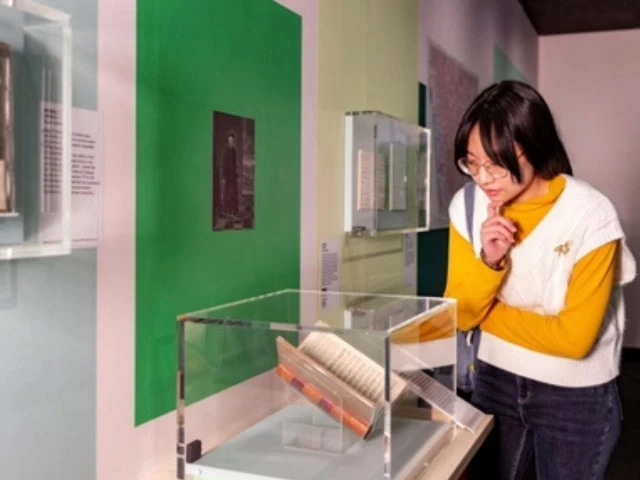
LONDON — Half a century after her passing, the enduring cultural footprint of the world’s best-selling novelist is receiving a profound, multi-dimensional reassessment. Opening its doors at the British Library on Friday, a major new exhibition titled "Agatha Christie: A World of Mystery" strips away the decades of myth and literary shorthand that often reduce the author to a caricature of the genteel English country house murder. Instead, the exhibition offers an investigative, deeply personal portrait of a pioneering traveler, a trained apothecary, an early pioneer of aquatic sports, and an acute observer of human psychology.
Featuring rare manuscripts, deeply personal correspondence, intimate photographs, and artifacts never before seen by the public, the showcase is designed not merely to celebrate a literary legacy, but to excavate the real-life foundations that birthed some of the most enduring puzzle-box mysteries in the history of publishing.
Executive Overview
For generations, the name Agatha Christie has been synonymous with ingenuity, ingenious plotting, and the comforting tropes of the British "whodunnit." With global sales exceeding two billion copies—placing her works behind only the Bible and the plays of William Shakespeare—her commercial dominance is undisputed. Yet, as cultural historians and literary critics have increasingly noted, the sheer ubiquity of her creations has often overshadowed the unconventional, daring, and remarkably modern woman who engineered them.
Read Also
"Agatha Christie: A World of Mystery" aims to correct this imbalance. Marking the 50th anniversary of her death, the exhibition orchestrates an immersive journey through five distinct thematic zones. From the sun-bleached archaeological trenches of the Middle East to the smoke-and-mirrors glamour of West End theater, and from the antiseptic precision of a World War I hospital dispensary to the rhythmic sway of the Orient Express, the exhibition illustrates how Christie’s real-world experiences directly fueled her creative output.
By presenting early drafts, working notebooks, and personal effects—including the very typewriter upon which her immortal detectives sprang to life—the British Library exhibition invites scholars, casual readers, and crime fiction aficionados alike to look past the iconic silhouettes of Hercule Poirot and Miss Marple and confront the formidable intellect of their creator.
Detailed Chronology: From Torquay to Global Icon
To understand the architecture of Agatha Christie’s mind, one must trace the biographical trajectory that took her from a quiet Victorian childhood in Devon to the far-flung corners of the British Empire and the pinnacle of global literary fame.
Formative Years and the Edwardian Era (1890–1914)
Born Agatha Mary Clarissa Miller on September 15, 1890, in the seaside resort of Torquay, Devon, Christie grew up within the comfortable confines of a well-to-do Victorian family. Eschewing formal schooling for much of her early life, she was educated at home by her mother, leading to an idiosyncratic upbringing rich in imaginative play, music, and an early voracious appetite for literature. The exhibition’s opening section—a meticulously crafted mock country house—evokes this idyllic, deeply traditional English background. Yet, beneath the veneer of polite society lay an observant child who spent hours analyzing the eccentricities of her neighbors and the visiting aristocracy, laying the groundwork for the social satire and psychological profiling that would later anchor her fiction.
The Great War and the Dispensary (1914–1918)
The outbreak of the First World War radically upended Christie’s life, as it did for millions of her generation. Voluntarily enlisting as a nurse at the Town Hall Red Cross Hospital in Torquay, she initially tended to wounded soldiers before training as an apothecary’s assistant (dispenser). This chapter of her life is far more than a biographical footnote; it was the crucible in which her mastery of homicide was forged. Handling dangerous compounds—including arsenic, strychnine, curare, and thallium—on a daily basis gave Christie an authoritative, scientifically grounded understanding of toxicology. This hands-on medical knowledge would subsequently allow her to construct intricate poison plots that baffled both her readers and contemporary medical professionals.
The Birth of Poirot and Literary Breakthrough (1920–1926)
Encouraged by a challenge from her sister Madge to write a detective novel, and drawing upon her professional experiences with Belgian refugees housed in Torquay during the war, Christie created Hercule Poirot. In 1920, The Mysterious Affair at Styles was published, introducing the fastidious, egg-headed detective with his "little grey cells." While modest in its initial commercial impact, the novel established the narrative blueprints of the Golden Age of Detective Fiction.
The decade that followed was one of stratospheric rise, culminating in 1926 with The Murder of Roger Ackroyd. The novel’s groundbreaking and controversial narrative twist permanently altered the rules of the genre. However, 1926 was also the year of profound personal crisis: following the death of her mother and the discovery of her first husband Archie’s infidelity, Christie suffered a nervous breakdown and vanished for eleven days, sparking one of the largest manhunts in British history before being discovered at a Yorkshire spa hotel.
Global Travel, Archaeology, and Second Act (1928–1939)
Reinventing her life after her divorce from Archie, Christie embarked on a solo voyage to the Middle East aboard the Orient Express in 1928—a journey that would directly inspire Murder on the Orient Express (1934). In Iraq and Syria, she met the brilliant young archaeologist Max Mallowan, whom she married in 1930.
For the next two decades, Christie spent months at a time living in field tents across archaeological sites in Ur, Nimrud, and Nineveh. Far from being a passive observer, she actively participated in excavations, cleaning fragile artifacts with meticulous patience (famously using a miniature cream jar spatula to clean ancient ivories) and photographing the digs. This era saw her productivity soar, yielding masterpieces such as Death on the Nile (1937), Appointment with Death (1938), and And Then There Were None (1939), widely regarded as the ultimate locked-room mystery.
The Golden Decades, Theater, and Later Years (1940–1976)
During the Second World War, while Mallowan worked for British intelligence in Cairo, Christie remained in London, working at the University College Hospital dispensary and continuing to write prolifically—including penning the final Poirot and Marple novels (Curtain and Sleeping Murder), which were locked in a bank vault to be published posthumously.
In the post-war era, Christie conquered a new frontier: the stage. Her theatrical adaptations, most notably The Mousetrap (which opened in 1952 and holds the record for the longest-running play in the world) and Witness for the Prosecution, cemented her status as a global entertainment powerhouse. Appointed a Dame Commander of the Order of the British Empire (DBE) in 1971, Christie passed away peacefully on January 12, 1976, leaving behind a staggering literary estate.
Supporting Context & Metrics: The Scale of Christie’s Literary Empire
To fully appreciate the cultural weight of the British Library exhibition, one must contextualize Agatha Christie’s output through hard metrics and literary history.
- The Staggering Output: Over a career spanning more than half a century, Christie wrote 66 detective novels, 14 short story collections, and the world’s longest-running play.
- Global Reach: Her works have been translated into at least 100 languages, making her the most translated individual author in history, ahead of Jules Verne and William Shakespeare.
- Commercial Dominance: With lifetime sales conservatively estimated at over two billion copies, her books continue to sell hundreds of thousands of copies annually across digital, audio, and print formats.
- The Golden Age Blueprint: Alongside contemporaries Dorothy L. Sayers, Margery Allingham, and Ngaio Marsh, Christie defined the "Golden Age of Detective Fiction"—a period between the First and Second World Wars characterized by fair-play puzzles where the reader is given all the clues necessary to solve the crime alongside the investigator.
The Architecture of the Exhibition
The British Library’s curation reflects this multifaceted history by dividing the exhibition into five distinct, highly immersive environments:
- The Country House: Exploring her Victorian and Edwardian roots in Devon, examining how the insular, class-conscious architecture of English estates provided the classic setting for country house murders.
- The Dispensary: A clinical, atmospheric recreation highlighting her World War I service and her expert deployment of poisons, featuring real pharmaceutical ledgers and period medical equipment.
- The Train Carriage: Designed to evoke a 1920s luxury rail compartment, this section examines how global mobility, colonial railways, and Christie’s own extensive travels informed her plotting.
- The Archaeological Dig: A makeshift 1930s field tent celebrating her fieldwork in the Middle East with Max Mallowan, showcasing expedition photographs, personal diaries, and recovered antiquities.
- The Theatre: A spotlight on her phenomenal success as a dramatist, complete with original playbills, prompt scripts, costume designs, and archival footage from early West End productions.
Official Statements and Curatorial Insights
Speaking ahead of the public opening, representatives of the Christie estate and literary scholars emphasized that the exhibition deliberately avoids hagiography in favor of a nuanced, revelatory human portrait.
"Most people who know about Agatha Christie — and to be fair, most people do know about Agatha Christie — think of the work. But I think what this gives you is an insight into the woman behind the work," said James Prichard, Christie’s great-grandson and Chief Executive Officer of Agatha Christie Limited.
Elaborating on the surprising facets of her personality featured in the displays, Prichard noted: "There’s pictures of her surfing, there’s pictures of her on roller skates… and then there’s the genesis of stuff. There’s the story behind the poisons that she used and all those kind of things. And I think it just gives you a wider scope of who the woman was that wrote these extraordinary stories."
Curators at the British Library echoed these sentiments, explaining that access to previously restricted family archives allowed them to present Christie not merely as a domestic novelist, but as an adventurous global citizen who actively engaged with the rapid technological, scientific, and geopolitical transformations of the 20th century.
Dr. Sophie Whitelake, lead curator of the exhibition, remarked: "Agatha Christie was an exceptionally modern woman living in a rapidly changing world. She drove her own cars, traveled alone across continents, embraced the physical thrills of surfing in Hawaii in the 1920s, and possessed a scientific intellect that rivaled any professional toxicologist of her era. This exhibition allows us to dismantle the comforting grandmotherly myth and replace it with the reality of a fiercely intelligent, daring creative force."
Future Outlook: The Undiminished Legacy of the Queen of Crime
As "Agatha Christie: A World of Mystery" opens its doors to the public in London, it arrives at a time of renewed global appetite for her work. In recent years, high-budget cinematic adaptations directed by and starring Kenneth Branagh (Murder on the Orient Express, Death on the Nile, A Haunting in Venice) have introduced her labyrinthine plots to entirely new generations of filmgoers. Simultaneously, critically acclaimed television adaptations, graphic novel adaptations, and interactive theatrical experiences continue to reframe her narratives for contemporary audiences.
Furthermore, the exhibition signals a broader shift in how literary institutions approach mid-century genre fiction. No longer dismissed as mere escapist pulp, Christie’s works are increasingly recognized by literary critics as sophisticated social documents of an empire in transition, astute explorations of trauma and post-war psychology, and masterclasses in structural engineering.
For scholars, fans, and the curious public alike, the British Library exhibition serves as an invitation to re-examine the woman who spent her life constructing intricate webs of deception. Fifty years after her death, Agatha Christie’s little grey cells remain as sharp, relevant, and captivating as ever—proven once again as visitors step past the threshold of the British Library into a world where every artifact tells a story, and every clue leads back to an extraordinary mind.





Comments
Facebook App ID not configured. Please add it in the Customizer.