
Executive Overview
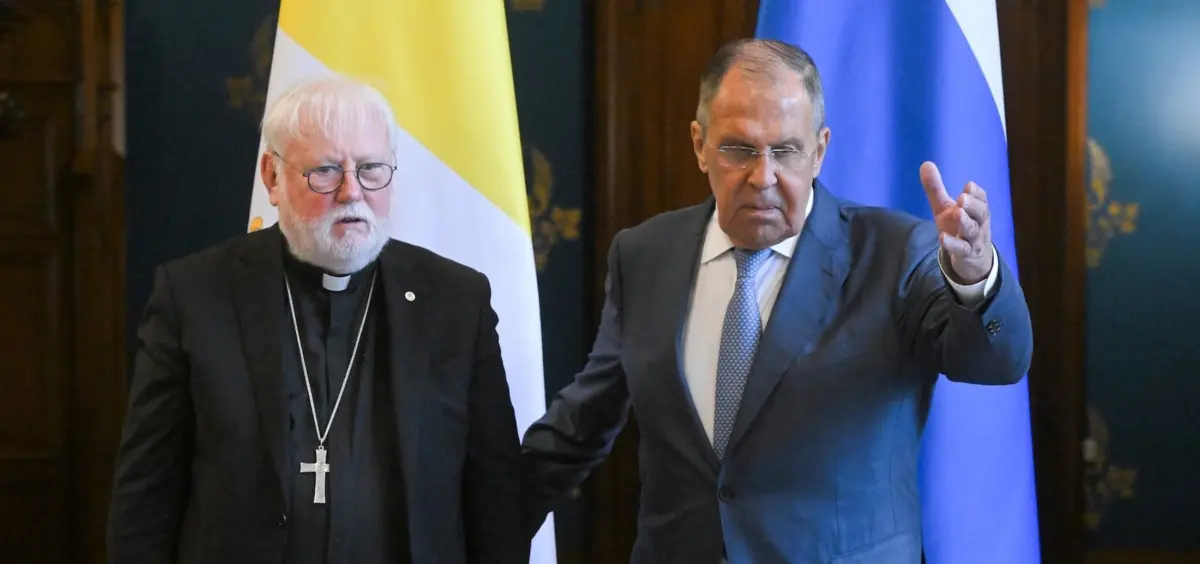
In late August, Archbishop Paul Gallagher, the Holy See’s Secretary for Relations with States and International Organizations—effectively the Vatican’s foreign minister—undertook a high-stakes, highly controversial five-day diplomatic mission to Moscow. Spanning August 24 to 28, Gallagher’s itinerary included substantive consultations with senior figures within the Vladimir Putin regime and representatives of the Moscow Patriarchate of the Russian Orthodox Church.
The mission has ignited intense debate among geopolitical analysts, ecumenical scholars, and regional stakeholders. To the Vatican’s diplomatic corps, the outreach is framed as an indispensable exercise in humanitarian advocacy—a necessary channel to secure the release of prisoners of war and facilitate the repatriation of Ukrainian children forcibly transferred to Russian territory. However, critics, particularly in Eastern Europe and Western policy circles, view the initiative through a far more skeptical lens. They argue that high-level Vatican engagement with an unrepentant aggressor risks conferring undue international legitimacy on the Kremlin, undercutting moral clarity, and compromising the foundational evangelical principles of the Holy See.
This report examines the intricate dynamics of Archbishop Gallagher’s Moscow visit, juxtaposing official Vatican optimism against the grim realities on the ground in Ukraine. It analyzes the rhetorical maneuvers of Russian Foreign Minister Sergey Lavrov, the theological and moral contradictions inherent in the Holy See’s dialogue with the Russian Orthodox Church, and the broader implications of Vatican realpolitik for an international order desperately in need of uncompromised moral leadership.
Read Also
Detailed Chronology of the Moscow Mission
The timing and unfolding of Archbishop Gallagher’s diplomatic sojourn exposed a profound dissonance between the ethereal language of Vatican statecraft and the kinetic brutality of Russia’s ongoing war against Ukraine.
August 24–28: The Moscow Itinerary
Archbishop Gallagher arrived in the Russian capital amid a tightly managed schedule orchestrated to project an image of open diplomatic channels. His meetings engaged key architects of Russia’s foreign and ecclesiastical policies. Among the most critical were his discussions with Russian Foreign Minister Sergey Lavrov and Metropolitan Antonij of Volokolamsk, the head of external church relations for the Russian Orthodox Church.
While closed-door negotiations focused on humanitarian corridors, prisoner exchanges, and the plight of displaced minors, the public framing of these meetings by Russian state actors quickly transformed the visit into an exercise in diplomatic propaganda.
The Contrast on the Ground
The surreal nature of the diplomatic outreach was acutely felt by observers inside Ukraine. Even as Archbishop Gallagher sat across the negotiating table from senior Russian officials in Moscow, the Kremlin marked the occasion not with de-escalation or gestures of goodwill, but with an intensification of missile and drone bombardments targeting civilian infrastructure across Kyiv and other urban centers.
Major Archbishop Sviatoslav Shevchuk, the head of the Ukrainian Greek Catholic Church—whose life was directly targeted by Russian death squads during the attempted blitzkrieg of Kyiv in February 2022—offered a haunting metaphor for the visit. While cautiously welcoming Gallagher’s appeals for negotiated peace, Shevchuk likened the diplomatic descent into Moscow to "a descent into Hades, when a sermon on the resurrection of the dead resounds from the depths of Hades."
This duality—diplomatic overtures proceeding in parallel with systemic war crimes—underscores the agonizing dilemma facing Holy See diplomacy: how to engage a hostile actor without appearing to normalize or sanitize its aggression.
Official Statements and Rhetorical Maneuvers
The post-visit rhetoric from Moscow laid bare the tactical utility that the Kremlin extracts from high-level Western and Vatican engagements.
Sergey Lavrov’s Diplomatic Spin
Following his bilateral meeting with Archbishop Gallagher, Russian Foreign Minister Sergey Lavrov struck an uncharacteristically upbeat and self-satisfied tone. According to reports from ACI Stampa, Lavrov remarked that despite profound geopolitical shifts, relations between the Russian Federation and the Vatican "continued to be marked by trust, friendship, and pragmatism."
Furthermore, Lavrov publicly thanked officials at the Holy See for what he termed their "balanced position on the situation in Ukraine and the surrounding areas."
Lavrov’s carefully curated lexicon warrants rigorous deconstruction:
- "Geopolitical context": Substituting this sterile bureaucratic euphemism for an unprovoked war of territorial conquest and a systematic hybrid war against European allies sanitizes the reality of Russian aggression.
- "Pragmatism": By praising the Vatican’s "pragmatism," Lavrov implicitly stripped Holy See diplomacy of its moral foundation, suggesting that Vatican foreign policy can be bent toward Realpolitik devoid of transcendent ethical anchors.
- "Balanced position": Characterizing the Vatican’s posture as "balanced" functions as a subtle rhetorical trap. It implies that the Holy See views the conflict as a tragic misunderstanding between equal parties, rather than a clear-cut case of unlawful invasion by a dominant power against a sovereign neighbor.
Archbishop Gallagher’s Assessment
Upon concluding his mission, Archbishop Gallagher offered a more circumspect, yet still remarkably sanguine, assessment of his engagements. In an interview with Vatican News, he described his meeting with Metropolitan Antonij of Volokolamsk as "very encouraging."
Gallagher acknowledged that "a different view remains on some questions," particularly concerning the broader international landscape. Yet, he emphasized that both sides "seek to encourage one another to follow the path of the Gospel," characterizing the relationship between the Holy See and the Moscow Patriarchate as a "very cordial, fraternal relationship."
Supporting Context and Metrics: The Ecumenical Crisis
To fully grasp the implications of Archbishop Gallagher’s dialogue with Russian ecclesiastical authorities, one must examine the profound moral crisis engulfing the leadership of the Russian Orthodox Church (ROC).
The Blasphemy of Patriarch Kirill
Just two and a half weeks prior to Gallagher’s mission, prominent Catholic commentator George Weigel published a critical analysis in The Wall Street Journal examining a new publication by Patriarch Kirill, head of the Russian Orthodox Church. In this volume, Kirill explicitly defended Vladimir Putin’s war on Ukraine using theological language that ecumenical scholars and Eastern Orthodox leaders have condemned as heretical and blasphemous.
Kirill’s militarized theology—which promises spiritual absolution for soldiers dying in Ukraine and frames the invasion as a metaphysical battle against Western decadence—has ruptured the fabric of global Orthodoxy. Ecumenical Patriarch Bartholomew of Constantinople, the "first among equals" in the Eastern Orthodox communion, has repeatedly distanced himself from Kirill’s apostasy, pointing out that the Moscow Patriarchate has thoroughly subordinated the Gospel of Christ to the geopolitical ambitions of the Kremlin.
Metropolitan Antonij and the Kremlin Apparatus
Metropolitan Antonij, who hosted Archbishop Gallagher, occupies his high-ranking post at the pleasure of Patriarch Kirill. Operating as the chief international and ecumenical emissary for an institution fundamentally co-opted by the Russian state, Antonij cannot be viewed as an independent religious actor.
When Vatican officials engage with figures like Antonij as theological partners, they risk validating a church hierarchy that acts as a moral accessory to war crimes. This uncritical ecumenical engagement threatens to stall genuine theological dialogue for generations, blinding Rome to the reality that it is negotiating not with independent churchmen, but with ideological operatives of the Russian state.
Future Outlook and Strategic Implications
The Vatican’s diplomatic strategy in Eastern Europe stands at a historic crossroads. The fundamental tension of Holy See diplomacy has always been the delicate balancing act between prophetic moral witness and practical humanitarian intervention.
The Cost of Silence and Forbearance
Vatican diplomats frequently argue that maintaining back-channel communications with unsavory regimes is necessary to achieve tangible humanitarian outcomes—such as securing the release of prisoners of war or tracing Ukrainian children kidnapped and relocated deep inside Russian territory. This utilitarian calculus has merit; every child returned or prisoner freed is a victory for human dignity.
However, forbearance carries a steep cost if the underlying falsehoods go unchallenged indefinitely. When Kremlin officials like Lavrov publicly spin Vatican visits as endorsements of a "balanced" approach, and when state-controlled media uses these meetings to project diplomatic normalcy, the moral capital of the Holy See is eroded.
The Imperative of Uncompromised Moral Leadership
The contemporary global landscape is plagued by authoritarian resurgence, systemic disinformation, and brutal territorial aggression. In such an environment, the world is desperate for uncompromised moral leadership—a voice that transcends raw "pragmatism" and speaks unvarnished truth to power.
Historically, the soft power of the Holy See has derived not from economic leverage or military might, but from its absolute moral authority: its willingness to clearly identify good and evil, victim and aggressor, truth and falsehood. Roman foreign policy and strategic thinking must realign with this foundational reality. Humanitarian pragmatism must never be allowed to eclipse prophetic clarity, lest the Vatican’s pursuit of peace inadvertently lends moral cover to the very forces tearing the international order apart.


Comments
Facebook App ID not configured. Please add it in the Customizer.