
Executive Overview
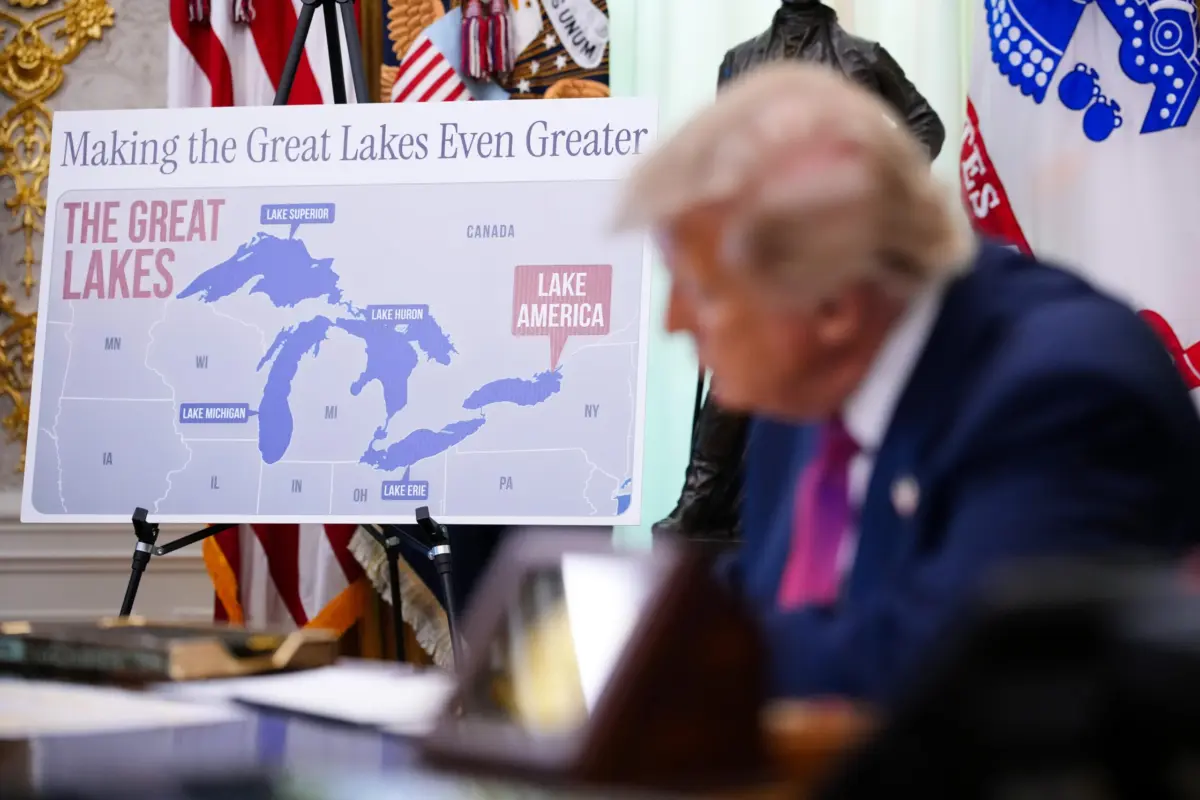
Relations between the United States and Canada have plunged to a historic low, catalyzed by an escalating economic trade war and compounded by a series of provocative geopolitical maneuvers from Washington. In an unprecedented executive action signed in the Oval Office, President Donald Trump directed the Department of the Interior to officially update federal geographic databases to rename Lake Ontario as "Lake America."
While administration officials have framed the move as a reclamation of national pride, political analysts, international trade experts, and provincial leaders view it for what it truly is: a retaliatory, punitive strike born out of diplomatic frustration. The sudden renaming follows the launch of a sweeping, unilateral tariff regime against America’s northern neighbor—a trade conflict ignited after Canadian Prime Minister Mark Carney reportedly refused to capitulate to aggressive American trade demands.
This unfolding crisis is much more than a petty political stunt or a bizarre footnote in modern cartography. For millions of Canadians, the unexpected tariffs and rhetorical hostility represent a profound betrayal by a historic ally, threatening integrated supply chains, cross-border commerce, and regional stability. Conversely, within the United States, the conflict exposes the volatility of modern executive power, where policy decisions appear increasingly driven by personal grievances, dominance politics, and an insatiable appetite for symbolic "wins" at any geopolitical cost. As state-level officials vow defiance against Washington’s mapmakers and economic sectors brace for retaliatory measures, the North American alliance faces its most severe stress test in generations.
Read Also
Detailed Chronology
To understand the current crisis, one must trace the rapid acceleration of tensions over recent weeks, a timeline marked by sudden economic escalation and escalating rhetorical broadsides from the highest levels of government.
The Spark: The Weekend Trade War
The diplomatic rupture began over the weekend when the White House announced a surprise package of broad-spectrum tariffs targeting Canadian imports. The economic justification provided by the administration was sparse, relying on generalized grievances regarding historical trade deficits and alleged unfair market advantages.
However, behind-the-scenes reporting reveals that the proximate cause was a breakdown in bilateral negotiations between President Trump and Canadian Prime Minister Mark Carney. Prime Minister Carney, facing domestic political pressures and a mandate to protect Canadian sovereignty, reportedly rejected several key American demands regarding energy concessions, agricultural quotas, and regulatory harmonization. Incensed by the resistance, the White House responded swiftly, transforming stalled negotiations into an active economic conflict.
The Oval Office Executive Order
As the trade war sent shockwaves through financial markets on Thursday, President Trump escalated the psychological and diplomatic pressure. Seated in the Oval Office, the President signed an executive order targeting the Geographic Names Information System (GNIS) maintained by the United States Department of the Interior.
The directive mandates that all federal maps, documentation, and digital assets produced by US agencies refer to Lake Ontario exclusively as "Lake America." The announcement caught federal cartographers off guard, sparking immediate questions regarding the administrative feasibility of enforcing such a change across federal agencies, let alone its total lack of standing under international geographic naming conventions.
Immediate Pushback and Defiance
The response from local and state leaders was swift. New York Governor Kathy Hochul, whose state shares a sprawling and economically vital border along the southern shore of the disputed body of water, took to social media almost immediately. Governor Hochul issued an unequivocal statement declaring that the state of New York would not recognize or implement the federal name change, ensuring that state-run tourism materials, environmental monitoring reports, and educational curricula would continue to use the historical designation.
Simultaneously, Canadian officials expressed profound disbelief and outrage. Rather than viewing the renaming as a harmless eccentricity, Ottawa interpreted the decree as a deliberate insult to a sovereign partner—reinforcing growing fears that the current US administration views Canada not as an equal partner, but as a subordinate territory ripe for economic subjugation.
Supporting Context & Metrics
The decision to unilaterally rename Lake Ontario does not occur in a vacuum; it is the latest iteration of a recurring pattern of administrative showmanship and a symptom of a deeper, inexplicable hostility toward Canada within the current White House.
The Economics of an Unprovoked Trade War
Economists across the political spectrum have struggled to find a rational foundation for the US-Canada trade war. As policy analysts note, there is virtually no domestic constituency within the United States—outside of a small circle of protectionist hardliners—demanding a trade war with Canada.
Consider the scale of integration between the two economies:
- Bilateral Trade Volume: The US and Canada share one of the largest trading relationships in the world, with hundreds of billions of dollars in goods and services crossing the border annually.
- Integrated Supply Chains: Industries such as automotive manufacturing, aerospace, and energy cross the international boundary multiple times during the production cycle. Imposing tariffs on these inputs acts essentially as a tax on domestic manufacturers.
- Energy Security: The United States relies heavily on Canadian crude oil, natural gas, and electricity to power northern and Midwestern states. Disrupting this flow introduces massive inflationary pressures into the American economy.
Despite these self-evident economic risks, the administration has pressed forward. Observers suggest that the trade war is less about correcting macroeconomic imbalances and more about the performative projection of dominance—a recurring theme in Trump’s foreign policy toolkit.
The Specter of Annexation Rhetoric
What makes the current economic hostilities particularly alarming to Canadian citizens and policymakers is the persistent undertone of territorial disrespect emanating from Washington. Over the past several months, President Trump has repeatedly floated the idea—framed by his defenders as a joke, but interpreted by Canadians as deeply menacing—of turning Canada into the 51st state.
This imperial rhetoric, combined with real-world economic coercion, has fundamentally altered the psychological landscape of Canada-US relations. What used to be taken as posturing is now being analyzed by security experts as a genuine psychological campaign designed to wear down Canadian political resolve.
Cartographic Manipulation as a Political Tool
The renaming of Lake Ontario is also noteworthy for its historical absurdity. Lake Ontario is an indigenous name—derived from the Wyandot (Huron) word ontario, meaning "lake of shining waters"—predating the existence of both the United States and Canada by centuries.
Furthermore, this is not an isolated incident. The ad hoc renaming of major geographic features has become a signature tactic of the current presidential term, drawing comparisons to similar controversial maneuvers targeting international landmarks and bodies of water earlier in the administration. These stunts place cartographers, tech giants (such as Apple and Google, whose mapping software decisions carry immense practical weight), and international bodies in an awkward diplomatic purgatory.
Official Statements
The diplomatic friction has generated sharp rhetoric from all sides of the border, illustrating the profound chasm between Washington’s performative governance and Ottawa’s urgent defense of national sovereignty.
-
The White House: Defending the executive order, administration spokespersons emphasized the President’s constitutional authority to manage federal nomenclature. "The President is simply ensuring that American assets reflect American greatness," a senior administration official noted anonymously. "Lake America is a fitting tribute to the economic might and patriotic spirit of the United States."
-
New York Governor Kathy Hochul: In a public statement via social media, Governor Hochul firmly rejected the federal directive within her jurisdiction. "Lake Ontario has borne its name for centuries, serving as a lifeline for commerce, ecology, and culture across our state. New York will not waste state resources playing along with arbitrary, politically motivated executive stunts. On our maps and in our communities, it remains Lake Ontario."
-
Canadian Prime Minister’s Office: While Prime Minister Mark Carney’s administration has focused primarily on managing the fallout from the illegalized trade measures, diplomatic cables leaked to the press indicate Ottawa views the cartographic decree as an escalation of bad faith. A high-ranking Canadian trade official remarked, "When a partner chooses to wage economic warfare and simultaneously engages in schoolyard antics regarding our shared natural landmarks, it signals a complete abandonment of diplomatic norms."
Future Outlook
As the trade war takes root and the ink dries on the Oval Office executive order, the trajectory of US-Canadian relations remains highly volatile. Several critical developments will dictate the scope of the crisis in the months ahead:
-
Corporate and Tech Compliance: A major battleground will be the private sector. Major technology firms, navigation providers, and mapmakers must decide whether to update their software to comply with the federal GNIS database or maintain historical international standards to avoid alienating Canadian users and international markets. Pressure from consumer advocacy groups and state governments like New York will further complicate corporate decision-making.
-
Retaliatory Economic Measures: Ottawa is currently finalizing a comprehensive package of counter-tariffs targeting politically sensitive American exports. If implemented, these measures will directly impact agricultural and manufacturing sectors in key US swing states, potentially generating domestic political blowback for the White House that could force a recalibration of administration policy.
-
Long-Term Structural Damage: Beyond the immediate political theatre, the long-term cost to the US-Canada alliance may be profound. Decades of mutual trust, intelligence sharing, and integrated defense cooperation (such as NORAD) rely on a foundation of mutual respect. By treating a sovereign neighbor as a punching bag for domestic political posturing, the United States risks permanently eroding the goodwill of its most vital and reliable ally.
For now, citizens on both sides of the border are left navigating an unpredictable reality where economic stability is held hostage to political whims, and even the lakes and rivers of North America are not safe from the turbulent tides of modern geopolitics.





Comments
Facebook App ID not configured. Please add it in the Customizer.