
Executive Overview
For well over a century, the monumental arches, sprawling green quadrangles, and sandstone facades of Stanford University have stood as a testament to the gilded-age wealth and enduring grief of its founders. Yet, while Leland Stanford—the railroad magnate, state governor, and U.S. senator—has historically dominated institutional lore, the university’s founding matriarch has frequently been relegated to the footnotes of history.
That narrative is now undergoing a radical transformation.
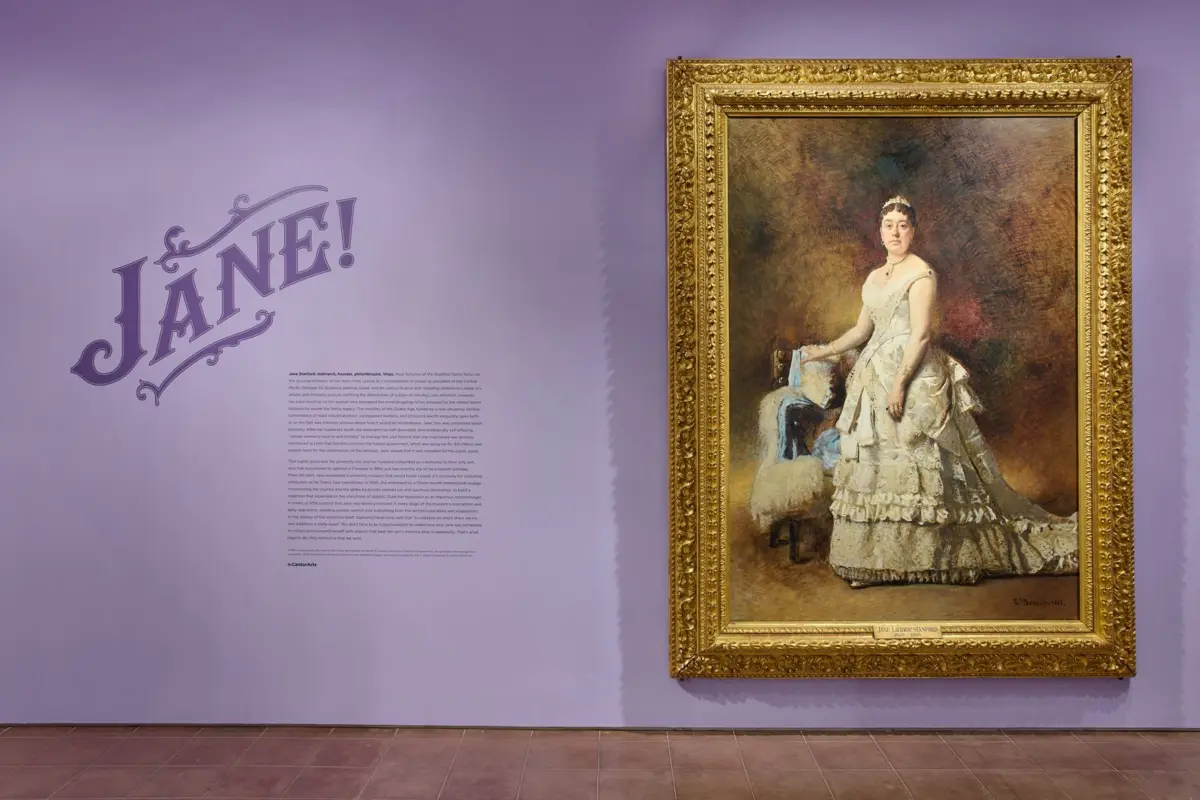
At the Cantor Arts Center, a groundbreaking long-term exhibition titled “Jane!” opened its doors, offering visitors an unprecedented, deeply intimate look at Jane Lathrop Stanford. Running through May 18, 2028, the showcase brings to light a trove of artifacts, family heirlooms, and works of art that have never before been displayed publicly. Curated by Patrick R. Crowley with contributions from assistant registrar Isabelle Rogers and university archaeologist Laura Jones, the exhibition seeks to rescue Jane Stanford from two-dimensional historical obscurity.
Read Also
/https://tf-cmsv2-smithsonianmag-media.s3.amazonaws.com/filer_public/cb/f5/cbf53a8f-ab25-4f04-9809-58da970031e4/2026-07_jane_gc-4-web.jpg)
Far from being merely a grieving widow, Jane emerges as a formidable, travel-loving philanthropist, an ambitious architectural patron, and a visionary co-founder who held the reins of a major institution of higher learning during an era when women were largely excluded from such centers of power. Crucially, the exhibition does not shy away from the dark, dramatic chapters of her biography. It confronts head-on her turn toward Spiritualism in the wake of unimaginable loss, her pivotal role in building the university’s foundational museum, and the lingering, unsolved mystery of her 1905 assassination by strychnine poisoning—a lethal conspiracy that university officials spent nearly a century attempting to sweep under the rug.
Detailed Chronology: From Gilded Dreams to Tragic Realities
To understand Jane Stanford is to understand a life defined by meteoric social ascension, profound tragedy, and relentless resilience.
Born Jane Lathrop in Albany, New York, in 1828 into a large and prominent family, she married Leland Stanford in 1850. At the time of their union, Leland was practicing law before pivoting to the booming commercial sector. He eventually struck an astronomical fortune in the nascent railroad industry as a leader of the Central Pacific Railroad. On May 10, 1869, Leland achieved legendary status when he drove the ceremonial gold spike at Promontory, Utah, marking the triumphant completion of the first transcontinental railroad.
/https://tf-cmsv2-smithsonianmag-media.s3.amazonaws.com/accounts/headshot/IMG_7600-edit-v2.png)
As the family’s wealth and political influence soared—with Leland serving as the 8th Governor of California and later as a U.S. Senator—the couple welcomed their only child, Leland Stanford Jr., in 1868. The boy was the center of their universe, cultivated as the heir to an immense dynastic fortune.
The Turning Point: Europe and Tragedy (1884)
The trajectory of the Stanford family changed irrevocably in 1884. While embarking on a grand tour of Europe, young Leland Jr. contracted typhoid fever. Despite frantic efforts by physicians, the 15-year-old succumbed to the illness in Athens, Greece.
The grief shattered his parents. As Isabelle Rogers, assistant registrar at the Cantor Arts Center, eloquently observes, the couple suddenly found themselves without a child, prompting Jane to declare that "all of California could be her children."
:focal(1500x1000:1501x1001)/https://tf-cmsv2-smithsonianmag-media.s3.amazonaws.com/filer_public/cb/f5/cbf53a8f-ab25-4f04-9809-58da970031e4/2026-07_jane_gc-4-web.jpg)
Choosing to transform their personal agony into a public legacy, Jane and Leland dedicated their vast fortune to establishing a university in honor of their son. Officially named the Leland Stanford Junior University—though universally known as Stanford University—the institution opened its doors to its first students in October 1891.
Widowhood and Sole Governance (1893–1905)
Tragedy struck the family once more in 1893 when Leland Stanford passed away, leaving Jane to navigate the financial, administrative, and legal burdens of the burgeoning university largely on her own.
At the turn of the 20th century, it was exceptionally rare for a woman to wield unilateral control over a major institution of higher learning. Yet, as university archaeologist Laura Jones emphasizes, the university was never merely Leland’s solitary pet project; it was a deeply shared vision. Jane had studied commerce, wealth management, and governance alongside her husband. As a widow, she stepped seamlessly into the role of chief decision-maker, personally funding payroll, guiding architectural expansions, and shaping the university’s academic ethos during its most precarious formative years.
/https://tf-cmsv2-smithsonianmag-media.s3.amazonaws.com/filer_public/04/9d/049d1eb9-1c67-4577-a6ff-562c1f7bc7e4/mosaic.png)
The San Francisco Poisoning and Death in Hawaii (1905)
Jane’s remarkable life met a violent, cinematic end in early 1905.
On January 14, 1905, while residing in her San Francisco mansion, Jane took a sip of bottled mineral water and immediately experienced violent vomiting. Only two individuals were present in the household at the time: her personal secretary, Bertha Berner, and her personal maid. A subsequent chemical analysis revealed that the water had been heavily laced with strychnine, a commercial rat poison.
Terrified by the clear attempt on her life, Jane fled California, booking passage to Japan with an intermediate stop in Honolulu, Hawaii. On February 28, 1905, while staying at the Moana Hotel, Jane fell deathly ill once more after taking a dose of bicarbonate of soda intended to soothe her digestion. She died in agonizing pain shortly thereafter.
/https://tf-cmsv2-smithsonianmag-media.s3.amazonaws.com/filer_public/c5/92/c5920bad-a7a1-405a-998e-8eb181e8a40b/jls14897_cdp-pub_angel.jpg)
An autopsy performed in Hawaii confirmed what Jane had long suspected: she had ingested a fatal dose of strychnine. Yet, Stanford University’s then-president, David Starr Jordan—who had repeatedly clashed with Jane over the administrative control and financial direction of the campus—intervened aggressively. Jordan traveled to Hawaii, dismissed the autopsy findings, and publicly announced to the press that Jane Stanford had died of natural heart failure. This institutional cover-up became the official narrative for nearly a hundred years.
Supporting Context & Metrics: Unearthing the Exhibition’s Treasures
The "Jane!" exhibition at the Cantor Arts Center is remarkable not merely for its thematic breadth, but for the sheer rarity of the artifacts on display. Curators have pulled items from deep archives that shed light on both the opulent tastes and the psychological inner world of the university’s matriarch.
- The Museum’s Origins: The Cantor Arts Center itself—originally opened in 1894 as the Leland Stanford Jr. Museum—was deliberately designed by its founders to mirror the neoclassical facade of the National Archaeological Museum in Athens. Young Leland Jr. had been deeply enamored with Greek antiquities during his final European tour, collecting ancient artifacts with the ambition of curating his own museum. Following his death, his parents incorporated his foundational collection into the museum’s initial inventories.
- Never-Before-Seen Heirlooms: Exhibition curator Patrick R. Crowley notes that the showcase features an eclectic mix of masterworks and bizarre family keepsakes. Among these are:
- An 1898 painting by Astley D.M. Cooper depicting Jane’s legendary jewel collection.
- A series of ceramic artworks—including a striking 1991 piece by artist David Gilhooly—depicting Leland Jr.’s final meal of bacon, eggs, and toast.
- Death masks cast for both Jane and her son, offering a haunting physical testament to Victorian mourning rituals.
- Plaster casts of hands initially mislabeled as Jane’s, but later conclusively identified as belonging to university president David Starr Jordan.
- A long-forgotten mosaic portrait of personal secretary Bertha Berner, discovered in the attic of a residence near the Stanford campus.
- The Turn to Spiritualism: To cope with the compounding grief of losing her only son and, subsequently, her husband, Jane embraced Spiritualism—a prominent 19th-century religious movement that posited living individuals could actively communicate with the deceased. This coping mechanism heavily influenced her worldview, blending deep-seated piety with the avant-garde esoteric practices of the Gilded Age.
Official Statements and Scholarly Perspectives
The exhibition serves as a physical manifestation of decades of rigorous historical reevaluation by Stanford faculty, archivists, and independent researchers.
/https://tf-cmsv2-smithsonianmag-media.s3.amazonaws.com/filer_public/91/19/911943c8-65db-4727-8472-c9a7c4d406a0/jls18217_cdp-pub_portrait.jpg)
"She’s huge as a philanthropist, and she doesn’t really get recognized for that," notes Laura Jones, director of Stanford’s heritage services and the official university archaeologist. "People talk all the time now at Stanford about ‘founders.’ All our students want to found something or build something. And she really is our prototype."
Exhibition curator Patrick R. Crowley characterizes Jane in promotional materials as a figure who was "so formidable, peculiar and unexpectedly human." Crowley emphasizes that while public memory has frequently sidelined her in favor of her husband’s industrial legacy, Jane’s imprint on the university’s physical architecture, cultural collections, and survival is absolute.
The murkiness surrounding her death has likewise received renewed academic rigor. In his landmark 2022 book, Who Killed Jane Stanford?, Stanford historian Richard White analyzed the contradictory newspaper coverage and police reports generated in the wake of the murder. White noted that contemporary accounts of the poisoning were "often conveyed in breathless coverage by the city’s newspapers," overlapping and shifting over time to obscure accountability.
/https://tf-cmsv2-smithsonianmag-media.s3.amazonaws.com/filer_public/37/65/3765fd26-99f1-41ce-adf4-f98e9202dd97/leland.jpg)
Modern scholarship, building on earlier investigations by medical researchers Robert W.P. Cutler and W.B. Carnochan, points to two primary suspects:
- Bertha Berner: Jane’s personal secretary, who was the sole individual present during both the San Francisco and Hawaii poisonings, and who may have been motivated by financial provisions in Jane’s will.
- David Starr Jordan: The university president who clashed with Jane over institutional autonomy and governance. According to White’s historical analysis, Jordan acted as an "accessory after the fact," orchestrating the medical cover-up of her strychnine poisoning to protect the university’s nascent reputation and deflect suspicion from his own administration.
Future Outlook: Redefining the Stanford Origin Story
As visitors walk through the galleries of the Cantor Arts Center through May 2028, the exhibition challenges them to look beyond the sandstone arches and corporate prestige of modern Silicon Valley. It asks the academic community to confront the raw, bleeding human history upon which the institution was built.
By centering Jane Stanford—her expansive international travels, her passionate patronage of the arts, her unwavering stewardship through financial and personal ruin, and the dark conspiracy that prematurely ended her life—the exhibition recalibrates the historical compass of the university. No longer merely a silent marble bust or a hyphenated surname, Jane Stanford is reclaimed as a complex architect of modern education.
/https://tf-cmsv2-smithsonianmag-media.s3.amazonaws.com/filer_public/41/6e/416e4309-595b-4fe7-9232-bd9aa2cbb6ba/199153_gilhooly_breakfast-2.jpg)
In doing so, the exhibition bridges the gap between 19th-century mourning and 21st-century historical accountability, ensuring that the founding matriarch’s true story is finally brought out of the shadows and into the light.



Comments
Facebook App ID not configured. Please add it in the Customizer.