
Executive Overview
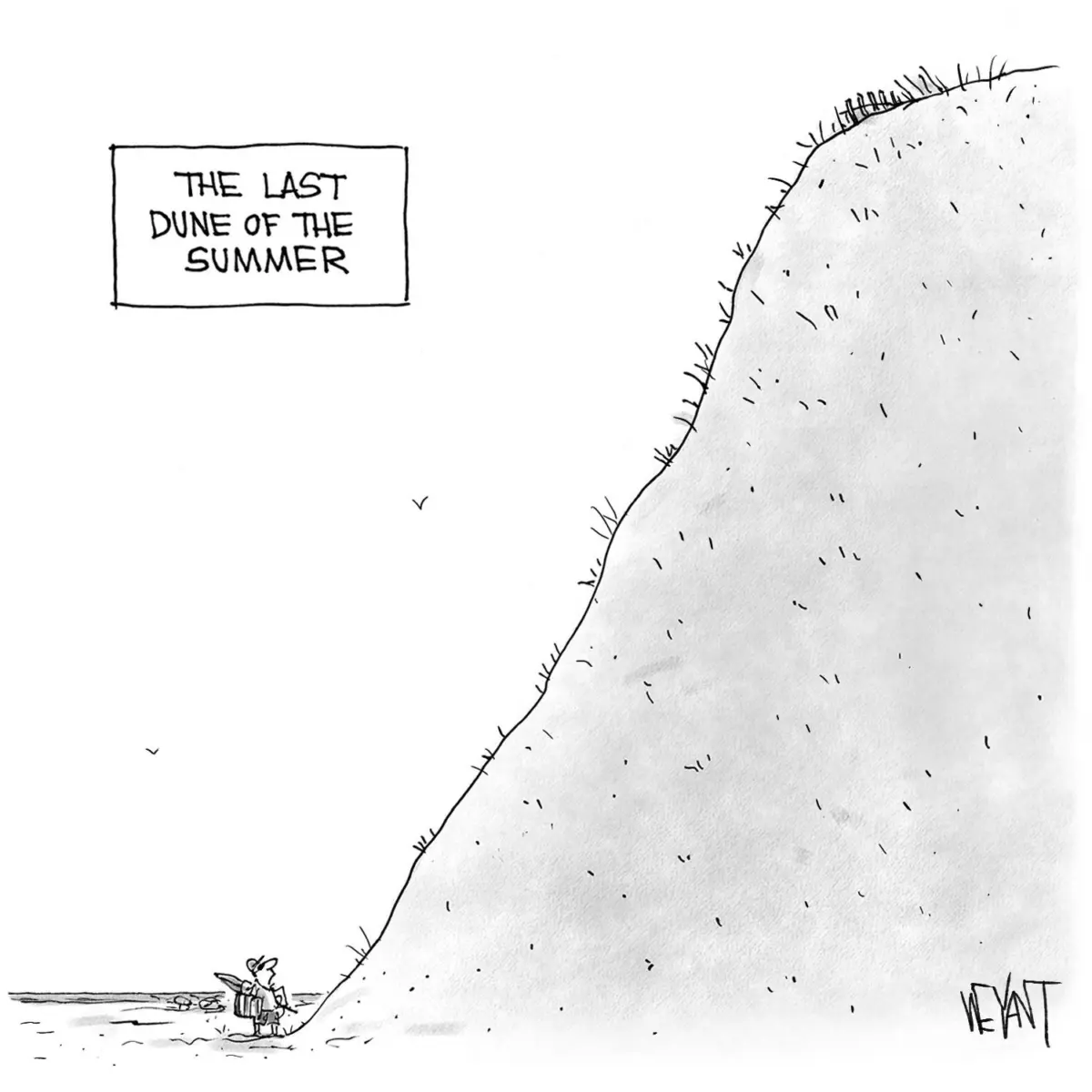
As late-summer sunlight shifts into the crisp hues of early autumn, few media institutions capture the collective anxiety and subtle melancholy of seasonal transitions quite like The New Yorker. In its latest celebrated visual feature, titled "The Last Dune of the Summer," award-winning cartoonist and illustrator Christopher Weyant offers a poignant, understated commentary on the relentless march of time. The single-panel illustration depicts an overburdened beachgoer—equipped with an umbrella, beach chair, and summer paraphernalia—standing at the base of a towering, insurmountable sand dune, metaphorically framing the daunting return to autumn routine.
Beyond its immediate humor, the artwork highlights a broader journalistic and cultural phenomenon: the single-panel cartoon as a masterclass in compressed storytelling. Weyant, a distinguished Harvard University Nieman Fellow and Theodor Seuss Geisel Award winner, continues a storied tradition that elevates visual satire from simple leisure reading into a reflective mirror of society’s shared psychological landscape. This feature explores the history, mechanics, and industry context surrounding Weyant’s work, examining how single-panel illustrations remain one of print and digital journalism’s most resilient and evocative mediums.
Detailed Chronology: The Trajectory of Christopher Weyant’s Career
To understand the cultural resonance of "The Last Dune of the Summer," one must trace the career of its creator, whose artistic evolution spans editorial commentary, award-winning children’s literature, and prestigious academic fellowships.
Read Also
+-----------------------------------------------------------------------------------+
|                           KEY MILESTONES IN WEYANT'S CAREER                        |
+-----------------------------------------------------------------------------------+
|  Early 2000s   | Begins contributing regularly to The New Yorker & major outlets  |
|  2015          | Wins Theodor Seuss Geisel Award for "You Are (Not) Small"         |
|  2016          | Awarded prestigious Nieman Fellowship in Journalism at Harvard    |
|  2017–Present  | Expands syndicated political/cultural cartoons & picture books    |
|  Current       | Releases "The Last Dune of the Summer," cementing seasonal genre |
+-----------------------------------------------------------------------------------+
The Early Years and The New Yorker Debut
Christopher Weyant established himself as a prominent voice in American illustration during the late 1990s and early 2000s. Joining the elite roster of regular contributors to The New Yorker, his work stood out for its clean linework, expressive character design, and ability to distill complex human neuroses into single, accessible moments. His cartoons quickly spread across major global syndicates, appearing in publications such as The Wall Street Journal, The Boston Globe, and USA Today.
2015: Literary Acclaim with the Geisel Award
In 2015, Weyant achieved major literary recognition outside traditional editorial pages. Collaborating with author Anna Kang, Weyant illustrated the acclaimed children’s book You Are (Not) Small. The picture book, which used sparse text and vivid character illustrations to explore themes of perspective and empathy, was awarded the 2015 Theodor Seuss Geisel Award by the American Library Association. This accolade cemented Weyant’s versatility across both adult satire and children’s visual storytelling.
2016: Harvard Nieman Fellowship
In a landmark achievement for visual artists, Weyant was named a Nieman Fellow in Journalism at Harvard University for the Class of 2016. The fellowship—traditionally reserved for print, broadcast, and investigative journalists—recognized Weyant’s cartooning as a vital form of editorial reporting and public advocacy. During his tenure at Harvard, Weyant studied the intersection of political visual discourse, digital media dissemination, and the evolving role of satire in democratic accountability.
2017–Present: Expanding Digital and Print Horizons
Following his fellowship, Weyant expanded his thematic scope, combining sharp political commentary on contemporary American governance with timeless observational humor. Features like "The Last Dune of the Summer" illustrate his ongoing mastery of universally relatable human experiences, balancing lighthearted seasonal nostalgia with existential subtext.
Supporting Context & Metrics: The Economics and Mechanics of Visual Satire
While a single-panel cartoon appears effortless to the reader, it represents the tip of an competitive and highly selective editorial iceberg. Within the heritage print landscape—exemplified by The New Yorker—visual humor serves both as visual relief and primary narrative content.
The Selectivity of The New Yorker Cartoon Desk
The New Yorker cartoon department operates under one of the most intense selection processes in media publishing. Understanding these dynamics provides crucial context for the placement of Weyant’s work:
| Metric / Dimension | Industry Standard / Selection Data |
|---|---|
| Weekly Submissions Received | ~500 to 1,000 individual rough sketches |
| Contributing Artists per Week | 50 to 100 professional cartoonists |
| Published Cartoons per Issue | 12 to 18 panels |
| Acceptance Rate | Approximately 1.2% to 1.8% |
| Digital Readership Reach | Multi-million global online subscribers & social followers |
Deconstructing "The Last Dune of the Summer"
In Weyant’s piece, composition plays an essential role in driving the joke home:

- Scale and Proportion: The protagonist is positioned at the lower left of the frame, visually dominated by a steep, imposing incline of sand that spans the height of the composition. This dramatic scale asymmetry creates an immediate sense of burden and exhaustion.
- Iconography of Leisure vs. Labor: The subject carries classical symbols of summer relaxation—a folded beach chair, an umbrella, and a tote bag. However, the physical posture suggests labor rather than leisure, capturing the ironies of American holiday culture where "resting" often entails grueling logistics.
- The Seasonal Metaphor: The dune functions as a physical wall between the carefree freedom of summer and the structured demands of autumn. By labeling it "The Last Dune of the Summer," Weyant transforms a mundane beach landscape into an existential threshold.
           +-------------------------------------------------------+
           |                 EDITORIAL MECHANICS                   |
           |                                                       |
           |   [Visual Scale]  ==> Imposing Sand Dune (Autumn)     |
           |          ^                                            |
           |          | (Contrast)                                 |
           |          v                                            |
           |   [Iconography]   ==> Burdened Beachgoer (Summer)     |
           |                                                       |
           |   RESULT: Universal emotional resonance & catharsis   |
           +-------------------------------------------------------+
The Role of Accessibility and Digital Metadata
In the modern digital publishing ecosystem, image accessibility has transformed how cartoons are consumed. Detailed image descriptions and alt-text tags—such as the metadata accompanying Weyant’s piece online—ensure that screen readers can convey the compositional humor to visually impaired audiences. This focus on accessibility reflects a broader media trend toward inclusive visual journalism, broadening the impact of single-panel storytelling.
Official Statements and Industry Perspectives
Critics, editors, and academics have long analyzed the strategic role of visual satire in shaping public discourse.
On the Role of Single-Panel Satire
Speaking on the impact of cartooning during his Nieman Fellowship at Harvard, Weyant emphasized the journalistic responsibility inherent in visual storytelling:
"Cartoons are often viewed as simple entertainment, but at their core, they are condensed editorial essays. A great panel doesn’t just make you smile—it forces you to recognize a truth about your daily life, your politics, or your society in less than three seconds."
Editorial Insights from The New Yorker Tradition
Art historians and former cartoon editors at The New Yorker have frequently noted how seasonal cartoons act as emotional milestones for readership communities. Commenting on the tradition of end-of-summer humor, media scholars note:
"The end of summer brings a universal sense of quiet panic—the dread of returning to schedules, dark evenings, and heavy coats. Cartoonists like Christopher Weyant perform a public service by turning that collective seasonal depression into shared catharsis. When we laugh at the figure dragging a beach chair up an endless dune, we are laughing at our own unwillingness to let go of the light."
Future Outlook: The Evolution of Visual Humor in the Digital Age
As media consumption shifts increasingly toward algorithmic feeds, visual storytelling faces both significant challenges and unprecedented opportunities.
+-----------------------------------------------------------------------------------+
|                        FUTURE TRENDS IN EDITORIAL CARTOONING                      |
+-----------------------------------------------------------------------------------+
|  Digital Archives & Monetization | High-resolution licensing, print sales, NFTs    |
|  AI & Generative Tools            | Defense of human nuance, craft, and commentary|
|  Social Media Virality            | Standalone single-panel format ideal for feeds    |
|  Cross-Medium Expansion           | Cartoonists bridging print, picture books, animation|
+-----------------------------------------------------------------------------------+
Preservation of Human Nuance in an Automated Era
With the rise of generative AI tools, the value of hand-drawn human observation has become a focal point within the illustration community. Editors emphasize that while algorithms can synthesize images, they lack the emotional intelligence, personal vulnerability, and socio-cultural timing required to produce resonance in cartoons like "The Last Dune of the Summer." Artists like Weyant represent the enduring necessity of human instinct in commentary.
Multi-Platform Adaptation
The trajectory of contemporary cartoonists increasingly demands versatility across formats:
- Children’s Literature: Weyant’s success with Anna Kang on books like You Are (Not) Small offers a sustainable model for cartoonists to diversify their creative output while building cross-generational audiences.
- Digital Syndication: Single-panel cartoons possess an inherent advantage on mobile devices and social networks, where clear composition and concise captions outperform lengthy text formats in capturing immediate reader attention.
- Archival and Fine Art Value: Dedicated digital stores and archival print programs allow publications to monetize classic cartoons long after their original publish date, turning temporary editorial pieces into long-term artistic assets.
Conclusion
Christopher Weyant’s "The Last Dune of the Summer" stands as a testament to the persistent vitality of the single-panel cartoon. By translating complex human emotions into a single frame, Weyant confirms that even as publishing technologies evolve, the fundamental human need for witty, reflective, and empathetic storytelling remains unchanged. As summer recedes, the simple image of a beachgoer confronting an insurmountable dune reminds us that while seasons inevitably end, the power of art to lighten our shared burdens endures.





Comments
Facebook App ID not configured. Please add it in the Customizer.