
Executive Overview
In the fast-paced ecosystem of social media, viral trends emerge and fade with dizzying speed, often leaving behind a trail of fleeting amusement. However, a recent global social media craze—which quickly saturated feeds across Pakistan and beyond—has morphed from a lighthearted exercise in digital nostalgia into a serious crucible for conversations regarding data privacy, biometric consent, and the ethics of feeding personal likenesses into machine learning platforms.
The trend in question invited users, including a constellation of high-profile Pakistani celebrities and prominent entertainment portals, to use artificial intelligence platforms like ChatGPT to imagine what they, or contemporary stars, would have looked like during the 1980s. The results—airbrushed, synth-pop-inspired, technicolor portraits blending vintage fashion aesthetics with modern celebrity faces—garnered millions of impressions, likes, and shares within days.
Yet, beneath the glittering veneer of neon-soaked aesthetics and synth-driven nostalgia lies a darker reality that digital rights experts, privacy advocates, and security researchers have long warned against. The seemingly harmless act of uploading a clear, high-resolution portrait to an AI system to generate a retro avatar constitutes a massive, voluntary transfer of biometric data to corporate entities.
Read Also
As critics and digital security experts have aggressively pointed out, every face submitted to these platforms helps train the underlying neural networks, sharpening their ability to map facial geometries, replicate micro-expressions, and potentially generate hyper-realistic deepfakes without the original subject’s explicit knowledge or ongoing consent.
This article explores the mechanics of the 1980s AI trend, documents how it swept through the Pakistani entertainment industry, analyzes the sharp pushback from digital rights activists, and examines the broader, more alarming implications of surrendering our biometric identities to the black box of generative artificial intelligence.
Detailed Chronology
The Genesis and Viral Explosion of the 1980s Aesthetic
The phenomenon began quietly as an algorithmic novelty before snowballing into a mainstream obsession. Generative AI tools, equipped with sophisticated image-to-image pipelines and multimodal vision capabilities, gained the capacity to take a user-submitted portrait and seamlessly composite it into historical, stylistic epochs. The 1980s—a decade synonymous with bold power shoulders, voluminous permed hair, dramatic eye makeup, and technicolor gradients—proved to be an irresistible canvas.
Within days, Instagram, TikTok, and X (formerly Twitter) were flooded with side-by-side comparisons of influencers and everyday users. The appeal was psychological as much as it was aesthetic: it offered a comforting, albeit fabricated, lens of nostalgia, allowing individuals to mentally transport themselves to an era they may have only read about in history books or experienced through vintage cinema.
The Pakistani Entertainment Industry Jumps Aboard
As is often the case with viral internet phenomena, the trend found hyper-accelerated adoption within the South Asian entertainment landscape. Prominent Pakistani actors, musicians, and digital lifestyle brands quickly mobilized to capitalize on the algorithmic momentum, publishing galleries of their favorite stars reimagined as 1980s icons.
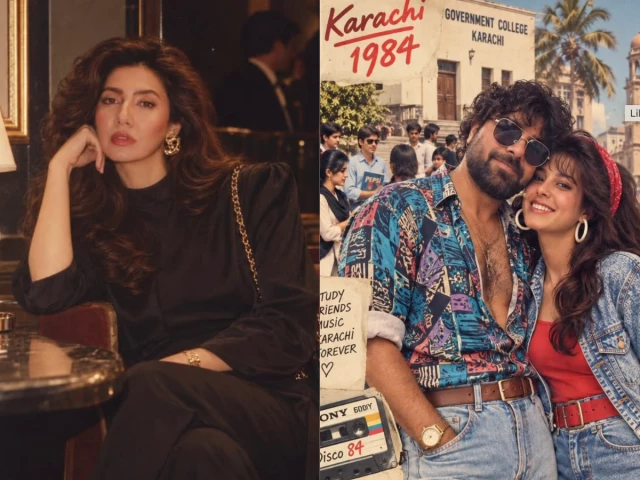
- Mashion’s Curated Gallery: The lifestyle platform Mashion emerged as an early adopter, releasing a heavily shared compilation of AI-generated portraits depicting some of Pakistan’s most recognizable leading ladies. Actresses Mahira Khan, Mawra Hocane, Ayeza Khan, Anmol Baloch, Sanam Saeed, Aina Asif, and Zara Noor Abbas were digitally transported into the 1980s glamour circuit. Accompanying the post was a caption reading: "80s glam meets today’s biggest stars. We reimagined Pakistani actresses as leading ladies of a different era, and honestly, they were built for it." While the post racked up thousands of engagements, it simultaneously served as the catalyst for the first wave of public backlash, with followers questioning the artistic and ethical necessity of relying on synthetic media to celebrate real human talent.
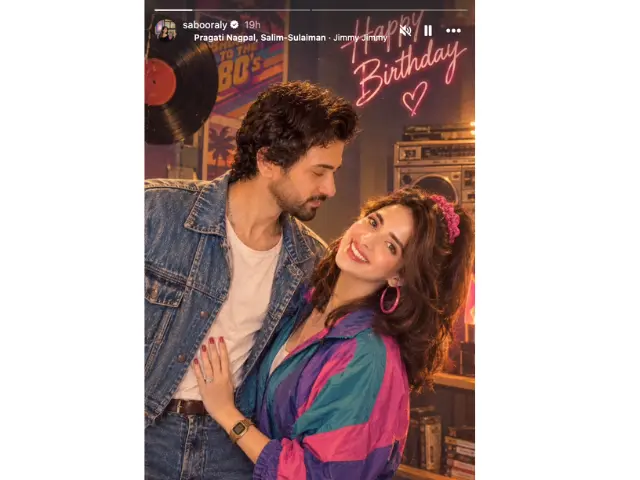
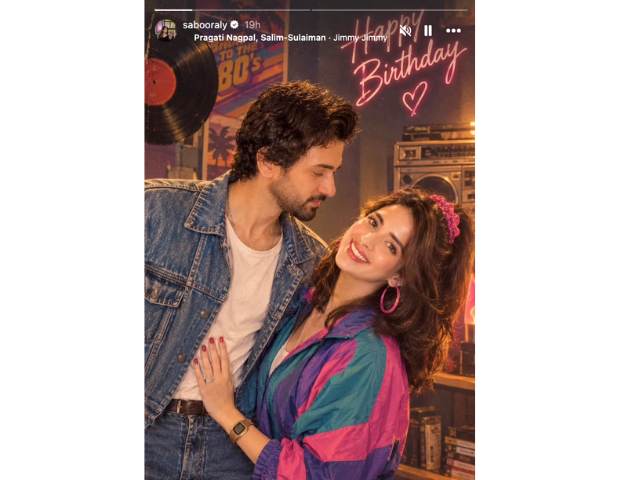
- Celebrity Participation: The trend rapidly bled into personal accounts. Well-known actor Yasir Hussain shared AI-generated portraits of himself alongside his wife, actress Iqra Aziz, prompting a mix of amusement and skepticism from their fan bases. Similarly, actress Saboor Aly shared an AI-generated rendering of herself and her husband, actor Ali Ansari, via her Instagram Story. The contagion spread across the industry, drawing in a wide cohort of Pakistani media personalities including Shahroz Sabswari, Mariyam Nafees, Anoushey Ashraf, Zhalay Sarhadi, Noor Hassan, Nimra Khan, and Armeena Khan, each eager to display their retro alter-egos to their respective digital followings.
The Counter-Wave: Dissent, Satire, and Digital Activism
As the virtual photo album filled up, a vocal counter-movement began to take shape. Comment sections on celebrity posts shifted from complimentary remarks about vintage styling to pointed questions regarding data harvesting and the commodification of celebrity likenesses.
The friction reached a critical juncture when prominent digital rights advocates intervened, transforming a pop-culture debate into an urgent warning about cybersecurity and biometric autonomy.
Amidst the digital frenzy, veteran musician and former Strings frontman Bilal Maqsood cut through the AI-generated noise with a dose of authentic nostalgia. Opting out of neural networks entirely, Maqsood shared an actual, unedited archival photograph from the band’s heyday in the 1980s. Accompanying the throwback image was a sharp, satirical jab at the digital zeitgeist: "People are using AI to look like they’re from the 80s. 80s people: Hold my photo album." Maqsood’s post served as a poignant reminder of the value of genuine history in an age increasingly dominated by synthetic fabrication.
Supporting Context & Metrics
Understanding Biometric Harvesting and Machine Learning Training
To comprehend the gravity of the backlash surrounding the 1980s AI trend, one must examine the underlying mechanics of modern generative artificial intelligence platforms. When a user uploads a clear photograph of their face to a commercial AI tool—whether for face-swapping, style transfer, or historical reimagining—they are interacting with complex neural networks that require vast quantities of visual data to function, refine, and evolve.
- Facial Geometry Mapping: AI models do not merely "look" at a photo the way a human does; they convert facial features into high-dimensional mathematical vectors. Distance between the eyes, jawline contours, nasal bridge angles, and skin texture are translated into numerical representations known as embeddings.
- Model Training and Fine-Tuning: Millions of users eagerly feeding their clear, unmasked, high-resolution faces into these platforms provide tech companies with a goldmine of diverse, real-world biometric data. This data is frequently utilized to fine-tune foundational models, improving their ability to recognize, synthesize, and manipulate human faces with hyper-realistic fidelity.
- The Persistence of Data: Once uploaded to third-party servers, a user’s biometric profile rarely vanishes when the app is closed. Terms of service agreements for many consumer-facing AI applications often grant companies broad, irrevocable licenses to store, process, and use submitted content for research, product development, and machine learning training.
The Looming Threat of Deepfakes and Identity Theft
The core anxiety articulated by cybersecurity experts and digital rights activists centers on the democratization and weaponization of deepfake technology. A deepfake is synthetic media in which a person in an existing image or video is replaced with someone else’s likeness using artificial neural networks.
Historically, creating a convincing deepfake required significant technical expertise, specialized computing hardware, and hundreds of hours of video footage of the target individual. However, as AI platforms ingest millions of high-resolution facial scans provided voluntarily through viral trends, the barrier to entry collapses.
- Enhanced Synthesis: If a bad actor or malicious entity desires to create a convincing deepfake of a celebrity, politician, or private citizen for extortion, disinformation campaigns, or fraud, having access to a pre-trained model or a database of clean facial embeddings significantly reduces the margin of error.
- The Consent Paradox: When celebrities or influencers participate in these trends, they inadvertently act as unwitting ambassadors for corporate data collection, normalizing behaviors that erode privacy rights for the wider population who look to them for cues on digital culture.
Official Statements & Expert Analysis
The cultural clash between viral entertainment and digital security culminated in sharp rebukes from defenders of digital rights, who did not mince words when addressing the participants of the trend.
Usama Khilji’s Viral Condemnation
One of the most prominent critiques came from Pakistan-based digital rights activist Usama Khilji, who took to Instagram to issue a scathing denunciation of the trend and those participating in it. Sharing his thoughts via his Instagram Story, Khilji directly addressed the psychological trap of viral social media participation:
"All you idiots are training CHATGPT with your face so it can reproduce your images better when someone wants to generate your deepfakes. Stop falling for every trend. Stop trusting big tech. Stop feeding your face to machines."
Khilji’s blunt assessment laid bare the disconnect between the desire for fleeting social media validation and the long-term security implications of surrendering one’s biometric data. His warning highlighted that the utility that makes these AI tools so entertaining—their ability to accurately map and render a specific person’s face—is precisely the capability that makes them dangerous when placed in the hands of malicious actors.
Industry and Legal Perspectives
Legal scholars and privacy advocates emphasize that current regulatory frameworks—particularly in developing digital economies like Pakistan—are ill-equipped to handle the rapid proliferation of generative AI and biometric harvesting.
- Regulatory Lags: Traditional data protection laws focus heavily on personally identifiable information (PII) such as national identity numbers, phone numbers, and physical addresses. Biometric data, facial geometries, and synthetic likenesses often exist in a legal grey area, leaving citizens with little recourse if their digital likeness is scraped, stored, or misused.
- The Illusion of Ownership: Many users operate under the false assumption that posting an image on social media grants them perpetual ownership over how that image is utilized by third-party algorithms. In reality, once an image crosses the threshold into an AI training pipeline, the original creator loses all practical control over its derivative manifestations.
Future Outlook
As artificial intelligence continues to weave itself into the fabric of daily life, the 1980s AI trend will likely be remembered not merely as a quirky chapter of internet history, but as a watershed moment that exposed the vulnerabilities of human behavior in the digital age.
The Road Ahead: Navigating the Synthetic Era
The tension between technological novelty and privacy preservation is poised to intensify in the coming years. Several critical trajectories are emerging as society grapples with the fallout of unchecked biometric harvesting:
- Stricter Regulatory Scrutiny: Governments and regulatory bodies worldwide are facing mounting pressure to draft comprehensive legislation addressing generative AI, facial recognition, and synthetic media. Future laws may mandate explicit, granular consent mechanisms before any user-submitted image can be used for machine learning training.
- The Rise of Digital Hygiene: Just as cybersecurity awareness taught generations of internet users not to click on suspicious links or share passwords, public education campaigns led by digital rights advocates will likely begin focusing on "biometric hygiene"—educating the public on the risks of uploading unmasked facial data to unverified third-party platforms.
- Technological Counter-Measures: We may witness the proliferation of anti-facial recognition tools, such as software designed to subtly distort digital images in ways that confuse AI training models while remaining imperceptible to the human eye, allowing users to participate in digital spaces without surrendering their biological signatures.
Conclusion
The 1980s AI trend offered a vibrant, nostalgic escape into a bygone era of neon and synthesized sound. Yet, beneath the aesthetic charm lies a sobering reminder of the digital trade-offs defining the 21st century. As celebrities and everyday users alike continue to navigate the ever-expanding universe of generative artificial intelligence, the fundamental questions raised by this viral craze—surrounding consent, data privacy, and the protection of personal identity—will only grow more urgent, demanding vigilance from creators, consumers, and lawmakers alike.





Comments
Facebook App ID not configured. Please add it in the Customizer.