
Executive Overview
In an era defined by hyper-connectivity and the relentless churn of digital media, societies frequently find themselves trapped in a dizzying momentum of successive catastrophes. For Pakistan, this global phenomenon manifests with a devastating, unique intensity. Citizens are routinely rushed from one national trauma to the next, denied the fundamental human dignity of closure, mourning, or systemic accountability.
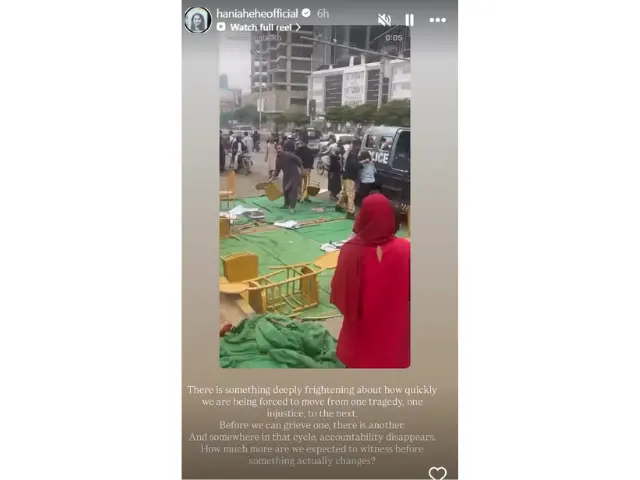
This grim reality was recently thrust back into the national spotlight by one of the country’s most prominent cultural figures. Renowned actor Hania Aamir took to social media to voice her profound dismay over a recurring societal pattern: the seamless transition from one tragedy to another without resolution, justice, or institutional learning.
At the heart of Aamir’s critique is a deeply unsettling video capturing police intervention at a sit-in on Karachi’s vital thoroughfare, Sharea Faisal. The protest was organized by the desperate family members of Pakistani sailors who have been held hostage by Somali pirates since April. For five agonizing months, these families have camped, marched, and pleaded for state intervention, only to be met with bureaucratic inertia and, ultimately, law enforcement crackdowns.
Read Also
Aamir’s intervention is not an isolated outburst, but rather part of a broader, mounting wave of dissent from Pakistan’s creative elite. Figures like Mahira Khan, Sabeena Farooq, and musician Talha Anjum have increasingly leveraged their colossal digital footprints to demand state action for the captive sailors.
This article explores the intricate layers of this crisis. It examines the harrowing timeline of the sailors’ captivity, the escalating tensions between grieving families and state authorities, the socio-political implications of celebrity activism in Pakistan, and the psychological toll of a society perpetually living on the precipice of unresolved tragedy.
Detailed Chronology: Five Months of Captivity, Protests, and State Friction
To fully grasp the gravity of the events that triggered public outrage, one must trace the timeline of the crisis back to its inception—a narrative defined by geopolitical vulnerability, maritime danger, and institutional silence.
April: The Capture in the Indian Ocean
The crisis began in the spring when a vessel carrying Pakistani sailors found itself targeted and subsequently hijacked by Somali pirates in the volatile waters of the Indian Ocean. While maritime piracy off the coast of East Africa has historically been an international security concern, the prolonged detention of these specific crew members quickly exposed the vulnerabilities faced by blue-collar Pakistani laborers operating in high-risk global shipping corridors.
Initially, details trickled in slowly. Families received frantic, fragmented information about the seizure of their loved ones. As days turned into weeks, the initial shock gave way to a terrifying realization: securing the release of hostages held by irregular, heavily armed maritime syndicates required complex diplomatic maneuvers, intelligence cooperation, and financial negotiations that appeared entirely beyond the immediate bandwidth—or priority—of local authorities.
May to August: The Mounting Agrief and Grassroots Mobilization
As the months rolled on with no definitive rescue strategy communicated to the families, the private anguish of the sailors’ relatives transformed into public protest. Throughout the summer, multiple demonstrations were staged in major urban centers, most notably in Karachi, the nation’s economic hub and home to many of the affected families.
These early protests were characterized by heart-wrenching scenes: mothers, wives, and children holding up photographs of the missing men, pleading with the Ministry of Foreign Affairs and maritime agencies to intervene. Despite the emotional resonance of these gatherings, they yielded little tangible progress. Official statements remained sparse, often reduced to standard diplomatic assurances that "efforts are underway," lacking deadlines, transparency, or strategic depth.
September: The Boiling Point on Sharea Faisal
The crisis reached a volatile crescendo in September. Driven by mounting desperation after nearly half a year of captivity, family members announced a major march and established a sit-in camp near the Ministry of Foreign Affairs liaison office and along Sharea Faisal—one of Karachi’s busiest arterial roads.
The intent was clear: to disrupt the status quo and force the state to acknowledge their plight through high-visibility civil disobedience. However, the state’s response was swift and uncompromising.
Footage that soon flooded social media platforms showed police units moving in to break up the sit-in. The visuals of law enforcement personnel dismantling tents and confronting grieving, exhausted family members sparked nationwide condemnation. While police officials later maintained that they had merely "engaged" with the protesters to restore traffic flow and denied using excessive force, the optical reality delivered a devastating blow to the state’s credibility. It was this specific footage, shared widely across digital networks, that served as the catalyst for Hania Aamir’s public critique.
Supporting Context & Metrics: The Anatomy of Celebrity Activism in Pakistan
To understand the cultural weight of Hania Aamir’s intervention, one must examine the unique ecosystem of Pakistani celebrity culture, digital demographics, and the structural frequency of national crises.

The Digital Megaphone: Hania Aamir’s Reach
With a staggering following exceeding 15 million users across her social media platforms, Hania Aamir commands an audience larger than the circulation numbers of many mainstream print publications and comparable to major television networks. Her digital reach spans demographics, heavily engaging Gen Z and millennial Pakistanis who primarily consume news through social media feeds rather than traditional evening bulletins.
Aamir is no stranger to balancing commercial entertainment with sociopolitical commentary. Last year, at a UK Parliament event where she was honored with the Star of Pakistan Award, she delivered a pointed message emphasizing that "craft is craft, humanity is humanity," arguing that human empathy must transcend political and geographical boundaries. Furthermore, her willingness to publicly address her own mental health battles—such as candidly detailing the psychological toll and panic attacks she navigated throughout the grueling production schedules of 2025—has fostered a deep sense of authenticity with her audience. When an actor known for vulnerability speaks out on institutional apathy, the public listens.
A Collective Awakening: The Entertainment Industry Takes a Stand
Aamir is part of a notable paradigm shift within the Pakistani entertainment industry. Historically, mainstream celebrities often shied away from contentious political or human rights issues out of fear of professional blacklisting, state harassment, or alienating commercial sponsors.
However, the scale of recent national crises has eroded this cautious neutrality.
- Mahira Khan, arguably Pakistan’s most globally recognized cinematic icon, has repeatedly used her platform to spotlight humanitarian causes, including the plight of the captive sailors.
- Sabeena Farooq, celebrated for her compelling television performances, has actively amplified calls for state accountability regarding the hostages.
- Acclaimed musician Talha Anjum has similarly lent his voice, fusing cultural cachet with civic advocacy.
This convergence of art and activism signals a maturing creative class—one that recognizes that massive digital followings carry a moral imperative to challenge systemic indifference.
Official Statements and Institutional Responses
The chasm between public expectation and state action has been the defining characteristic of the five-month ordeal.
The Law Enforcement Narrative
In the wake of the Sharea Faisal crackdown, Karachi police authorities moved quickly to manage the public relations fallout. In official statements released to the media, law enforcement agencies asserted that their presence on the scene was administrative rather than punitive.
Police spokespersons claimed that officers had merely "engaged" with the demonstrators in an effort to clear a critical public thoroughfare. They emphasized that the sit-in was causing severe traffic gridlocks, inconveniencing thousands of citizens, and posing public safety risks near sensitive government liaison offices. Crucially, the police categorically denied allegations of physical brutality or unauthorized use of force, framing their actions as a necessary maintenance of public order rather than an attempt to silence distressed families.
The Diplomatic and Governmental Silence
Conversely, the response—or lack thereof—from the federal ministries responsible for overseas nationals, maritime affairs, and foreign relations has been widely criticized as opaque and reactive.
While bureaucratic channels reportedly communicated behind closed doors with international maritime partners and regional intelligence assets, the lack of public progress reports left a vacuum easily filled by anxiety and suspicion. Families of the sailors reported feeling stonewalled by mid-level bureaucrats who offered vague promises without institutional backing or financial support for the affected households, many of which lost their primary breadwinners the moment the ship was seized.
Future Outlook: Breaking the Cycle of Impunity
Hania Aamir’s poignant observation—that Pakistanis are rarely afforded the time or emotional space to process one tragedy before the next begins—strikes at the very core of the nation’s contemporary malaise. This phenomenon, often described by sociologists as "chronic crisis fatigue," breeds a dangerous cocktail of cynicism, civic disengagement, and institutional impunity.
[ Crisis Occurs ] ---> [ Public Outrage & Protests ] ---> [ State Crackdown / Apathy ] ---> [ Next Crisis Erupts ]
         ^                                                                                          |
         |------------------------------------------------------------------------------------------|
                               (The Vicious Cycle of Unresolved Trauma)
As the families of the kidnapped sailors enter their sixth month of agony, the trajectory of this specific case will serve as an essential litmus test for the Pakistani state’s responsiveness to ordinary citizens.
For real change to occur, several structural shifts are imperative:
- Transparency in Crisis Management: The state must institutionalize clear, empathetic, and regular communication channels for families affected by overseas kidnappings or disasters, removing the wall of bureaucratic silence.
- Protection of the Right to Dissent: Law enforcement agencies must pivot away from aggressive crowd-control tactics when dealing with grieving citizens, recognizing that peaceful assembly is a fundamental democratic pressure valve, not a security threat.
- Sustained Celebrity and Media Vigilance: As demonstrated by Hania Aamir, Mahira Khan, and their peers, keeping the spotlight on forgotten crises prevents powerful institutions from sweeping human tragedies under the rug.
Until the state learns to value closure, accountability, and the welfare of its most vulnerable citizens with the same urgency it applies to political maneuvering, Pakistanis will remain trapped on a relentless treadmill of unresolved sorrow—witnessing tragedy after tragedy, waiting endlessly for the dawn of systemic reform.





Comments
Facebook App ID not configured. Please add it in the Customizer.