
Executive Overview
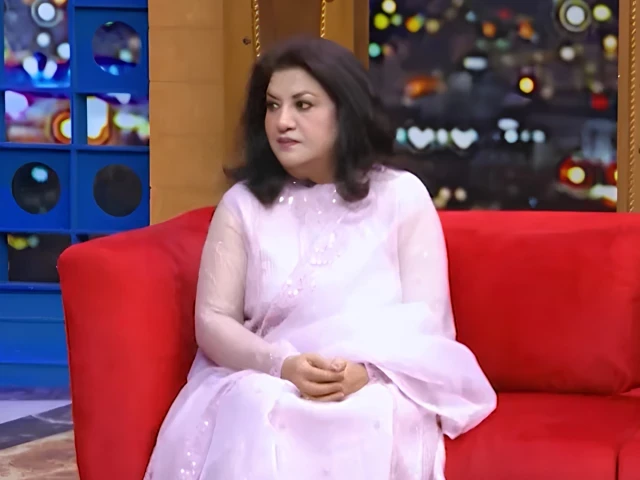
The contemporary landscape of Pakistani television drama is often celebrated for its soaring commercial reach, burgeoning digital footprint, and international appeal. Yet, beneath this glossy veneer of high-definition broadcasts and million-view YouTube milestones lies a growing creative crisis. Veteran actress Hina Dilpazeer—universally adored for her iconic, boundary-pushing portrayal of "Momo" in the generational sitcom Bulbulay—has laid bare the systemic frailties plaguing the country’s entertainment industry.
In a candid, wide-ranging retrospective interview, Dilpazeer did not mince words. She dissected a rigid "lobby system" that narrows casting choices, critiqued the precipitous decline of writing standards, and mourned the loss of the rigorous professional discipline cultivated during the golden age of Pakistan Television (PTV). Far from being a mere lamentation of a bygone era, Dilpazeer’s critique serves as an urgent diagnostic of an industry at a crossroads. As commercial pressures override artistic merit, and as actors are increasingly chosen for their social media followings rather than their mastery of Urdu diction and dramatic timing, the cultural integrity of the Pakistani screen drama is facing an unprecedented test.
This article examines Dilpazeer’s profound commentary, exploring the mechanics of television typecasting, the dilution of literary and linguistic standards in modern scripts, the legacy of the PTV training ground, and the accidental origins of a career that redefined Pakistani comedy.
Read Also
Detailed Chronology: From Accidental Beginnings to an 18-Year Legacy
To understand Hina Dilpazeer’s artistic authority, one must trace the unconventional trajectory of her career—a journey built not on aggressive self-promotion or calculated networking, but on raw, spontaneous talent and an instinctive grasp of human nuance.
The Incidental Entry: Bubul and Burns Road Ki Nilofer
Dilpazeer’s entry into the performing arts was entirely serendipitous. She had merely visited a television set for an ancillary project when a sudden crisis hit the production of a play titled Bubul. The actress slated to play a domestic worker failed to arrive for the shoot, leaving the director scrambling for a replacement. Spotting Dilpazeer, the crew asked if she could step in at a moment’s notice.
With no time for rehearsals or character notes, Dilpazeer relied on her acute powers of observation. She happened to be wearing a saree, which prompted her to think critically about the character’s physical identity: Which domestic worker wears a saree to work? Drawing from her childhood memories, she recalled a Bengali woman who had once worked at her family home. Adopting the woman’s distinct cadence, rhythm, and accent, Dilpazeer opened the door on cue and delivered a single line of dialogue inquiring about a missing child.
That fleeting, improvised moment caught the sharp eye of acclaimed writer Fasi Bari Khan, who was present on set. Recognizing an authentic, organic talent, Khan immediately marked her out for future collaboration. That chance encounter led directly to Burns Road Ki Nilofer, cementing Dilpazeer’s reputation as a character actress of extraordinary depth and flexibility long before she became a household name.
The Phenomenon of Momo and Bulbulay
While Dilpazeer’s early dramatic work showcased her versatility in serious and nuanced roles, it was her casting in the slapstick sitcom Bulbulay that transformed her into a cultural institution. What was originally intended as a single-episode guest appearance evolved, through sheer audience demand and undeniable on-screen chemistry, into an 18-year television marathon.
Reflecting on the monumental success of Momo—a character defined by her endearing forgetfulness, eccentric logic, and chaotic charm—Dilpazeer consistently deflects sole credit. She insists that Momo was not a solo creation, but the product of a collaborative ecosystem. The character’s idiosyncratic traits, comedic timing, and memorable catchphrases were forged through the collective creative collusion of the cast, directors, and crew working on set.
Yet, the 18-year run of Bulbulay also illustrates the double-edged sword of television longevity. While it cemented her place in the hearts of millions across generations, it simultaneously pigeonholed her in the minds of commercial casting directors, establishing a typecasting trap from which she has struggled to escape.
Supporting Context & Metrics: The Anatomy of Typecasting and Industry Lobbies
Dilpazeer’s critique of modern television casting exposes structural pathologies that extend far beyond her personal career. Her observations illuminate how risk-averse commercial strategies have stifled creative diversity within Pakistan’s major entertainment networks.
The "Lobby System" and Festival Programming
At the heart of Dilpazeer’s critique is what she terms the "lobby system"—a closed-loop casting mechanism wherein television channels repeatedly turn to a small, predictable circle of favored performers, particularly for high-profile holiday transmissions.
"I think the lobby system is very strong," Dilpazeer noted. "Every channel has five to seven preferred people who wear white sherwanis for Eidul Fitr programmes and black sherwanis for Eidul Adha programmes."
This cyclical casting reduces festive programming to a monotonous parade of familiar faces, regardless of whether those actors suit the specific demands of the narrative or thematic material. For seasoned character actors who do not belong to these privileged circles, the doors to high-profile projects remain firmly shut. Serious, layered scripts that demand emotional range and dramatic weight are routinely sidelined in favor of projects designed around guaranteed commercial personalities.
The Paradoxical Blessing of Rejection
Rather than succumbing to bitterness over her exclusion from serious dramatic scripts, Dilpazeer views this professional marginalization through a philosophical lens. She describes her current status as a "blessing in disguise."
In an industry where actors are frequently pressured to accept subpar material simply to maintain visibility, Dilpazeer’s selective status gives her autonomy. If she were trapped on the relentless treadmill of contemporary serial production, she argues, she would be forced to compromise her artistic standards by accepting weak, derivative scripts. By stepping back, she preserves her integrity, waiting for the rare projects that match her exacting standards—regardless of which network produces them.
Official Statements and Industry Insights
Beyond casting politics, Dilpazeer’s interview ventured into broader cultural critiques, touching upon the degeneration of language, the superficiality of modern writing, and the tragic state of Pakistan Television (PTV).
The Comatose State of PTV
Comparing the contemporary media landscape to the golden age of state television, Dilpazeer offered a stark diagnosis of PTV’s current institutional health:
"PTV is technically still alive, but it’s in a coma; it’s running only as long as the plug stays connected."
This vivid metaphor captures the institutional decay of an organization that once served as the gold standard for broadcasting excellence in South Asia. In its heyday, PTV was not merely a medium of mass entertainment; it was a cultural academy that rigorously trained actors, directors, writers, and technicians.
The Loss of Adab, Training, and Etiquette
Dilpazeer emphasized that the current generation of television practitioners often lacks the foundational exposure, mentorship, and professional discipline that defined the PTV era. In the past, newcomers were mentored by educated, experienced intellectuals who instilled a deep appreciation for adab (etiquette), linguistic precision, and technical stagecraft.
Today, she argues, that crucial editorial and cultural oversight has vanished. The absence of mentorship is palpable in the lack of depth displayed by younger talent, who frequently prioritize rapid social media visibility over the slow, painstaking cultivation of craft.
The Crisis of Scriptwriting and Language
Perhaps Dilpazeer’s most damning critique was reserved for the written word. In television, she maintains, the script is the absolute backbone of any production. Without a strong literary foundation, no amount of star power can salvage a hollow narrative.
She contrasted the profound, ideology-driven writing of earlier generations with contemporary television scripts, which she argues are built around superficial behavioral traits rather than deep thematic ideas. Furthermore, she expressed deep dismay at the degradation of language within the industry:
"If you are performing in an Urdu drama, and you say, ‘My Urdu is weak, please write my script in Roman English,’ then what kind of acting are you going to pull off?"
For Dilpazeer, mastery over the language of the script is non-negotiable. When actors rely on phonetic shortcuts and demand scripts in Roman script due to deficient linguistic skills, the authenticity of the performance inevitably collapses. She criticized the commercial pressure exerted by television executives who push actors to sign projects based solely on their digital popularity, warning that such practices result in cultural products that are entirely devoid of substance.
The Digital Disconnect
In an era where industry participants are expected to maintain an aggressive, round-the-clock presence across Instagram, TikTok, and Twitter, Dilpazeer remains cheerfully detached. Her relationship with modern communication technology is strictly utilitarian:
"I use my phone like an old-fashioned transistor radio: I turn on a song or a podcast, set it aside, and walk away. I don’t sit around scrolling through feeds; I don’t have that kind of time."
This willful alienation from the digital rat race underscores her commitment to artistic substance over algorithmic validation.
Future Outlook: A Call for Meritocracy
Hina Dilpazeer’s reflections are much more than a veteran artist’s nostalgic complaints; they constitute a manifesto for reform within the Pakistani entertainment sector. Her critique challenges broadcasters, producers, and writers to re-evaluate their priorities.
The future vitality of the Pakistani drama serial depends heavily on whether the industry can break free from the creative stagnation enforced by its commercial lobbies. If television executives continue to prioritize superficial popularity and risk-averse casting over narrative depth and linguistic precision, the cultural prestige that Pakistani dramas have earned globally will steadily erode.
However, Dilpazeer retains a cautious optimism. Her outlook is anchored in the belief that artistic cycles are transient:
"So, whenever a better time comes, and work is assigned purely on a merit basis, perhaps I will be considered for different kinds of roles as well."
Until that meritocratic renaissance arrives, artists of Dilpazeer’s caliber stand as vigilant guardians of an older, richer theatrical tradition. They remind us that true longevity in the performing arts is not secured by trending hashtags or festive sherwanis, but by uncompromising dedication to the script, respect for the language, and an unyielding commitment to the truth of the human character.



Comments
Facebook App ID not configured. Please add it in the Customizer.