
Executive Overview
For generations, the cultural narrative surrounding creative writing has romanticized the ideal conditions of production: total solitude, endless stretches of uninterrupted hours, and a dedicated sanctuary removed from the frantic distractions of domestic life. Aspiring authors often envision a future marked by the acquisition of a quiet office, a panoramic view, and the luxury of time. However, a profound shift occurs when that idealized vision finally materializes.
As explored through the lived experiences of working novelists, the transition from the frantic chaos of early parenthood and packed schedules to the tranquil stillness of an empty nest does not automatically unlock a golden age of limitless literary output. Paradoxically, the sudden removal of time constraints and structural pressure can lead to creative paralysis, sluggish prose, and a surprising nostalgia for the stolen 15-minute intervals of the past.
This article examines the complex psychological and professional evolution of mid-career writers navigating mid-life transitions—often colloquially termed "schmenopause." It investigates the misconception that writing thrives in isolation, highlights why human connection and community engagement are vital oxygen for narrative development, and provides strategic frameworks for authors seeking to recalibrate their creative processes. By analyzing how modern writers trade pristine isolation for community involvement, local literary festival organization, and experiential living, we uncover a vital truth: creativity is fueled not by empty hours, but by the vibrant, messy realities of a fully engaged life.
Read Also
Detailed Chronology: From Stolen Minutes to the Empty Nest
To understand the modern authorial dilemma, one must trace the evolutionary arc of a writer’s daily routine across different life stages. The journey from frantic multi-tasking to solitary quietude reveals how drastically external circumstances dictate internal creative output.
Phase 1: The Architecture of Micro-Slices (The Early Career)
In the formative stages of a writer’s career, the primary obstacle is rarely a lack of ideas; it is a severe deficit of uninterrupted time. Authors managing young families often operate on what can be described as "opportunistic time-scrimping."
- The Domestic Obstacle Course: Writing sessions are forged in domestic trenches—the bathroom door acting as a porous barrier where toddlers slide small fingers underneath, chanting variations of "Can you see my fingers, Mommy?"
- The Arithmetic of Stolen Moments: Production relies entirely on micro-blocks of time. Creative labor is compressed into 15-minute intervals in school pickup lines, 40-minute windows during youth softball practices, 11-minute pauses before medical appointments, and rare 60-minute stretches during theatrical rehearsal tech weeks.
- The Psychological Driver: Far from hindering production, these strict boundaries force extreme focus. With no time to waste on procrastination, the urgency of the moment frequently translates into high word counts and sharp, uninhibited drafting. Despite the chaos—or perhaps because of it—books are successfully conceptualized, drafted, and revised.
Phase 2: The Illusion of Arrival (The Transitional Threshold)
With each successive publication, the authorial footprint expands. Gradually, the micro-slices of time begin to widen. The intervals stretch from minutes to hours, and the domestic landscape undergoes a permanent structural shift.
- The Acquisition of the Sanctuary: Eventually, the persistent efforts yield tangible professional milestones: a dedicated home office, a desk positioned with an expansive view of mountain ranges, atmospheric touches like glowing salt lamps, and—most importantly—an entire day stretching forward without external obligations.
- The Myth of the Promised Land: Arriving at this milestone creates the psychological expectation of peak productivity. The author assumes that with infinite time comes infinite inspiration, setting an internal quota to produce multiple books simultaneously under the pressure of being an "empty-nest creator."
Phase 3: The Paradox of Silence (The Mid-Career Awakening)
When the anticipated utopia of uninterrupted quiet finally arrives, the emotional reality proves jarringly counterintuitive.
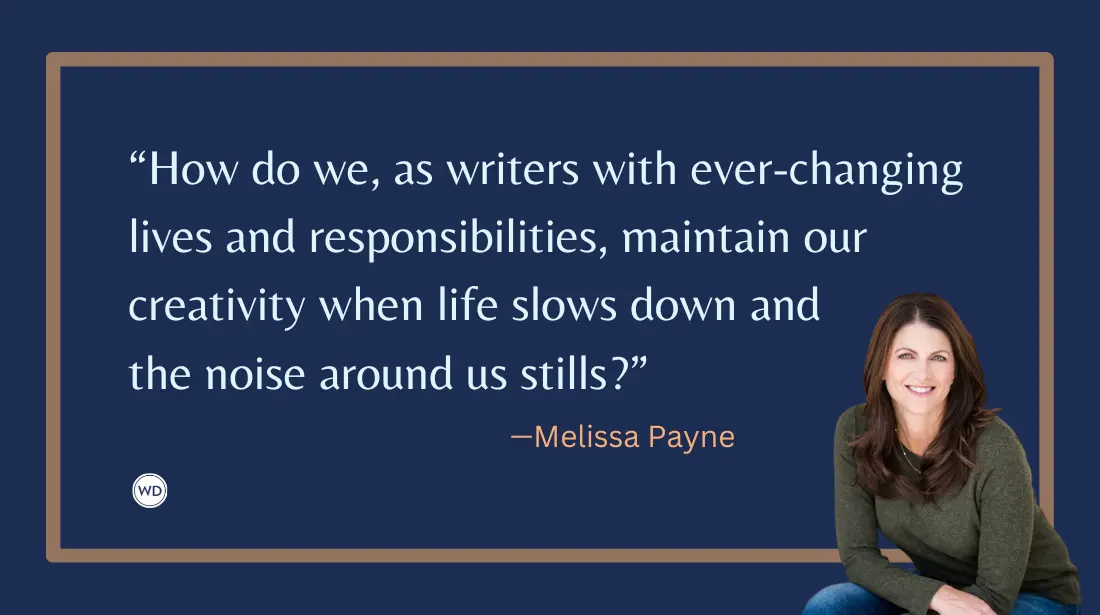
- The Weight of Endless Hours: Instead of inspiring boundless creativity, the vast expanse of empty time can feel intimidating and stark. The silence of an empty house lacks the energetic friction that previously sparked creative urgency.
- Grief for the Chaos: Writers frequently experience an unexpected wave of grief. They miss the bustling schedules, rushed dinners, noisy hallways, and the hyper-efficient bursts of writing achieved under pressure. The uninspired, sluggish drafting that emerges in the quiet office prompts serious self-reflection: Why is writing suddenly so difficult when the conditions are theoretically perfect?
Supporting Context & Metrics: The Psychology of Creative Friction
To contextualize the author’s struggle, it is helpful to examine broader psychological research concerning flow states, productivity, and the impact of life transitions on artistic output.
The Friction Hypothesis in Creative Production
Psychological studies on cognitive load and creative output suggest that total unstructured freedom can actually inhibit productivity—a phenomenon sometimes referred to as the paradox of choice.
- Constraint-Induced Productivity: Writers operating under strict time constraints benefit from artificial deadlines. When a writing session is limited to 40 minutes during a sports practice, the brain bypasses internal censorship and perfectionism, entering a rapid-fire flow state out of sheer necessity.
- The Void of Infinite Time: Conversely, when a writer faces an empty eight-hour workday, the cognitive load required to self-direct and manage that time increases exponentially. Without external friction or interruption to push against, the mind often wanders, leading to procrastination, self-doubt, and sluggish prose.
Mid-Life Transitions and Identity Realignment
The mid-career literary phase frequently coincides with major biological and psychological milestones—the empty nest syndrome and hormonal shifts associated with mid-life.
- The Identity Shift: For decades, an author’s primary identity may have been dual-tracked: parent/caregiver and writer. When the caregiving role recedes, a vacuum of identity forms.
- The Source of Narrative Material: Stories do not originate in vacuums; they are downstream products of human interaction, emotional friction, and shared experiences. When authors isolate themselves in pursuit of "the quiet life," they risk cutting off the primary supply chain of human observation and emotional data necessary for compelling storytelling.
Official Perspectives & Industry Insights
Industry veterans and literary community leaders increasingly recognize that the traditional image of the isolated genius working away in a garret is not only outdated, but counterproductive to sustainable long-term publishing careers.
Redefining the "Arrival" Point
Many contemporary authors argue against the concept of a definitive career destination. To feel that one has "arrived" implies stagnation—a dangerous state for any creative professional.
- Continuous Learning: Sustainable artistic careers depend on embracing a posture of perpetual beginnerhood. There is always a new narrative structure to master, a different demographic to reach, and evolving life experiences to translate onto the page.
- Deconstructing Isolation: Leading voices in the literary community emphasize that writing is fundamentally an act of communication. Therefore, retreating from the very community one seeks to address creates an artistic feedback loop that quickly grows stale.
Case Study: Community-Centric Creativity
A prime example of this philosophy in action is the pivot made by modern authors who reject solitary confinement in favor of collective engagement. Rather than spending isolated hours staring at a mountain view, many successful writers now deliberately curtail their desk time.
- Collaborative Outreach: Authors are increasingly stepping out of their home offices to co-create literary infrastructure. Initiatives such as the Mountain Stories Literary Festival in Colorado demonstrate how mid-career authors channel their energies into organizing regional events, leading craft workshops for youth and adults, and mentoring emerging voices.
- The Coffee Shop and Trail Economy: Modern writers frequently replace the silent home office with dynamic, shared environments—writing in bustling coffee shops alongside pets, holding collaborative writing sprints with peers, or integrating physical movement (hiking, fitness classes, swimming) into their daily routine.
Future Outlook: The Resilient Writer in a Changing World
As the publishing industry and the lives of individual authors continue to evolve, the future of mid-career writing points away from rigid isolation and toward integrated, community-rooted living.
Key Takeaways for the Evolving Author
- Embrace the Slices of Time: Authors should stop waiting for the mythical "perfect writing day." Creativity is a portable, flexible discipline that can be practiced in small increments anywhere, anytime.
- Prioritize Connection Over Isolation: Narrative depth requires oxygen, which is found in human relationships, community involvement, and shared experiences. Joining or leading writing groups, teaching classes, and participating in local arts organizations directly feeds creative output.
- Redefine Success: Move away from linear metrics of output volume or the romantic ideal of the solitary genius. True career longevity is rooted in adaptability, continuous personal growth, and the willingness to let life’s messiness inform the page.
Conclusion
Ultimately, the transition from the chaotic early years of writing to the quiet stillness of mid-life offers a profound lesson: there is no final arrival point in art or in life. By abandoning the pressure of the empty office and reconnecting with the vibrant, chaotic world outside, writers can unlock a renewed sense of purpose. Whether navigating the high-speed demands of youth or embracing the reflective calm of an empty nest, the formula for enduring creativity remains unchanged: live deeply, connect authentically, and write in all the spaces in between.


Comments
Facebook App ID not configured. Please add it in the Customizer.