As the United States approaches its 250th anniversary, the foundational narratives of the American Revolution are frequently revisited through the lens of modern historiography. Among the most enduring characters in this foundational drama are the "Hessians"—foreign auxiliary troops conjured in the American imagination as bloodthirsty, heartless mercenaries who crossed the Atlantic to crush an infant democracy for British gold.
However, a special historical report reveals that this popular depiction is largely a distortion. Roughly 30,000 German soldiers fought alongside British forces during the Revolutionary War, yet they were not technically mercenaries in the strict definition of the term. They were regular soldiers on loan from their sovereign princes under formal European subsidy treaties, and not all of them hailed from Hesse.
Far from being invincible supermen, these auxiliary troops were ordinary men swept up in geopolitical mechanics beyond their control. They endured a grueling, hellish ocean crossing, faced intense anti-foreign propaganda, participated in nearly every major military campaign of the war, and ultimately left a permanent demographic footprint. Millions of Americans today carry descendants of these German soldiers in their family trees, proving that the auxiliary deployment had a profound, if unintended, long-term impact on the very fabric of the new nation.
Detailed Chronology: From European Ports to the American Theater
The introduction of German troops into the North American theater was a gradual, highly calculated escalation by a frustrated British Crown seeking to decisively end a colonial insurrection.
Late 1775: The Crown Seeks Foreign Assistance
After more than a year of hostilities with colonial rebels intent on independence, British King George III reached a breaking point. In October 1775, the king announced his intent to quash the rebellion through "the most decisive exertions," adding that he had secured foreign assistance. Despite sharp opposition in Parliament, lawmakers backed the strategy, expecting the influx of manpower to quickly overwhelm the Continental Army.
Simultaneously, the Continental Congress and colonial leaders realized that the war was expanding beyond a domestic dispute. Colonial newspapers widely circulated news of the impending arrival of foreign troops, transforming public sentiment from a localized rebellion against parliamentary overreach into an existential fight against foreign invasion.
Spring 1776: The Hellish Atlantic Crossing
The first contingent of German auxiliary troops departed from the port city of Bremerlehe in mid-April 1776, stopping in Portsmouth before setting sail for North America on May 6. The Atlantic crossing was a nightmare of deprivation and disease.
Conscript soldier Johann Gottfried Seume detailed the brutal conditions in his memoirs, noting that men were packed so tightly into wooden bunks that they could only lie on their sides. On a designated command from the end of the row, the entire unit would flip over simultaneously to ease muscle fatigue. Rations were rotting: bacon featured black stripes and yellow centers, bread was infested with worms used as a substitute for fat, and drinking water smelled so foul that men had to hold their noses to swallow it.
August 15, 1776: Arrival at Staten Island
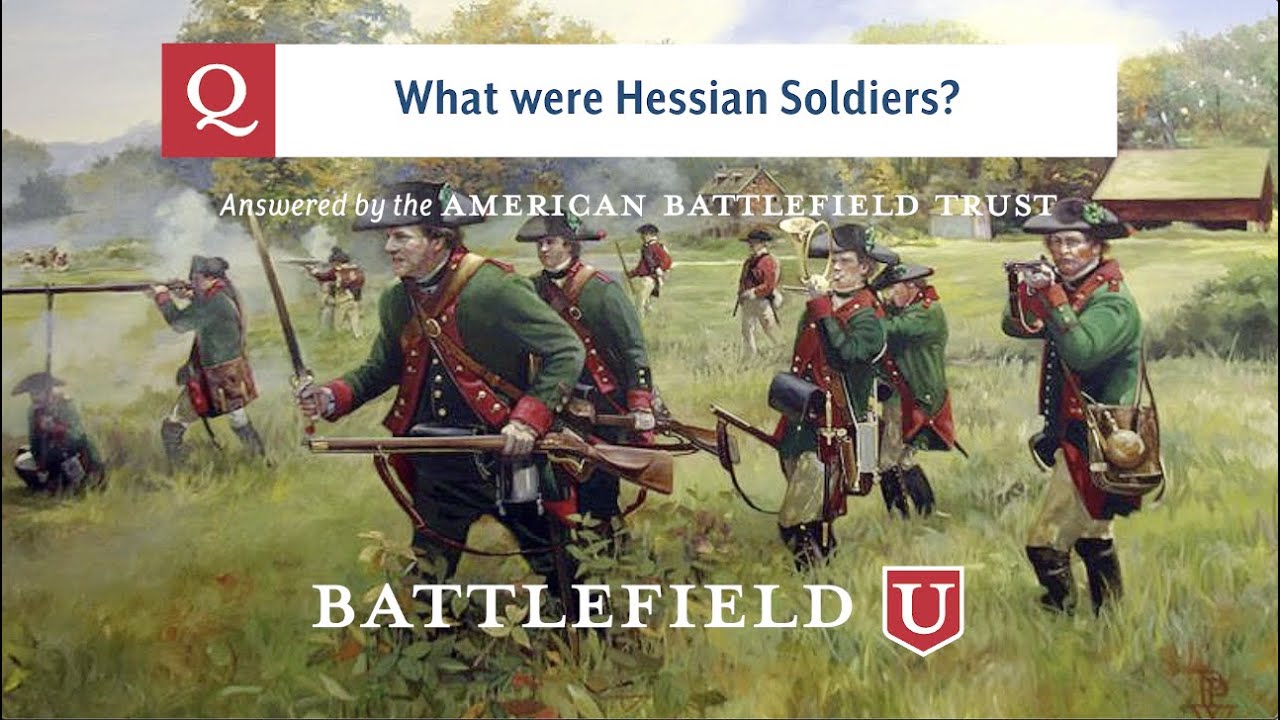
On August 15, 1776, a flotilla carrying more than 8,600 German soldiers arrived at Staten Island, New York. Unlike the iconic British redcoats, these troops wore striking blue or green coats, frequently accompanied by tall, pointy brass-fronted miter caps. Their arrival occurred just weeks after the adoption of the Declaration of Independence on July 4, 1776—a document that explicitly listed the deployment of "large armies of foreign mercenaries" as one of its primary grievances against King George III.
Late 1776: Combat and the Turning Point at Trenton
Immediately upon disembarking, British commander William Howe pressed the exhausted Germans into active duty. On August 22, British and German forces crossed the bay to Long Island. Five days later, a combined force of 20,000 troops (including 5,000 Germans) overwhelmed the Continental Army at the Battle of Long Island, forcing George Washington’s forces into a desperate retreat across the East River into Manhattan, and eventually through New Jersey into Pennsylvania.
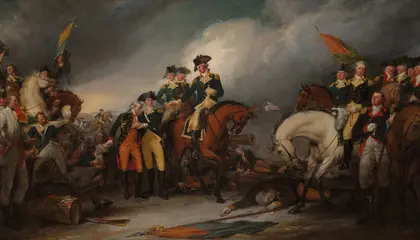
However, the aura of invincibility surrounding the Crown’s forces shattered on the night of December 25, 1776. Washington led his troops across the icy Delaware River to mount a surprise attack on the German garrison stationed in Trenton, New Jersey. Following a fierce two-hour engagement, the garrison surrendered, yielding close to 900 prisoners. The Battle of Trenton transformed the psychological trajectory of the war, proving that the Continental Army could successfully defeat professional European forces.
1777–1783: Protracted Campaign and Integration
Despite the American victory at Trenton, the conflict dragged on for another seven years, concluding with the Treaty of Paris in September 1783. German auxiliaries participated in virtually every major military campaign of the war. Over time, however, direct interaction softened American animosity. Colonists discovered that the Germans were often far more disciplined and humane than British regular forces, frequently offering kinder treatment to captured rebels than their British counterparts did.
Supporting Context & Metrics: Defining the "Hessians"
To accurately understand the role of German troops in the American Revolution, historians rely on demographic data, legal definitions, and geopolitical realities of 18th-century Europe.
The Mercenary Misconception
By strict definition, the German auxiliary soldiers were not mercenaries. Mercenaries are individual fighters who independently hire out their combat skills for personal financial gain. By contrast, the troops deployed to America were state-sponsored auxiliaries on loan from their reigning princes.
Great Britain signed formal subsidy treaties with six German principalities within the decentralized Holy Roman Empire, including Hesse-Cassel and Hesse-Hanau. The German rulers received cash subsidies and annual payments for the duration of the conflict. If troops were killed or wounded, the principalities were contractually obligated to provide replacements to maintain agreed-upon troop levels. Critics at the time denounced payments tied to casualties as "blood money," though the soldiers themselves were paid directly through British channels.
The Demographic Footprint
Historical analysis compiled by scholars such as Edward J. Lowell and modern historian Friederike Baer provides a clear picture of the human cost and demographic aftermath of the deployment:
Total German Troops Deployed: Approximately 30,000 soldiers.
Returned to Native Lands: Just over 17,300 soldiers.
Combat Fatalities: Roughly 1,200 men killed in action.
Non-Combat Fatalities: Nearly 6,400 men lost to disease, exposure, and accidents.
Deserters: Approximately 5,000 soldiers chose to leave service.
Permanently Settled in North America: Between 5,000 and 6,000 men, with up to 3,500 remaining in the United States and the remainder relocating to Canada.
Given these figures, modern genealogical research suggests that millions of contemporary Americans carry Hessian ancestry in their family trees.
Official Statements and Historical Perspectives
The deployment of foreign troops generated immense political rhetoric among the Founding Fathers, transforming hesitant moderates into ardent revolutionaries.
John Jay, who later served as the first Chief Justice of the United States, was initially a reluctant supporter of colonial separation who favored negotiation. The introduction of German troops catalyzed his ideological shift. In a widely distributed public address, Jay challenged the morality of the deployment:
"Why are the mercenaries of Germany transported near 4,000 miles to plunder your houses, ravish your wives and daughters?"
This sentiment was codified directly into the nation’s founding charter. The Declaration of Independence explicitly condemned the British monarch for utilizing foreign forces:
"He is at this time transporting large armies of foreign mercenaries to complete the works of death, desolation and tyranny, already begun with circumstances of cruelty and perfidy scarcely paralleled in the most barbarous ages…"
Conversely, General George Washington took a more pragmatic view of the auxiliary soldiers after observing their conduct on the ground. In a February 1777 letter, Washington remarked:
"One thing I must remark in favor of the Hessians, and that is, that our people who have been prisoners generally agree that they received much kinder treatment from them than from the British officers and soldiers."
Historian Friederike Baer, author of Hessians: German Soldiers in the American Revolutionary War, notes that contemporary propaganda weaponized the troops’ presence by spreading exaggerated myths—including rumors that the Germans were cannibals who ate babies—to rile up American men. In reality, Baer emphasizes, the soldiers were ordinary men who never anticipated that an overseas colonial conflict would endure for more than a year or two.
Future Outlook: Re-examining the Revolution in the 21st Century
As educational institutions, museums, and public historians prepare commemorative programs for the United States’ 250th anniversary, the narrative surrounding the Revolutionary War is increasingly embracing transnational perspectives.
The story of the German auxiliaries moves beyond outdated caricatures of Hessian villains, reframing the conflict as a global war with deeply human consequences. By analyzing the administrative mechanics of 18th-century European statecraft, the brutal realities of transatlantic military logistics, and the personal choices made by thousands of conscripts who chose to lay down their arms and build new lives in North America, modern scholarship provides a richer, more nuanced appreciation of America’s birth. The legacy of the German soldiers lives on not through the tyrannical subjugation intended by King George III, but through the quiet assimilation of thousands of immigrants who helped populate the developing American landscape.

/https://tf-cmsv2-smithsonianmag-media.s3.amazonaws.com/filer_public/15/6a/156a4923-bf80-47e0-8353-584546bf7130/hessians.png)
/https://tf-cmsv2-smithsonianmag-media.s3.amazonaws.com/accounts/headshot/greg2.png)
/https://tf-cmsv2-smithsonianmag-media.s3.amazonaws.com/filer_public/15/6a/156a4923-bf80-47e0-8353-584546bf7130/hessians.png)
/https://tf-cmsv2-smithsonianmag-media.s3.amazonaws.com/filer_public/0e/80/0e80db64-b989-4e83-80ed-6e306678c4d4/gettyimages-1397980674.jpg)
/https://tf-cmsv2-smithsonianmag-media.s3.amazonaws.com/filer_public/38/a7/38a79759-383b-4869-bf46-c6f855ad30df/compleat.jpg)
/https://tf-cmsv2-smithsonianmag-media.s3.amazonaws.com/filer_public/cf/14/cf14d00d-fa37-4406-8eb7-00a46f9e314d/johanngottfriedseume_frommeyersgroschenbibliothek.png)
/https://tf-cmsv2-smithsonianmag-media.s3.amazonaws.com/filer_public/34/d2/34d2d403-ec4f-4001-a857-090886ae1d34/johann_koch.png)




Comments
Facebook App ID not configured. Please add it in the Customizer.