
Executive Overview
The final American military personnel stationed in Iraq have formally packed their gear and departed, closing the book on an entanglement that spanned more than two decades. This historic departure arrives 23 years after the United States launched its initial invasion to topple Saddam Hussein, and 12 years after a smaller contingent returned to beat back the territorial expansion of the Islamic State (IS).
While the ultimate departure was executed quietly—the result of a phased drawdown meticulously negotiated by the Biden administration—its geopolitical fallout promises to reverberate across the Middle East for generations. What began in 2003 as a muscular, ambitious campaign to reshape the architecture of the Middle East through the "War on Terror" concludes with a muted, low-key logistical exit.
More critically, the vacuum left by the departure of Western forces has raised profound strategic anxieties. As Washington closes this chapter, the primary beneficiary of America’s two-decade-long investment of blood and treasure appears to be its principal regional rival: Iran. With US troops gone, Tehran and its formidable network of domestic proxies are well-positioned to expand their dominance over the Iraqi state, leaving ordinary citizens to grapple with the sobering realization that military might does not automatically translate into lasting political supremacy.
Read Also
Detailed Chronology: Two Decades of Conflict, Withdrawal, and Return
To understand the weight of the current exit, one must trace the winding, often tumultuous trajectory of American involvement in Iraq through distinct historical phases:
1. The 2003 Invasion and the Fall of the Baathist Regime
In March 2003, a US-led coalition spearheaded by the Bush administration invaded Iraq under the banner of eliminating weapons of mass destruction and liberating the Iraqi populace from the authoritarian grip of Saddam Hussein. The conventional military phase was swift; Baghdad fell within weeks, and the Baathist regime collapsed.
However, Washington drastically underestimated the complexities of post-war nation-building. The abrupt dissolution of the Iraqi military and the de-Baathification policies initiated by the Coalition Provisional Authority created a massive security vacuum. This environment quickly metastasized into a brutal, multi-sided insurgency and sectarian civil war that consumed tens of thousands of lives and bogged down American forces in a costly counterinsurgency campaign.
2. The 2011 Withdrawal and the Rise of ISIS
By late 2011, following years of intense public weariness and mounting casualties, the Obama administration oversaw the complete withdrawal of US combat troops from Iraq. The political leadership in Washington heralded the move as the fulfillment of a campaign promise to end the war.
However, the departure of American forces coincided with the sectarian policies of then-Prime Minister Nouri al-Maliki, which systematically alienated Iraq’s Sunni population. This internal instability provided fertile ground for the resurgence of extremist elements. Out of the ashes of Al-Qaeda in Iraq emerged ISIS—a hyper-violent, radical jihadist movement that rapidly swept across vast swaths of Syrian and Iraqi territory, declaring a transnational caliphate by the summer of 2014.
3. The 2014 Return: Operation Inherent Resolve
Faced with the shocking collapse of the Iraqi security forces and the horrific atrocities committed by ISIS, the United States was forced to reverse course. In 2014, Washington formed a global coalition to launch Operation Inherent Resolve.
Rather than deploying hundreds of thousands of combat boots on the ground as seen in 2003, this second intervention relied heavily on air power, intelligence sharing, logistics support, and embedded special operations advisors working alongside Iraqi security forces and Kurdish Peshmerga fighters. Over the subsequent decade, this campaign systematically degraded the Islamic State’s territorial control, culminating in the military defeat of its territorial caliphate, though clandestine cells continue to pose residual threats.
4. The Phased Drawdown and Final Exit
In the years following the territorial defeat of ISIS, the political landscape in Baghdad shifted. Successive Iraqi governments faced mounting domestic pressure from populist factions—particularly those aligned with neighboring Iran—to demand the expulsion of foreign troops.
Recognizing the changing strategic realities and the diminishing returns of a permanent footprint, successive US administrations gradually reduced the American military footprint. This phased drawdown, finalized under the Biden administration, culminated today with the formal departure of the last remaining US service members, effectively drawing the curtain on 23 years of direct military engagement.
Supporting Context & Metrics: The Human and Strategic Toll
The legacy of America’s two-decade involvement in Iraq cannot be separated from the staggering human, financial, and geopolitical costs incurred along the way.
Casualties and Human Cost
- American Lives Lost: Over 4,500 US service members lost their lives in Iraq across both the post-2003 invasion and the subsequent anti-ISIS campaign, with tens of thousands more returning home bearing severe physical and psychological scars.
- Iraqi Civilian Toll: While precise figures remain fiercely debated, independent monitoring groups estimate that hundreds of thousands of Iraqi civilians have died directly or indirectly as a result of the violence unleashed since 2003.
- Displacement: Millions of Iraqis have been internally displaced or forced into foreign exile over the past twenty years, fracturing communities and straining regional infrastructure.
The Geopolitical Pivot Toward Tehran
While the US military focused on counterinsurgency and counterterrorism, Iran systematically executed a long-term strategy to cement its influence within Iraq’s emerging political and security structures. Historically, Tehran and Baghdad were bitter enemies, a reality tragically underscored by the devastating Iran-Iraq War of the 1980s under Saddam Hussein.
However, the American-led removal of Hussein effectively eliminated Iran’s primary regional antagonist and paved the way for Tehran to expand its reach:
- Political Integration: Tehran forged deep alliances with prominent Iraqi political figures, including figures associated with the Badr Organization—such as Hadi al-Amiri—whose political wings now hold immense leverage within the Iraqi parliament.
- Paramilitary Proxies: Iran actively funded, armed, trained, and integrated numerous Shiite paramilitary groups under the umbrella of the Popular Mobilization Forces (PMF), transforming them into institutionalized actors within the Iraqi state apparatus.
- Soft Power and Economic Dominance: Beyond military clout, Iran poured hundreds of millions of dollars into commercial ventures, energy dependency (supplying crucial electricity and gas to Iraq), and the expansion and management of sacred Shiite pilgrimage sites in cities like Karbala and Najaf.
Official Statements and On-the-Ground Realities
The finality of the US withdrawal has prompted sharply divergent reactions from regional stakeholders, reflecting the deep anxieties and opportunistic triumphs characterizing the post-American Middle East.
The View from Tehran and Its Proxies
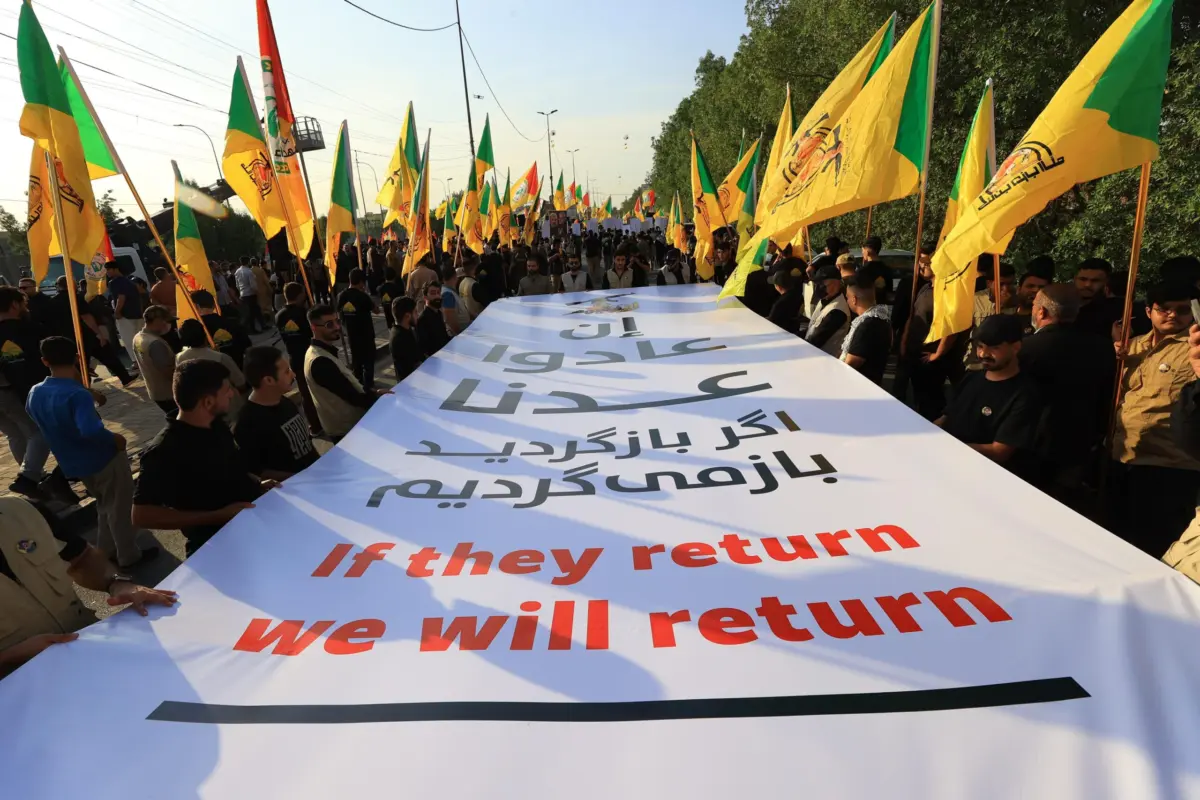
Unsurprisingly, Iran and its allied factions have openly celebrated the American departure, framing it as an unambiguous victory for their regional security vision. The commander of a prominent Iranian-backed militia in Iraq did not mince words, labeling the US withdrawal “a crushing defeat for the American project.” To Tehran, the exit validates a patient, attritional strategy designed to expel Western influence from the Persian Gulf and assert undisputed regional hegemony.
Anxiety Among the Iraqi Populace
In stark contrast to the celebratory rhetoric emanating from militia headquarters, ordinary citizens and independent observers on the ground in Baghdad and other urban centers express deep apprehension. Interviews conducted by international correspondents reveal a pervasive fear that the departure of American forces removes the final check on total domination by armed, Iran-linked factions.
As one local resident somber remarked to reporters, there is a mounting terror that the country “could be swallowed up” by powerful non-state actors operating outside the direct accountability of the central government.
The Iraqi Government’s Tightrope
The vulnerability of the Iraqi state is further illustrated by its internal policy struggles. Notably, the Iraqi government recently pushed back its self-imposed deadline for various Iran-backed militia factions to officially disarm and integrate fully under state command—a deadline that was originally scheduled to coincide precisely with the final date of the US withdrawal. This postponement underscores the deep structural weakness of Prime Minister Mohammed Shia’ al-Sudani’s administration in reigning down heavily armed factions that possess parallel loyalties to foreign capitals.
Future Outlook: Lessons Learned and the Limits of Power
As the dust settles on the final American convoy leaving Iraqi soil, policymakers and defense analysts in Washington are forced to confront a sobering post-mortem of the entire enterprise.
The Limits of Military Supremacy
The overarching takeaway from the two decades in Iraq is a stark reminder of the intrinsic limits of hard military power. The United States repeatedly demonstrated its unmatched capacity to win conventional battles, overthrow hostile regimes, and dismantle terrorist safe havens through sheer technological and tactical superiority.
Yet, translating military victory into durable, friendly, and self-sustaining political outcomes proved to be an entirely different, highly elusive endeavor. Nation-building cannot be imposed overnight through force of arms, particularly in deeply fractured sectarian societies with complex historical grievances.
The Threat of the Long Game
Furthermore, the Iraq saga highlights the danger of asymmetrical competition against resilient rivals. While American foreign policy has historically oscillated based on shifting domestic political cycles, regional adversaries like Iran have demonstrated a willingness and capacity to play the long game. By digging in deep, cultivating local networks, and patiently outwaiting the American commitment, Tehran has positioned itself to capitalize on Washington’s eventual fatigue.
Ultimately, the final US withdrawal from Iraq closes a turbulent, painful chapter in contemporary military history. Whether this exit marks a step toward genuine Iraqi sovereignty or merely the dawn of a new era of unchallenged regional hegemony by Tehran remains the defining question for a nation that has endured more than twenty years of relentless transformation.





Comments
Facebook App ID not configured. Please add it in the Customizer.