
Executive Overview
In the contemporary literary landscape, few speculative fiction authors navigate genre boundaries with the fluid versatility of Mike Chen. A New York Times, USA Today, and Publishers Weekly bestselling author, Chen has built a remarkable career by refusing to be tethered to a single sandbox. Whether he is exploring the agonizing aftermath of temporal displacement in Here and Now and Then, examining the fragile human connections forged six years after a devastating pandemic in A Beginning at the End, pairing a weary superhero with a supervillain in an anonymous support group in We Could Be Heroes, or upending tired tropes in the vampire subgenre with Vampire Weekend, Chen’s literary portfolio is unified by one constant: an unshakeable devotion to character-driven storytelling, emotional resonance, and a relentless curiosity powered by the ultimate narrative catalyst—the "what if?" question.
This profile examines Chen’s trajectory from an aspiring comic strip creator and fan-fiction enthusiast to an industry powerhouse with deep-seated ties to massive intellectual properties (IPs) like Star Wars and Marvel’s What If…? series. Drawing from an extensive interview, this piece analyzes his structural, engineer-driven writing methodologies, his strategies for translating complex scientific theories into relatable narrative frameworks, and his upcoming transition into gothic horror. Through it all, Chen remains a steadfast advocate for perseverance in the arts, offering a masterclass in how modern authors can successfully pivot across genres while maintaining a distinct, deeply empathetic voice.
Detailed Chronology: From 1980s Anime Fandom to Bestselling IP Integration
Chen’s literary DNA was forged long before he ever secured a traditional book contract. Growing up immersed in the science fiction and anime of the 1980s—most notably Tatsunoko Production’s landmark franchise Robotech—Chen utilized early creative outlets not to build complex world systems from scratch, but to explore the intimate human spaces resting quietly between massive, world-altering events.
Read Also
The Early Sandbox: Fan Fiction and Comic Strips
Long before he penned prose, Chen drew comic strips. He found himself perpetually fascinated by the downtime of genre fiction characters: What are they discussing in the mess hall before a major fleet engagement? How do they decompress while repairing bulkheads after a battle?
When asked about the developmental value of engaging in fan work early in a writer’s journey, Chen’s advice to aspiring college and high school students is definitive: go write fan fiction.
"The whole point of it is you have the sandbox built for you," Chen explains. "You don’t have to come up with who are the characters, what are their motivations, what’s the technology, what’s the magic system? You just say, ‘I want this character to meet this character in this place for this reason,’ and then you can play it out."
This early foundation allowed Chen to experiment freely with psychological beats, character interactions, and dialogue pacing without the cognitive load of ground-up worldbuilding. Even today, he uses similar mental sandbox exercises to stress-test action choreography or weapon logistics by pulling established elements from video game franchises like Mass Effect, playing out the mechanics internally before translating them to original prose.
Breaking into Corporate IP: The Star Wars and Marvel Pipeline
Transitioning from independent original fiction to writing within multi-billion-dollar intellectual properties requires a delicate blend of networking, strategic timing, and proof of reliability. For Chen, landing official tie-in projects with Lucasfilm (Star Wars) and Marvel (What If…?) was an organic extension of his professional reputation and a carefully calculated public campaign.
When Chen first signed with his literary agent, he made his ambitions explicit: he wanted to write a Star Wars novel, specifically targeting the prequel and Clone Wars eras. Through targeted networking, recommendations from fellow authors such as Delilah Dawson, Chuck Wendig, and Rebecca Roanhorse, and consistent introductions by his editorial team at Del Rey (now Random House Worlds), Chen steadily built industry awareness.
The pivotal moment arrived when Marvel star Simu Liu publicly "shot his shot" to secure the role of Shang-Chi, sparking a viral social media trend under the hashtag #ShootYourShot. Prompted by peers who recognized an opportune moment, Chen unleashed a massive, highly structured thread of narrative pitches on Twitter (now X).
[Agent Networking & Reputation] + [Peer Advocacy & Vouching] + [Public Strategic Pitching] = IP AcquisitionThe thread caught the attention of key decision-makers at Lucasfilm and Del Rey, cementing his reputation not only as an author intimately knowledgeable of canon lore, but as a professional capable of handling strict corporate guidelines and accelerated publishing turnarounds.
Supporting Context & Metrics: The Engineering Mindset Behind the Prose
Behind Chen’s whimsical narratives and emotional character arcs lies a distinctly analytical framework. Holding an engineering degree, Chen approaches novel construction with the precision of a structural architect.
The Spreadsheet and the Skeleton
Chen’s drafting process is methodical, structured, and heavily reliant on data organization:
- Macro-Level Synopsis: He begins with a comprehensive overarching synopsis, breaking the narrative down into 25-percent act segments.
- Granular Sequencing: Narrative beats are translated into sentence- or paragraph-level chapter segments and exported into a master spreadsheet.
- POV Assignment: Point-of-view (POV) characters are assigned based on physical presence and, most importantly, who undergoes the most profound internal transformation during that specific sequence.
- The Three-Pass Drafting Method:
- Phase 1 (The Skeleton): Pure dialogue and stage directions.
- Phase 2 (Prose Infusion): Building out the narrative prose and atmospheric texture.
- Phase 3 (Detail Polish): Refining scientific explanations, pacing, and emotional tension.
Bridging the Knowledge Gap: Hard Science vs. Accessibility
One of the most persistent hurdles for emerging science fiction and fantasy writers is the "infodump"—the tendency to front-load the first two chapters with dense worldbuilding mechanics and exposition. Chen advises against this instinct entirely.
"I see it in a lot of newer writers in science fiction or fantasy—they will try to put all their mechanics in the first two chapters of the book to explain everything. I’m constantly telling people that you don’t need to do that," Chen notes.
Instead, Chen catalogs all necessary scientific or temporal mechanics in his master spreadsheet, doling them out chapter by chapter based on immediate narrative necessity. For instance, in his debut novel Here and Now and Then, the fundamental question—is time travel governed by magic or science?—must be answered immediately because it dictates the operational physics of the plot. However, subsequent complexities are paced out organically, anchored by a core philosophy: consistency breeds comprehension. If the underlying rules remain simple, logical, and consistent, the reader will readily follow the science.
Official Statements and Industry Insights
In conversation, Chen remains remarkably candid about the realities of traditional publishing, editorial collaboration, and creative burnout.
On Letting Go of Creative Control
Early in his career, Chen learned vital lessons regarding title changes and editorial intervention. His post-apocalyptic novel A Beginning at the End was originally titled The Pause—conveying a world that paused rather than ended. Released in January 2020, just weeks before the global COVID-19 pandemic paralyzed society, the title choice proved to be an unintended masterclass in timing and adaptation.
Reflecting on editorial changes, Chen embraces a collaborative ethos:
"That was a real big learning experience in just letting go and trusting the professionals. And it became easier between that and then more editorial stuff where I’m just like, you guys are probably right. It’s fine. Even if I feel inner resistance, I’m just assuming that other people are smarter than me."
On Avoiding Subgenre Piegonholing
Having written about time travel, post-apocalyptic survival, superheroes, vampires, and deep-space political intrigue, Chen consciously avoids being typecast. When readers asked why he did not simply write a second time-travel book after his debut, Chen’s response was definitive:
"No, I don’t want to just be the time travel guy! I made this joke—it’s like a dartboard of subgenres, and I just want to hit a different one every time before I start to repeat myself."
Future Outlook: Gothic Horror and the Infinite Rolls of the Dice
Chen shows no signs of slowing down his cross-genre exploration. Looking ahead, the author is currently completing the final prose polish on a long-awaited entry into his writerly bucket list: gothic horror.
Entering the Haunted House
Having spent years analyzing the psychological dread of classic literature like Shirley Jackson’s The Haunting of Hill House, Chen is venturing directly into the haunted house subgenre. However, he candidly shares the psychological peculiarities of late-stage manuscript editing:
"I am finding that I actually have to kind of get myself through this… I’m doing that final prose polish before I send it to my editor. When I’m reading it I know that mechanically, there’s plenty of tension here, but I don’t feel tension in it. Did I get it all wrong?"
Conversations with fellow author Delilah Dawson provided much-needed perspective: You haven’t written a bad book; you’ve simply read your own horror manuscript twenty times. You are currently more scared of your editor than you are of the haunting.
A Final Word of Encouragement for Aspiring Writers
For writers navigating the daunting query trenches, Chen offers a grounded, pragmatic philosophy backed by industry longevity:
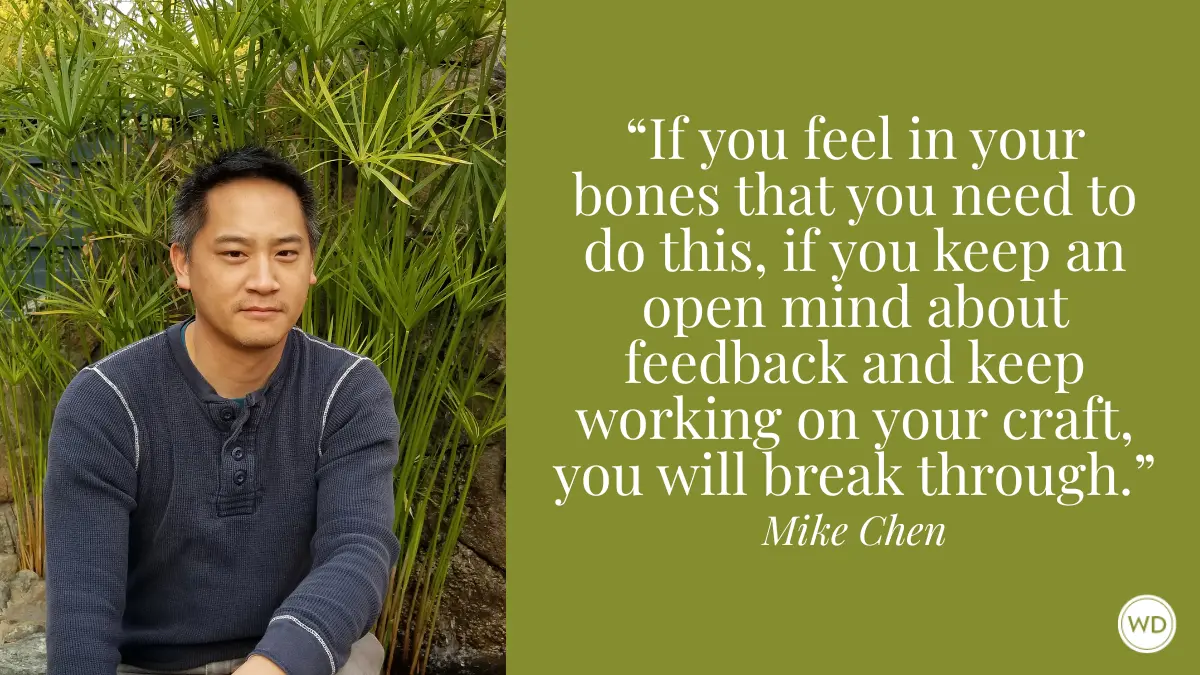
"Don’t give up. I know that’s trite, but I want to back it up with everyone I know who has not given up, who has wanted it enough, got an agent and sold… You’re rolling the dice, but you have unlimited rolls. You will eventually hit your 20."
As Mike Chen continues to throw literary darts across speculative fiction’s vast board—transforming space operas, temporal assassinations, and haunted manors into examinations of human empathy—his trajectory remains a testament to the power of curiosity, structural discipline, and unyielding creative endurance.



Comments
Facebook App ID not configured. Please add it in the Customizer.