

In the realm of contemporary children’s literature and biographical nonfiction, few works bridge the gap between personal tragedy and global human rights advocacy quite like Postcards from Malcolm X: How Yuri Kochiyama Became a Human Rights Activist. Written by acclaimed author Mia Wenjen, with evocative illustrations by Keith Henry Brown and published by Red Comet Press, this 42-page biographical picture book has captured the attention of critics and educators alike. Most recently, the book received a glowing, star-worthy appraisal from Publishers Weekly, reinforcing its critical standing alongside prior enthusiastic notices from Kirkus Reviews and the School Library Journal.
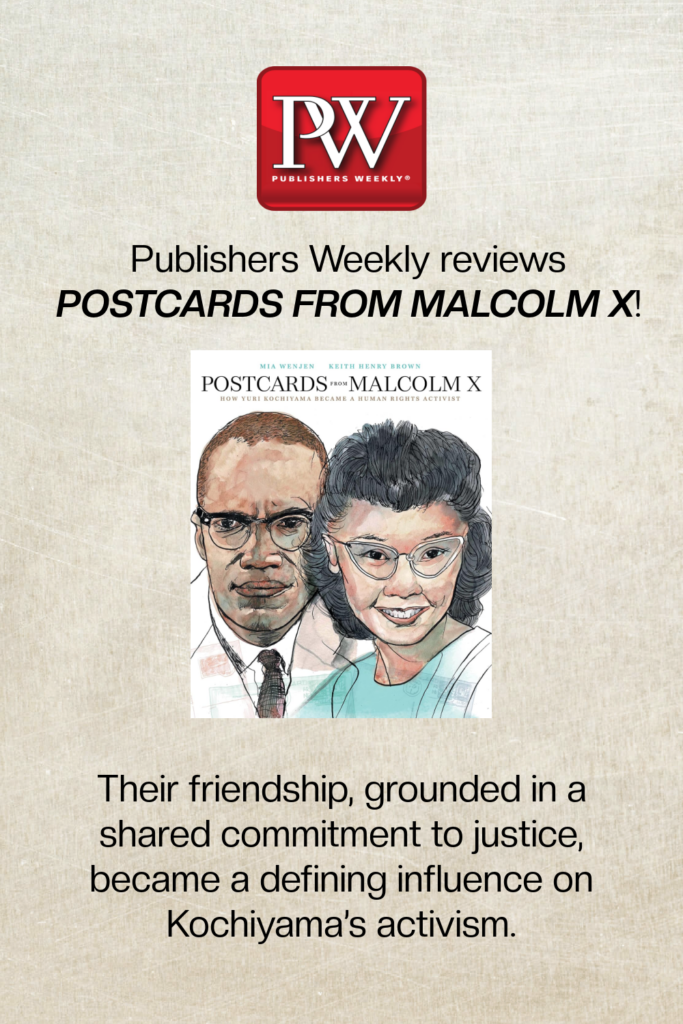
Aimed at readers ages 8 to 12, Postcards from Malcolm X explores the formative experiences of Japanese American activist Yuri Kochiyama (1921–2014). The narrative meticulously details how a quiet, personal tragedy evolved into a lifelong crusade for social justice. From her initial encounters with systemic injustice during World War II to her legendary, deep-rooted friendship and correspondence with Malcolm X in Harlem, Kochiyama’s life is presented as an accessible, energetic portrait of resilience. This feature-length article provides a comprehensive look at the book’s thematic resonance, historical context, critical reception, and broader place within Mia Wenjen’s impressive catalogue of multicultural children’s literature.
Detailed Chronology: The Evolution of an Activist
To understand the emotional and historical weight of Postcards from Malcolm X, one must trace the chronological milestones that defined Yuri Kochiyama’s journey from a sheltered youth to a towering figure of 20th-century intersectional activism.
Read Also

Early Life and the Catalyst of Injustice
Born in 1921, Yuri Kochiyama experienced a profound paradigm shift at the age of 20. In the turbulent aftermath of the 1941 bombing of Pearl Harbor, her father was wrongfully arrested and imprisoned by the U.S. government. The severe physical and emotional toll of this incarceration ultimately led to his death shortly after his release.

As Wenjen’s stirring biography outlines, witnessing this state-sanctioned injustice forced young Yuri to "see the world in a different way and vow to fight against hatred." Following Executive Order 9066, which forced the mass incarceration of Japanese Americans, Kochiyama and her family were sent to an American concentration camp.

The Lifeline of Stationery
Confined behind barbed wire, Kochiyama discovered a vital tool for survival and resistance: the written word. Packing stationery, envelopes, and stamps as essential items, she realized that "letters were her lifeline." In the face of profound isolation, correspondence became her primary vehicle for protest, human connection, and planting the seeds for systemic change. This motif of written communication forms the structural and emotional core of Wenjen’s book, directly inspiring its titular focus on postcards and letters.

Harlem, Coalition Building, and the Meeting with Malcolm X
Following the conclusion of World War II, Kochiyama married and eventually settled in Harlem, New York. Immersing herself in the local community, she and her family expanded their activism, joining demonstrations alongside Black and Puerto Rican workers fighting for labor rights, housing equity, and civil liberties.

A pivotal turning point occurred during a civil rights protest, which resulted in Kochiyama’s arrest. Taken to a Brooklyn courthouse, she crossed paths with Malcolm X. This brief encounter blossomed into a profound, intellectually and politically charged correspondence that endured throughout Malcolm X’s travels overseas in 1964. Their bond, forged in the fires of shared struggle and mutual respect for international liberation movements, permanently altered the trajectory of Kochiyama’s life work, cementing her status as a bridge-builder between Asian American, Black, and global anti-imperialist liberation struggles.
Supporting Context & Metrics: Book Specifications and Critical Reception
Postcards from Malcolm X is designed as an educational and artistic artifact, pairing rigorous historical research with evocative visual storytelling.

Publication and Physical Specifications
- Postcards from Malcolm X: How Yuri Kochiyama Became a Human Rights Activist
- Author: Mia Wenjen
- Illustrator: Keith Henry Brown
- Publisher: Red Comet Press
- Publication Date: October (Fall List)
- Target Audience: Ages 8–12 (Grades 3–7)
- Page Count: 42 pages
- Price: $24.99 Hardcover
- ISBN-13: 978-1-63655-089-3
Critical Consensus
The publishing industry has responded to the release with widespread critical acclaim:
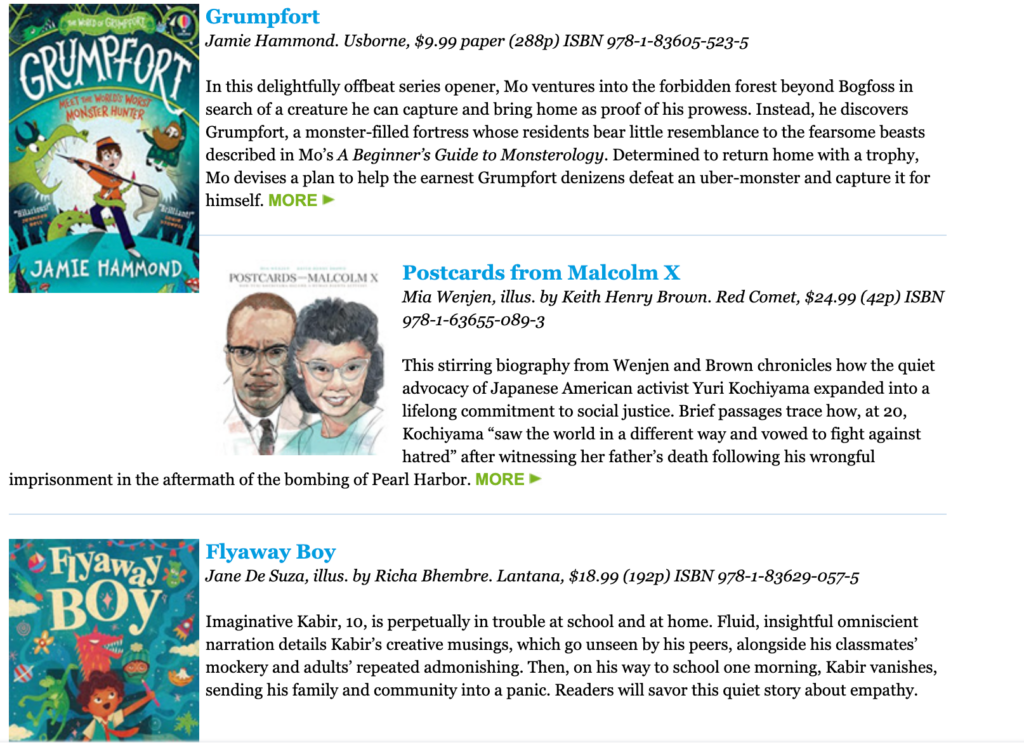
- Publishers Weekly: Praised the book as an "approachable and energetic portrait of an activist," noting how the conversational prose and loose ink-and-watercolor artwork capture the warmth of the bond between Kochiyama and Malcolm X. Reviewers also highlighted the extensive back matter, which provides young readers with deep historical context.
- School Library Journal & Kirkus Reviews: Both publications have lauded the title for bringing intersectional history to middle-grade readers, validating the book’s educational utility in modern classrooms.
Official Statements and Artistic Vision
The creative synergy between author Mia Wenjen and illustrator Keith Henry Brown is central to the book’s success. Through interviews, book trailers, and promotional materials, the creators have emphasized the deliberate choices made to bring Kochiyama’s story to a younger generation.
The Author’s Intent
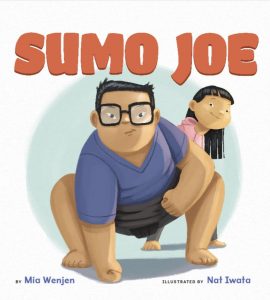
Mia Wenjen, known for her dedication to multicultural children’s books and diverse narratives (including Barbed Wire Between Us, Fortune Cookies for Everyone!, and We Sing from the Heart), has repeatedly stressed the importance of teaching children about cross-cultural solidarity. By focusing on Kochiyama’s reliance on letters during her incarceration and her later alliances in Harlem, Wenjen demonstrates that activism does not require a megaphone; it can begin with empathy, active listening, and a pen.

The Illustrator’s Approach
Keith Henry Brown’s artwork utilizes a loose ink and watercolor medium. This stylistic choice deliberately avoids rigid, sterile historical depictions, infusing the pages with an organic warmth, emotional accessibility, and vibrant energy. The illustrations visually translate the intimacy of written correspondence, making the historical figures feel immediate, relatable, and human to young readers navigating their own understanding of fairness and justice.
Future Outlook: Educational Impact and Related Works
As Postcards from Malcolm X finds its place on library shelves, school reading lists, and independent bookstore displays, its long-term impact on youth civic education promises to be substantial. The inclusion of extensive back matter ensures that the book functions not merely as a narrative story, but as a gateway to deeper historical inquiry.

Expanding the Canon of Social Justice Literature
Postcards from Malcolm X joins a robust ecosystem of socially conscious literature created by Mia Wenjen. Readers inspired by Kochiyama’s story can explore complementary themes across Wenjen’s broader bibliography:

- Barbed Wire Between Us (illustrated by Violeta Encarnación): Further explores the historical trauma and resilience of Japanese Americans facing wartime incarceration.
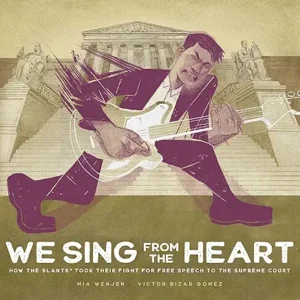
- We Sing from the Heart: How the Slants® Took Their Fight for Free Speech to the Supreme Court: Chronicles modern legal battles for civil liberties and freedom of expression.
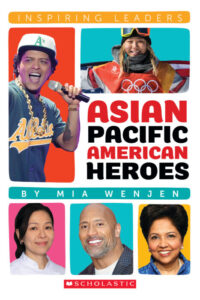
- Changing the Game: Asian Pacific American Female Athletes: Highlights trailblazing women who reshaped cultural boundaries.
Educator Resources and Community Engagement
To maximize the book’s utility in classrooms and homeschool environments, Red Comet Press and the author have rolled out multimedia promotional assets, including an official book trailer, unboxing videos, and author Q&As. These resources empower educators to facilitate nuanced discussions about civil rights, systemic oppression, and the power of cross-cultural coalition building.
In an era where the teaching of complex history is heavily scrutinized, Postcards from Malcolm X stands as a beacon of integrity, empathy, and historical truth. By illuminating the extraordinary life of Yuri Kochiyama, Wenjen and Brown offer young readers an invaluable blueprint for turning personal grief into collective hope, proving that words—whether written on a postcard or shouted from a march—can indeed change the world.





Comments
Facebook App ID not configured. Please add it in the Customizer.