For decades, Lucy Sante has occupied a towering position in the cultural landscape as one of America’s most incisive essayists, photography theorists, and chroniclers of urban subterranean life. Through seminal works like Low Life: Lures and Snares of Old New York (1991), Evidence (1992), Walker Evans (1999), and her recent deeply personal 2024 memoir I Heard Her Call My Name: A Memoir of Transition, Sante established an authoritative voice defined by intellectual rigor, historical depth, and an unwavering gaze toward the vernacular.
Yet, long before her prose graced the pages of premier cultural journals or won critical acclaim, Sante was assembling fragments of paper. Working quietly alongside her literary output, her visual art—specifically her intricate, evocative collages—has formed a parallel shadow-career. Recently, this hidden practice has stepped into the spotlight, highlighted by major solo exhibitions this past spring at Picture Theory in Chelsea and the American Academy of Arts and Letters in upper Manhattan.
Tracing Sante’s creative trajectory reveals that collage is not a secondary hobby, but the foundational impulse of her artistic life. From cutting up magazines as an immigrant teenager in the 1960s to sourcing vintage ephemera from the chaotic underbelly of the pre-gentrified Lower East Side, her visual output shares the same DNA as her writing: an obsession with the overlooked, the discarded, and the phantom narratives embedded within the physical artifacts of the past. As Sante prepares for the release of her upcoming 2026 essay collection, My Heart & Agree, her recent resurgence in the fine-art world prompts a profound reevaluation of her multimedia contributions to modern culture.
Detailed Chronology: From Magazine Clippings to Fine-Art Acclaim
The Formative 1960s: Emigration and Early Influences
Sante’s encounter with collage began in earnest during her youth as an immigrant in the 1960s. Armed with an X-Acto knife and an insatiable appetite for visual culture, she found her early materials in two primary domestic archives: a stack of 1950s and early-1960s Arizona Highways magazines and her parents’ subscription to Life.
During this period, her teenage experiments were heavily informed by the popular media of the counterculture. She absorbed the visual language of underground graphics, mimicking the psychedelic, hybrid aesthetics popularized by designers like Wilfried Sätty in the early editions of Rolling Stone. At the same time, Sante developed an enduring aesthetic reverence for the metaphysical juxtapositions of fellow Belgian René Magritte, whose deadpan surrealism planted the seeds for her own idiosyncratic visual collisions.
The Lower East Side and the Strand Bookstore (1970s–1980s)
By the 1970s, Sante had embedded herself in the gritty, fiercely independent bohemian community of New York City’s Lower East Side. This era provided both a physical sanctuary and an unending stream of raw material.
During a stint working at the legendary Strand Bookstore, Sante was appointed by the iconic owner Fred Bass as the entirety of the shop’s paperback department. While the role involved the tedious chore of managing weekly onslaughts of romance novels for eager bargain hunters, it also came with a phenomenal perk. Whenever the store acquired private libraries, Sante was handed everything that wasn’t a hardcover book—magazines, technical manuals, maps, medical textbooks, and arcane ephemera. She carted these treasures home by the bagful, establishing a vast private archive that she continues to mine for her art today.
This ecosystem of downtown New York was uniquely fertile. As Sante recalls of the cultural milieu:
"Nobody was very literary on the Lower East Side in the ’70s. People were starting bands and making movies… You could waltz into New York City hitchhiking from Denver or somewhere and find yourself a cheap apartment and get a job at the Strand. Your salary would pay your rent, and you had money left over to go clubbing."
Amid this scene, Sante designed flyers for local bands, including the Del-Byzanteens—a legendary downtown art-punk ensemble for which she wrote lyrics. The band’s roster read like a roll call of future avant-garde luminaries, featuring filmmaker Jim Jarmusch, painter Jamie Nares, and composer Phil Kline.
Transition to Academia and the Return to Visuals
For decades, Sante dedicated the lion’s share of her professional energy to writing and academia. She spent years sharing her vast knowledge as a professor of writing and the history of photography at Bard College, a post from which she officially retired in 2023.
While her pen remained active—culminating in critical masterpieces and essay collections—her tactile craving for physical art-making never truly vanished. In recent years, Sante deliberately re-channeled her creative energies back into visual media. This renewed focus culminated in critically praised solo exhibitions: a retrospective display bridging her early 1970s works with pieces made after 2020 at the American Academy of Arts and Letters, alongside a concurrent showcase at Picture Theory in Chelsea.
Supporting Context & Metrics: The Anatomy of a Masterpiece
To understand Sante’s visual methodology is to examine her relationship with texture, colorblindness, and the historical weight of paper.
Navigating Limitations
Because Sante is colorblind, traditional painting presented a frustrating hurdle in her youth. Restricted largely to black-and-white drawing, she found her true chromatic and structural salvation in the prefabricated hues of vintage print media. Faded inks, yellowed newsprint, and desaturated advertisements provided a sophisticated, ready-made palette that bypassed her physiological constraints while offering rich layers of texture.
The Architecture of De La (2023)
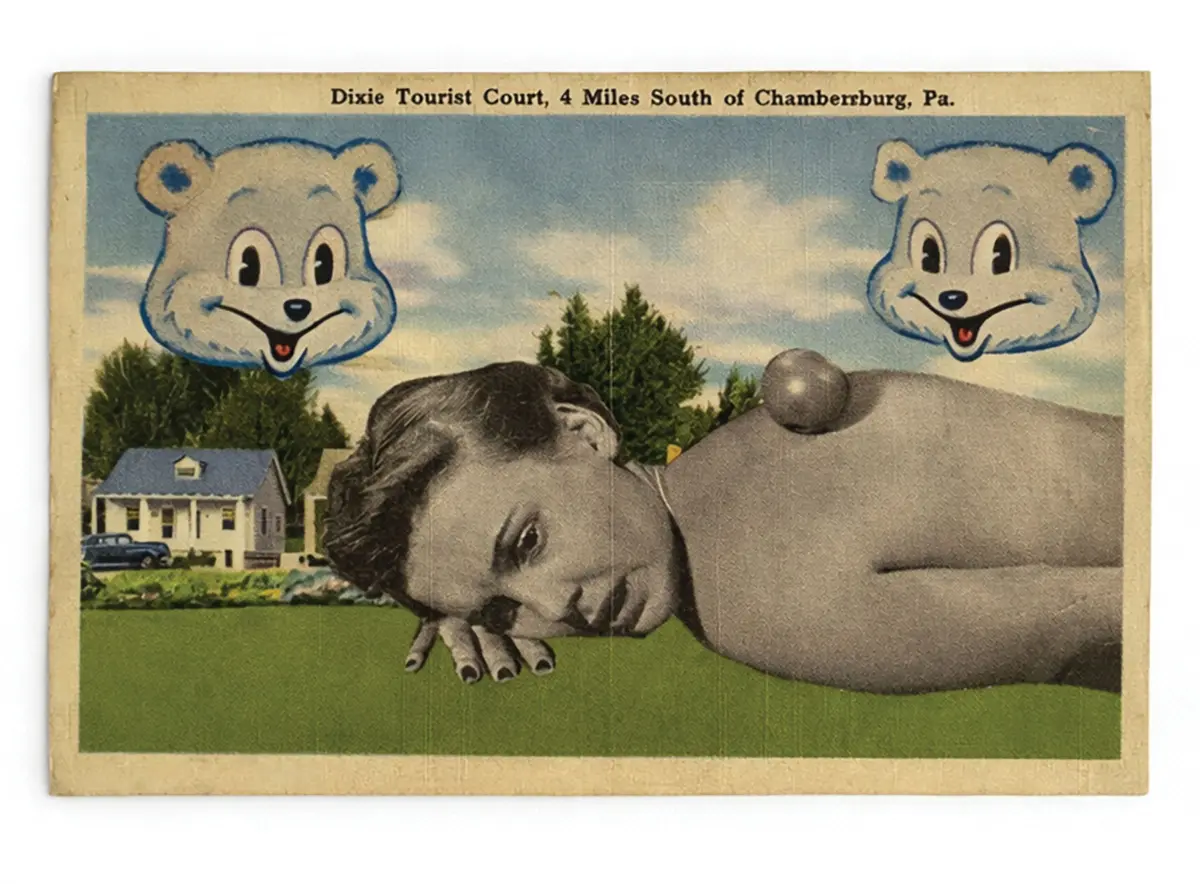
Perhaps no work better encapsulates Sante’s mature collage philosophy than De La (2023), a piece she proudly retains in her personal collection. Describing its genesis, Sante highlights a serendipitous collision of disparate historical moments:
The Foundation: The yellow and white background hues originate from a damaged promotional poster for an early film by Italian auteur Elio Petri, purchased out of a shopping bag of torn ephemera on St. Marks Place in 1981.
The Typography: The lettering is sourced from miscellaneous papers retrieved from a local auction in upstate New York, including a Spanish-language poster for a touring Laurel and Hardy anthology.
The Accents: A tire motif is lifted from a 1930s French automotive magazine; a crisp chrysanthemum is plucked from a seed-company advertisement in a vintage issue of Life; and a gloved hand holding a flower traces back to a 1950s edition of the British humor magazine Punch.
The Centerpiece: The focal point features a woman with fingerprints on her back, pulled from a 1930s French soft-porn magazine—an image Sante saved for decades before finding its precise conceptual home.
This meticulous assemblage mirrors her cinematic inspirations. Sante notes that roughly 95 percent of her collages incorporate lettering because she conceives of them as fictional movie posters. Recalling the monumental, sculpted typography of cinematic epics like Ben-Hur (1959) and Hawaii (1966), she constructs visual spaces where monumental text anchors swirling, ambiguous narratives.
Official Statements and Artistic Philosophy
In interviews, Sante has consistently articulated an artistic framework rooted in poetry, ambiguity, and physical craftsmanship.
On the Primacy of Ambiguity
Rejecting the notion that art must deliver a clear, didactic message, Sante aligns her visual practice with the tenets of poetry and early modernist movements like Dada and Surrealism. She cites deep affinities with Max Ernst, Robert Rauschenberg, Jess, Bruce Conner, John Heartfield, Hannah Höch, El Lissitzky, and Alexander Rodchenko.
"It’s ambiguity central," Sante explains. "I started life, so to speak, as a poet… That means making a structure from a sort of lean-to of ambiguities—one ambiguity resting on another, all suggesting a story and all suggesting a meaning but never actually giving it to you. If I make a collage and it seems to have a legible message, I have failed."
On the Craving for Tactility
Unlike writing, which Sante views as an intellectual exercise that distances the creator from immediate physical labor, collage satisfies a deep-seated bodily craving.
"It’s something I feel in my hands—like, ‘By the pricking of my thumbs, something wicked this way comes.’ It’s the feeling that I need to make something. Being a writer does not involve the body the way that making visual art does, and I have that craving. I wanted to be an artist before I ever thought of being a writer."
The Aesthetics of Decay
Sante’s attraction to materials is fundamentally tied to their mortality. Pristine, mint-condition artifacts hold little appeal for her. Instead, she seeks out the damaged, the weathered, and the forgotten.
"I like dirt. I like fading. I like things that are crinkled, things that are ripped. I prefer things that are damaged, because they carry their histories. They establish a custodial chain and have a lot of dead people’s fingerprints on them. If something looks like it comes out of the box, even if it was published in 1922, I’m far less interested than if it’s fucked up."
Future Outlook
As Lucy Sante looks ahead, her creative momentum shows no sign of slowing down. With her highly anticipated essay collection My Heart & Agree slated for release in 2026—a volume that promises to further explore her lifelong fascination with Surrealist photography, cowboy iconography, and Soul Train—her critical voice remains as sharp as ever.
Simultaneously, her studio practice in upstate New York continues to hum with quiet, tactile anticipation. Even when pressed with literary deadlines, Sante remains an active archivist of cultural debris. She reports scouring online marketplaces for nineteenth-century chromolithographs and acquiring discarded, decades-old comic books retrieved from forgotten crawl spaces.
The recent critical and institutional embrace of her visual art marks a long-overdue synthesis of her dual identities. By bridging the gap between the printed page and the handmade artifact, Lucy Sante continues to unearth poetry from the ruins of twentieth-century print culture, offering viewers a portal into alternative histories that are as haunting as they are mesmerizing.





Comments
Facebook App ID not configured. Please add it in the Customizer.