
Executive Overview
This coming November, the cultural landscape of the Middle East will expand significantly with the public debut of the Doha Pavilion, a permanent architectural and artistic structure dedicated exclusively to the oeuvre of legendary German artist Gerhard Richter. Set to open on November 20, 2025, the pavilion is strategically positioned within MIA Park, just outside the iconic, I.M. Pei-designed Museum of Islamic Art in Doha, Qatar.
Conceived as a total work of art—a Gesamtkunstwerk—the building itself has been designed by Richter in close collaboration with Selldorf Architects, the internationally acclaimed New York-based firm led by Annabelle Selldorf. Known for her sensitive institutional transformations, including high-profile projects for the Frick Collection, the Art Gallery of Ontario, and premier gallery spaces for David Zwirner and Hauser & Wirth, Selldorf brings a masterclass in minimalist precision to this cross-cultural dialogue.
The pavilion’s premiere coincides with the launch of Rubaiya Qatar, an ambitious new contemporary art quadrennial running from November 21 through April 2027. Featuring 25 new commissions and six major public art installations with an intentional focus on artists from outside the Western Hemisphere, Rubaiya Qatar provides a vibrant international context for the Richter Pavilion’s permanent arrival.
Read Also
For Richter, whose career spans over six decades of pioneering experimentation across abstraction, photorealism, and conceptual installation, this structure represents a singular career milestone. As the artist himself has noted, the Qatari capital is not merely one of several possible homes for the project, but rather "the right place and the only place" for this specific manifestation of his artistic vision.
Detailed Chronology: From the 2013 Inspiration to the 2025 Reveal
The genesis of the Doha Pavilion is rooted in a pivotal journey undertaken by Richter more than a decade ago. Tracing the trajectory of the project reveals a deliberate, methodical artistic evolution deeply intertwined with the architectural and cultural fabric of the Qatari capital.
2013: The Catalyst in Doha
In 2013, Gerhard Richter traveled to Doha, Qatar. The trip arrived precisely two years into the development of his revolutionary Strip paintings—a body of work born from the iterative digital division and mirroring of his earlier abstract work, Patterns. Surrounded by the city’s striking juxtaposition of ancient Islamic heritage and hyper-modern urban architecture, Richter experienced a conceptual breakthrough. The visual cadence of Doha’s built environment sparked the realization that his Strip works demanded a permanent, dedicated architectural container capable of synthesizing their thematic threads.
The Development Phase: Bridging Art and Architecture
In the years following his exploratory visit, Richter translated his conceptual sketches into a concrete architectural proposition. Recognizing the need for structural mastery to match his artistic ambition, Richter partnered with Selldorf Architects. Over several years of meticulous planning, the artist and the architecture firm collaborated to ensure that the building would function simultaneously as an autonomous sculpture and a specialized gallery space. Every elevation, material choice, and spatial transition was calibrated to frame specific bodies of Richter’s work in a controlled, contemplative environment.
Late 2025: Inauguration and the Launch of Rubaiya Qatar
The realization of this decade-long vision culminates this autumn. On November 20, 2025, the Doha Pavilion will officially open to the public under the auspices of Qatar Museums. The timing is intentionally synchronized with the inaugural edition of Rubaiya Qatar, a new global quadrennial for contemporary art. Opening the following day, November 21, Rubaiya Qatar will animate the city through April 2027, featuring 25 new commissions and six public art installations. By anchoring the quadrennial’s opening week, the Richter Pavilion establishes Doha not only as a regional powerhouse for museology, but as a primary global nexus for site-specific contemporary art.
Supporting Context & Metrics: The Intersection of Islamic Geometry and Richter’s Abstraction
The Doha Pavilion is far more than a neutral white cube; it is a profound exploration of geometric kinship across centuries and cultures. To fully understand the pavilion, one must examine the lineage of Richter’s Patterns and Strips, as well as the architectural mathematics underpinning the building’s exterior.
The Mathematics of the Exterior: From Patterns to Architecture
The exterior walls of the Doha Pavilion are wrapped in decorative tiles generated through mathematically inclined digital processes. These patterns are direct descendants of Richter’s monumental Patterns series—complex grids of color slices that initially led the artist to develop his Strip paintings.
According to Qatar Museums, these exterior geometries consciously "recall the carefully constructed geometries of Islamic art, where interlaced arabesques and endlessly repeating tiles dazzle the eye and act as windows into the spiritual world." By utilizing algorithms to split and multiply color scales, Richter has arrived at a contemporary visual language that mirrors the infinite, contemplative symmetries of traditional Islamic ornamentation. This creates a striking cross-cultural dialogue between Western post-war abstraction and the historical visual traditions of the Islamic world.
The Interior Experience: Strips, Mirrors, and the Strip Tower
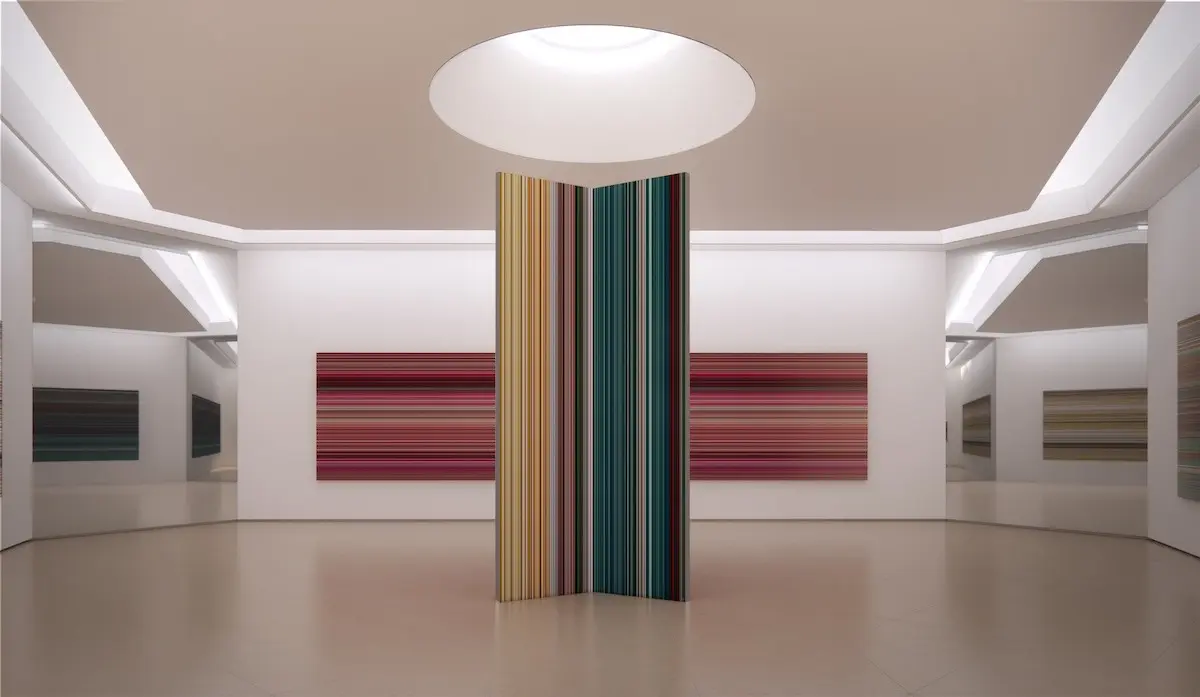
Stepping inside the pavilion reveals a tightly curated, highly immersive environment designed to challenge the visitor’s perception of space, reflection, and image-making. The interior layout features:
- Strip Paintings: Large-format works characterized by razor-thin, digitally printed and varnished horizontal color lines that stretch the limits of perceptual bandwidth.
- Mirrors: Strategically placed large-scale glass and reflective surfaces positioned directly between the Strip paintings. These works do not merely reflect the room; they introduce the viewer directly into the artistic composition, offering a literal reflection and meditation on the nature of painting and image-making.
- The Strip Tower: A vertical sculptural manifestation of the artist’s linear abstractions, anchoring the volumetric space of the pavilion and creating a dynamic counterpoint to the horizontal flow of the wall-mounted paintings.
Architectural Metrics and Urban Placement
Sited within MIA Park—a lush, coastal public green space designed by architect Pei Partnership Architects that wraps around the Museum of Islamic Art—the pavilion occupies a prestigious footprint in Doha’s cultural corridor. MIA Park is already celebrated for hosting monumental public art by international masters such as Richard Serra (7) and Damien Hirst (The Miraculous Journey). The addition of a permanent, artist-designed pavilion further densifies this open-air museum district, creating a walkable, dialogue-driven urban landscape on the shores of the Arabian Gulf.
Official Statements and Perspectives
The weight of this cultural milestone has elicited profound reflections from the key figures driving the project.
Gerhard Richter on the Inevitability of Doha:
"My trip to Doha in 2013 came two years into developing my Strip paintings, and the city’s architecture and history sparked an idea for a pavilion that could unite the thematic threads of that body of work. The Pavilion’s exterior features decorative tiles based on the Patterns that first led me to the Strips. Inside, Strip paintings hang alongside Mirrors and the Strip Tower. Doha is the right place and the only place for my Pavilion."
Annabelle Selldorf on Collaborative Honor:
"It is an uncommon honor to assist Gerhard Richter in realizing his vision for this project—a major addition to his endlessly probing and fascinating body of work—as well as a privilege to contribute to Doha’s extraordinary ensemble of contemporary architecture."
Qatar Museums on Global Cultural Positioning:
As articulated in the official press release from the Qatar Museums group, the pavilion represents a deepening commitment to housing world-class, site-specific art that transcends geographical boundaries. By integrating Richter’s meditation on geometry and light into MIA Park, Qatar Museums continues its trajectory of transforming Doha into an essential destination for international art scholarship and public engagement.
Future Outlook: The Impact of the Doha Pavilion on Global Art Tourism
The opening of the Doha Pavilion arrives at a time of significant evolution in global museum culture. As encyclopedic institutions increasingly look toward decentralized, site-specific, and artist-driven spaces, permanent pavilions dedicated to single masters—such as the Menil Collection’s Rothko Chapel in Houston or the Chinati Foundation in Marfa, Texas—serve as vital counter-narratives to the blockbuster temporary exhibition model.
By establishing a permanent architectural home for Gerhard Richter outside of Europe and North America, Doha signals a maturation of its cultural ecosystem. The pavilion will not only draw art historians, critics, and pilgrims of contemporary abstraction from across the globe, but it will also serve as a permanent educational resource for the region’s burgeoning creative community.
Furthermore, as Rubaiya Qatar opens its inaugural edition on November 21, running through April 2027 with a pronounced focus on non-Western artists, the Richter Pavilion will act as a permanent anchor for the quadrennial’s ongoing discourse. It stands as a bridge between historical European avant-garde traditions and the dynamic, rapidly expanding contemporary arts infrastructure of the Gulf.
When the doors of the Doha Pavilion open this November, visitors will step into a space where German conceptual rigor meets Islamic geometric timelessness—a lasting testament to an artist who found his ultimate architectural reflection on the shores of Qatar.



Comments
Facebook App ID not configured. Please add it in the Customizer.