
Executive Overview
The landscape of reflective display technology has officially entered a vibrant new chapter. E Ink Holdings, the undisputed pioneer and global leader in electronic paper technology, has announced a landmark upgrade to its flagship full-color platform: the enhanced Spectra 6. Building upon its initial
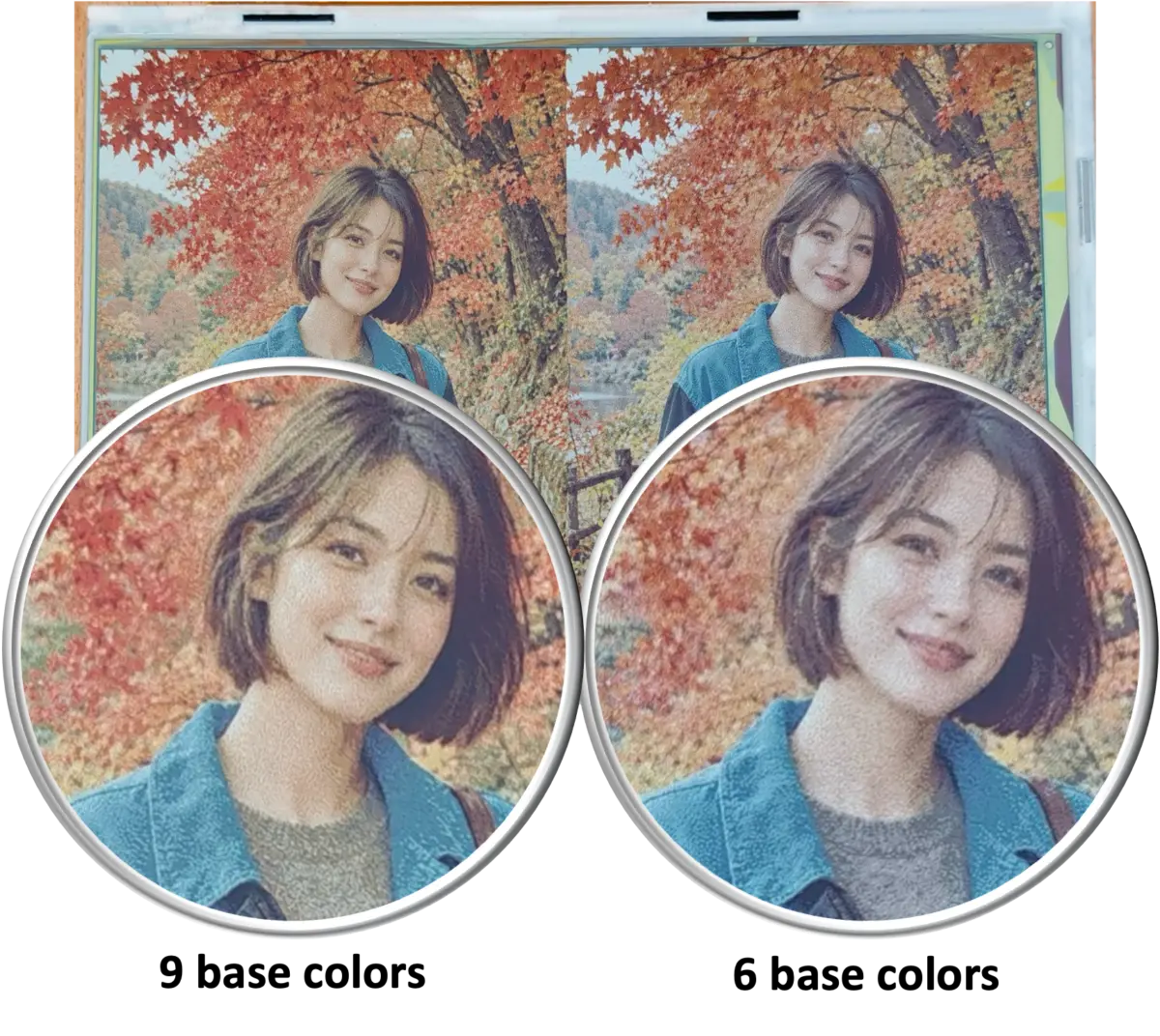
success of mimicking high-end color paper printers, the upgraded Spectra 6 technology dramatically expands its native capabilities by jumping from six base colors to nine.
This technological leap addresses one of the most persistent hurdles in the evolution of electronic paper—the rendering of nuanced, lifelike photographic imagery without relying on power-hungry, backlit LCD or OLED panels. By introducing orange, cyan, and light green to its existing palette of black, white, red, yellow, blue, and green, E Ink has successfully bridged the gap between muted electronic signage and vivid, natural-looking fine art photography.
Read Also
To showcase this milestone, consumer tech brand Aura has stepped forward as the launch partner, integrating the new 9-color technology into its latest product offering: the Ink 10—a completely cordless, highly efficient 10-inch digital e-paper photo frame. Moving past the limitations of traditional, tethered LCD screens that demand continuous electrical currents, the Ink 10 combines E Ink’s cutting-edge reflective particles with a proprietary software dithering algorithm. The result is a display that looks indistinguishable from a physical print, boasting an impressive 200 PPI (pixels per inch) resolution and a battery life that stretches up to three months on a single charge.
As businesses look to replace traditional static paper advertisements with dynamic, energy-efficient smart signage, and as consumers seek out home decor technology that seamlessly blends into living spaces without messy cords, the evolution of Spectra 6 marks a pivotal turning point in visual display engineering.
Detailed Chronology: The Evolution of Spectra 6
To truly understand the weight of E Ink’s latest announcement, it is necessary to examine the trajectory of the company’s color e-paper innovations over the past several years.
The Inception of Spectra 6
When E Ink originally debuted the Spectra 6 platform, it was heralded as a major breakthrough specifically engineered for retail environments, in-store point-of-purchase (POP) advertising, indoor signage, and architectural home decor. Prior iterations of color e-paper often suffered from washed-out pastels, limited contrast ratios, and slow page-turn or update speeds. Spectra 6 changed that narrative by utilizing an advanced particle-based color architecture designed to rival the visual fidelity of the most advanced commercial color paper printers on the market.
However, despite its rich saturation and deep contrast, the original platform was bound by a fundamental limitation: its palette consisted of six base pigments (black, white, red, yellow, blue, and green). While this was more than adequate for block graphics, corporate logos, and retail pricing tags, it presented challenges when attempting to render complex human skin tones, subtle autumn gradients, or deep, atmospheric landscape photography. Images often required heavy dithering—a technique of diffusing pixels to simulate missing shades—which occasionally resulted in visible graininess or a posterized appearance.
The Engineering Leap to Nine Colors
Recognizing that the next frontier for e-paper was high-fidelity photographic reproduction, E Ink’s research and development teams embarked on a multi-year initiative to expand the platform’s chemical and electronic boundaries. The breakthrough came with the addition of three critical new primary pigments: orange, cyan, and light green.
Integrating these new chromatic elements was no trivial task. Adding physical color-particle capsules to a reflective electrophoretic display requires meticulous control over electrical charges, fluid viscosity, and pigment migration speeds. Furthermore, managing a 9-color system demands significantly more computational overhead than its predecessor. To bring the Spectra 6 9-color modules to life, E Ink had to pair the display hardware with a robust, highly optimized system-on-chip (SoC) architecture, alongside an advanced E Ink timing controller (TCON) capable of precisely orchestrating the micro-voltages required to move nine distinct particle types into their designated spatial positions.
As part of its initial rollout strategy, E Ink has confirmed that the 9-color display module will be produced exclusively in a 10-inch form factor for the foreseeable future. This strategic size choice targets high-end digital photo frames, desktop dashboards, and specialized interactive retail kiosks where viewing distances are intimate and visual clarity is paramount.
Supporting Context & Metrics: Under the Hood of the Aura Ink 10
The commercial viability of any display technology depends heavily on how hardware manufacturers harness its potential. Enter Aura, a prominent name in digital photo display solutions, which has leveraged the new 9-color Spectra 6 panel to build the Ink 10.

Hardware Specifications and Display Metrics
The Aura Ink 10 represents a notable generational leap over previous models in the company’s Ink series—most notably the larger Ink 13-inch frame.
- Display Resolution: The Ink 10 features a sharp 200 PPI display density. This is a substantial upgrade from the 150 PPI found on the Ink 13, resulting in crisper text rendering, finer edge definition, and significantly reduced pixel visibility when viewed up close.
- Color Spectrum Integration: By utilizing the expanded 9-color palette (adding orange, cyan, and light green), the frame overcomes the muddy color transitions that previously plagued electronic photo frames.
- Software Optimization (Dithering Algorithms): Hardware alone cannot achieve photorealistic quality. Aura has implemented a proprietary dithering algorithm tailored specifically for the 9-color Spectra 6 matrix. This software works in tandem with the physical pigment particles to create smoother color gradients, more uniform flesh tones on human faces, and intricate textural details in fabrics, nature scenes, and architectural subjects.
- Power Efficiency & Cordless Freedom: Unlike conventional digital picture frames that rely on power-hungry backlit LCD or OLED panels—requiring unsightly power cords draped down living room walls—the Ink 10 is entirely cordless. Driven by E Ink’s zero-power standby nature (electricity is only consumed when the image changes), the frame’s internal rechargeable battery can last up to three months on a single charge, depending on update frequency.
- Form Factor and Versatility: Designed with minimalist interior aesthetics in mind, the compact dimensions of the Ink 10 allow it to fit effortlessly onto bookshelves, office desks, bedside nightstands, or integrated into modular gallery walls.
Official Statements and Industry Perspective
The commercial unveiling of the 9-color Spectra 6 platform has drawn significant attention from industry leaders and tech analysts alike, underscoring the shift toward sustainable, eye-friendly digital displays.
In an official statement addressing the launch, JM Hung, President of E Ink Holdings, emphasized the strategic importance of pushing the boundaries of reflective display science:
"When Spectra 6 first launched a few years ago, it established a new color standard in e-paper—color that rivals the most advanced color paper printers on the market. Expanding six to nine base colors allows us to push that standard further and continue to make ePaper an appealing alternative to paper."
Hung’s remarks point to a broader corporate vision: transforming e-paper from a niche medium reserved strictly for monochrome e-readers into a ubiquitous visual standard across retail, corporate, and consumer domestic spaces. By closing the quality gap between digital simulation and physical print media, E Ink is actively positioning its technology as an environmentally friendly alternative to traditional paper advertising, which generates millions of tons of waste annually.
Industry analysts have similarly praised the integration of orange, cyan, and light green. In consumer testing environments, images featuring sunsets, dense foliage, and human portraiture—categories that historically exposed the limitations of electronic ink—rendered with a warmth and depth previously thought impossible for electrophoretic displays.
Future Outlook: The Road Ahead for 9-Color E-Paper
The introduction of the 9-color Spectra 6 technology and its premiere in Aura’s Ink 10 frame open up exciting avenues for the future of digital interaction. As manufacturing yields improve and the supply chain matures beyond the initial 10-inch constraint, several key trends are expected to shape the market:
1. Expansion into Larger Form Factors and Signage
While the 9-color display is currently optimized for 10-inch consumer devices, the underlying technology paves the way for larger industrial and retail signages. Retailers demanding hyper-realistic promotional displays—such as cosmetic counters showcasing complex makeup palettes or grocery chains displaying fresh produce with natural vibrancy—will likely lobby for larger 24-inch and 32-inch 9-color panels in the near future.
2. The Rise of Sustainable Smart Home Decor
As consumers become increasingly fatigued by the constant glow of blue-light-emitting screens and the clutter of power cables, zero-emission, reflective decor is experiencing a surge in demand. Devices like the Aura Ink 10 demonstrate that home technology does not need to look like a computer monitor. By mimicking the diffuse reflection of physical photographs, e-paper frames offer a calming, gallery-quality aesthetic that consumes virtually zero idle electricity.
3. Integration with AI and Cloud Ecosystems
Future iterations of e-paper frames and smart signage will undoubtedly benefit from artificial intelligence. Smart curation algorithms—capable of sorting family photo libraries, automatically cropping images to optimize focal points, and applying specialized dithering profiles on the fly—will ensure that every picture displayed on a 9-color Spectra 6 screen looks professionally edited and perfectly balanced.
Conclusion
E Ink’s expansion of the Spectra 6 platform from six to nine base colors is much more than a routine specification bump; it is a transformative milestone for electronic display technology. By solving long-standing chromatic limitations and proving its viability in sleek, cordless consumer hardware like the Aura Ink 10, E Ink has solidified e-paper’s place as a primary medium for both commercial advertising and modern home aesthetics. As the technology continues to scale, the line between digital screens and printed art continues to blur, promising a more sustainable, visually stunning future.



Comments
Facebook App ID not configured. Please add it in the Customizer.