
Executive Overview
In a landmark convergence of sustainable technology and municipal infrastructure, E Ink has announced a major strategic investment and comprehensive partnership with Soofa, an industry leader in solar-powered digital information kiosks. This alliance is designed to supercharge the nationwide deployment of eco-friendly, highly
readable outdoor signage across American cities. At the core of this joint initiative is the mass integration of E Ink’s cutting-edge 75-inch Kaleido Outdoor color ePaper displays. These state-of-the-art screens are engineered to deliver crisp, vibrant digital content even under direct, glaring sunlight while consuming a fraction of the electricity demanded by traditional LED or LCD digital billboards.
For E Ink, a global titan in electronic paper development, this marks a historic milestone: it is the company’s very first direct investment in a turnkey, end-to-end digital signage solution provider. By moving beyond pure component manufacturing and stepping directly into a business model that harmonizes hardware deployment, localized advertising operations, and civic engagement, E Ink is signaling a profound shift in how smart cities will communicate with their citizens in the decades to come.
Read Also
As municipalities globally grapple with aggressive carbon reduction goals, soaring energy costs, and the need for resilient, off-grid communication channels during emergencies, the E Ink and Soofa partnership offers a compelling blueprint for the future of urban public spaces.
Detailed Chronology: From MIT Roots to National Municipal Adoption
The Shared Genesis: MIT Media Lab Origins
The partnership between E Ink and Soofa is not merely a transactional business arrangement; it represents a homecoming of sorts. Both entities trace their foundational intellectual and technical roots directly back to the prestigious Massachusetts Institute of Technology (MIT) Media Lab. E Ink’s foundational electrophoretic display technology was famously conceptualized and incubated at MIT in the late 1990s by a team of researchers seeking to mimic the physical properties of ink on paper.
Years later, Soofa was spun out of the same academic ecosystem, founded in 2014 by urban planners and technologists who envisioned a world where public furniture could double as digital civic infrastructure. This shared lineage has fostered a decade-long collaborative relationship, building a deep institutional trust that has now culminated in equity investment and a deeply integrated product roadmap.
Scaling the Urban Landscape
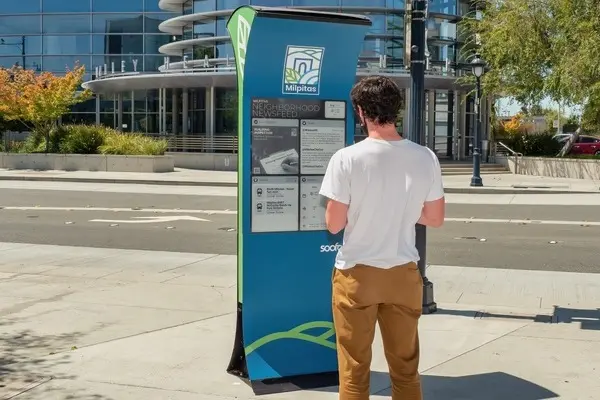
Since its inception, Soofa has methodically carved out a niche as the premier provider of sustainable public information kiosks. Moving away from the energy-intensive, aesthetically intrusive digital monoliths that plague modern metropolises, Soofa engineered a sleek, solar-powered alternative designed specifically for pedestrian environments.
Over the past decade, the company has successfully integrated its kiosks into more than 60 major U.S. municipalities. High-profile deployments in cities such as Boston, Atlanta, and Los Angeles have proven that decentralized, self-sustaining public information networks can thrive in diverse climates and dense urban canyons. These kiosks serve as hyper-local community hubs, broadcasting real-time public transportation updates, emergency weather alerts, hyper-local news feeds, civic announcements, and targeted municipal advertising.
The Evolution of the Display: Entering the Era of Color ePaper
A critical bottleneck for early solar-powered outdoor signage was display technology. Monochrome electronic paper, while remarkably power-efficient, lacked the visual engagement required for modern municipal communication and commercial advertising.
The introduction of E Ink’s 75-inch Kaleido Outdoor color ePaper display completely alters this equation. By combining the ultra-low power consumption of electronic paper with a full spectrum of color capabilities, the new generation of Soofa kiosks can display rich, eye-catching graphics, maps, and advertisements without needing a connection to the municipal power grid. This technological leap solved the historical trade-off between visual vibrancy and energy sustainability.
Supporting Context & Metrics: The Smart City Revolution and the Energy Crisis
The Hidden Cost of Traditional Digital Signage
To truly understand the disruptive significance of the E Ink-Soofa partnership, one must examine the staggering resource consumption of conventional outdoor digital signage. Standard LED and LCD billboards require massive amounts of continuous electrical power to remain visible against ambient sunlight. In many cases, these signs run on power grids dependent on fossil fuels, generating substantial carbon footprints while radiating unwanted urban heat.
Furthermore, running high-voltage electrical lines to isolated public parks, transit stops, and pedestrian plazas is notoriously expensive, often requiring extensive civil engineering, trenching, road closures, and prolonged permitting processes. These logistical hurdles have historically priced smaller municipalities and suburban communities out of modern digital communication networks.
The Mechanics of Off-Grid Efficiency
Soofa’s solar-powered kiosks bypass these infrastructural nightmares entirely. Engineered for rapid, frictionless deployment, a standard Soofa kiosk can be installed by a streamlined two-person team using basic tools, eliminating the need for heavy machinery, specialized electrical contractors, or deep excavation.
Operating entirely on self-contained solar power systems, these units harvest clean energy during daylight hours, storing it in high-capacity internal batteries designed to withstand extreme weather fluctuations. Because E Ink displays only consume power when the image on the screen is actively changing—drawing zero electricity to maintain a static image—the energy drain is virtually negligible compared to backlit LCD panels that must pump light through liquid crystals twenty-four hours a day.

+-------------------------------------------------------------------+
|               Comparative Energy & Infrastructure Metrics         |
+--------------------------+-------------------+--------------------+
| Metric                   | Traditional LCD   | E Ink Kaleido /    |
|                          | Outdoor Signage   | Soofa Solar Kiosk  |
+--------------------------+-------------------+--------------------+
| Power Source             | Hardwired Grid    | 100% Solar-Powered |
|                          | (High Voltage)    | Off-Grid           |
+--------------------------+-------------------+--------------------+
| Continuous Power Draw    | High (Constant    | Near Zero          |
|                          | Backlighting)     | (Bistable Tech)    |
+--------------------------+-------------------+--------------------+
| Installation Complexity  | High (Trenching,  | Low (2-Person      |
|                          | Permits, Wiring)  | Manual Assembly)   |
+--------------------------+-------------------+--------------------+
| Sunlight Readability     | Prone to Glare/   | Highly Readable in |
|                          | Washout           | Direct Sunlight    |
+--------------------------+-------------------+--------------------+
Market Dynamics: The Convergence of IoT and Sustainability
The global market for smart city infrastructure is experiencing exponential growth, driven by municipal mandates for net-zero carbon operations and citizen demands for transparent, real-time public communication. Urban planners are increasingly moving away from closed-loop, corporate-controlled digital ad networks in favor of decentralized, multi-use civic infrastructure.
By combining forces, E Ink and Soofa are positioning themselves at the vanguard of this movement. The partnership bridges the gap between hardware manufacturing and municipal service operations, creating a vertically aligned powerhouse capable of scaling rapidly across North America and international markets.
Official Statements and Leadership Vision
The strategic alliance has elicited enthusiastic commentary from executive leadership at both companies, underscoring the deep philosophical and technological alignment driving the partnership.
Johnson Lee, Chairman and CEO of E Ink, emphasized the transformative potential of the collaboration:
"Soofa shows how E Ink technology can make useful information more accessible while keeping energy consumption low. Our shared MIT Media Lab roots and longstanding collaboration make this investment especially meaningful. We are pleased to support Soofa’s next stage of growth and help bring sustainable community signage to more neighborhoods."
Industry analysts note that Lee’s emphasis on accessibility and low energy consumption reflects a broader corporate pivot at E Ink. As electronic paper breaks out of its traditional stronghold in e-readers (such as the Amazon Kindle or Kobo devices) and expands into massive architectural and public displays, partnerships with application-layer innovators like Soofa provide an essential bridge to commercial maturation.
Leadership at Soofa has similarly echoed these sentiments, pointing out that the infusion of capital and technological resources from E Ink will dramatically accelerate their product rollout schedule. With the backing of a multi-billion-dollar display pioneer, Soofa is poised to transition from a regional market leader into a ubiquitous national standard for sustainable urban communication infrastructure.
Future Outlook: What’s Next for Sustainable Public Displays?
Expanding the Municipal Footprint
The immediate roadmap for the E Ink and Soofa partnership centers on scaling the deployment of the newly minted 75-inch Kaleido Outdoor color ePaper kiosks across existing and prospective partner cities. With over 60 municipalities already integrated into Soofa’s network, the low-hanging fruit involves upgrading legacy monochrome or smaller-format screens to the vibrant new color displays.
Furthermore, municipal sales pipelines are expanding rapidly as city councils face mounting pressure to meet climate action deadlines. Kiosks that act simultaneously as public safety warning systems, public transit hubs, and revenue-generating advertising spaces represent an exceptionally attractive ROI for cash-strapped local governments.
Technological Horizons: Interactivity and IoT Integration
Looking further into the future, the integration of E Ink displays within smart city kiosks opens up exciting possibilities for advanced Internet of Things (IoT) connectivity. Future iterations of Soofa kiosks could incorporate localized environmental sensors—tracking air quality, noise pollution, and micro-climate temperature shifts—and display that data in real-time on the low-power ePaper screen for passing pedestrians.
Moreover, advancements in touch-enabled electronic paper and low-power wireless communication protocols could introduce interactive wayfinding and localized civic polling directly at the kiosk level, all while remaining entirely off-grid and solar-powered.
A Paradigm Shift in Urban Advertising
Beyond civic utilities, the commercial implications for outdoor advertising are profound. Advertisers are increasingly targeted by consumer backlash and regulatory scrutiny over the excessive energy consumption and light pollution caused by traditional digital billboards.
By offering a fully sustainable, zero-emission canvas that harmonizes with the urban landscape rather than assaulting it with blinding LED glare, Soofa and E Ink are introducing a conscience-driven alternative to out-of-home (OOH) advertising. Brands seeking to bolster their environmental, social, and governance (ESG) credentials will find immense value in advertising on solar-powered, paper-like displays.
Conclusion
The strategic investment by E Ink into Soofa is far more than a simple corporate financial transaction. It is a calculated validation of a sustainable urban future—one where technology serves humanity and the environment in equal measure. As these colorful, sun-readable, solar-powered kiosks begin to populate street corners from coast to coast, they will stand as physical monuments to a smarter, cleaner, and more connected world.


Comments
Facebook App ID not configured. Please add it in the Customizer.