
Executive Overview
In the architecture of fiction, suspense is largely engineered through friction. For centuries, writers have relied on binary conflicts to propel narratives forward, forcing protagonists into high-stakes corners where they must choose between two equally agonizing outcomes. Will the character pick Door #1 or Door #2? Will they sacrifice love for duty, or truth for self-preservation?
Yet, according to acclaimed novelist Katherine A. Sherbrooke, the most satisfying resolutions—and the most unforgettable plot twists—often lie completely outside this traditional binary. In the literary trade, Sherbrooke champions the invention of "Door #3": an alternative resolution that neither the reader nor the protagonist sees coming, yet feels entirely inevitable in hindsight.
Drawing from her extensive career writing complex character-driven fiction, including her debut Fill the Sky, the historical drama The Hidden Life of Aster Kelly, and her decade-in-the-making latest release This Much Is True, Sherbrooke has formalized a masterclass in plotting. By treating story development as a hybrid of map-making and stage magic, authors can misdirect their audiences with visible dilemmas while quietly planting the seeds for a paradigm-shifting third option. This comprehensive analysis explores Sherbrooke’s methodology, examining how she constructs impossible moral mazes, employs the "what if?" brainstorming technique, and delivers narrative payoffs that leave readers breathless.
Read Also
Detailed Chronology: The Evolution of Sherbrooke’s Writing Philosophy
Sherbrooke’s journey toward the theory of Door #3 did not arrive as an abstract academic realization; it was forged in the trenches of the creative writing workshop and refined across multiple novels, each presenting increasingly difficult structural hurdles.
Phase 1: The Birth of a Theory in Fill the Sky
Sherbrooke first stumbled upon the mechanics of the third option while enrolled in a workshop class called "Novel in Progress" during the drafting of her debut novel, Fill the Sky. The book follows three longtime friends who travel to Ecuador in a desperate bid to see if local shamans can save one of them, Ellie, from terminal cancer.
While the literal stakes involved life and death, the emotional core of the novel hinged on a devastating moral dilemma: Ellie is consumed by guilt over a brief, intense period of marital infidelity. She is terrified that her husband will discover the secret after her death, leaving him isolated with a betrayal she cannot explain. Conversely, she is equally paralyzed by the fear that confessing now will unnecessarily poison the limited time they have left.
As chapters were workshopped, Sherbrooke noticed a fascinating phenomenon. Her workshop peers quickly moved past standard critiques of prose and pacing to passionately debate what Ellie should do. Half the group was fiercely convinced Option #1 was the only ethical path, while the other half argued with equal conviction for Option #2.
Faced with a polarized audience, Sherbrooke recognized a classic narrative trap: any choice she picked would alienate half her readers and feel blatantly predictable to the rest. The solution required an inventive escape hatch. Near the end of the book, during a deeply emotional healing ritual, Ellie experiences a profound realization: her husband already knows, and he has been just as terrified to ask as she has been to confess.
[Traditional Binary]
  ├── Option #1: Confess now (Risk poisoning remaining time)
  └── Option #2: Take it to the grave (Risk posthumous discovery)

[The Sherbrooke Breakthrough]
  └── Door #3: Mutual unspoken understanding (The revelation that he already knows)
By shifting the narrative goalpost from whether to tell him to how to reassure him of his enduring place in her heart, Sherbrooke delivered a resolution that was both surprising and profoundly satisfying.
Phase 2: Planting the Magic Trick in The Hidden Life of Aster Kelly
With her third novel, The Hidden Life of Aster Kelly, Sherbrooke applied the Door #3 framework to an early-book plot twist set against the glamorous yet cutthroat backdrop of 1940s Hollywood.
The protagonist, an aspiring designer named Aster Kelly, finds herself pregnant with the child of a man who she is certain will propose marriage if informed—a conventional "honor-bound" future she actively rejects. Facing an era where single motherhood meant near-impossible financial ruin and social ostracization, Aster faces a grim binary: return to her parents’ home to raise her child under scandal, or marry a man she does not love.
The breakthrough came via background world-building. Aster shares a deep friendship with her design mentor, Fernando, who is secretly in love with Christopher Page, Hollywood’s rising star. When a ruthless studio executive threatens to expose Christopher’s homosexuality—a career-ending catastrophe at the time—Aster proposes an unorthodox solution: she and Christopher will elope.
This unexpected union solves immense, distinct problems for all three characters while allowing them to maintain their chosen lives in secret. It was a classic "rabbit in the hat" moment. The elopement elements were entirely present in the background, but because the reader’s attention was glued to the traditional binary choices, the third door arrived with the force of an inevitable revelation.
Phase 3: The Decadelong Crucible of This Much Is True
Sherbrooke’s latest novel, This Much Is True, presented her most formidable structural challenge to date. The narrative tracks Veronica Harmon, a woman in her 50s forced to confront a suppressed trauma from her high school days upon discovering that her abuser is the father of her daughter’s fiancé.
During a weekend designed for the two families to bond, Veronica faces an agonizing dilemma: swallow a secret she has never shared with a single soul and live with the lie forever, or speak out and inevitably detonate her daughter’s future.
The complexity of this moral bind paralyzed Sherbrooke for a decade, during which she wrote two entirely different books before returning to crack the code. Driven by a desire to subvert the limited options historically afforded to survivors of sexual assault—silence and private torment versus public accountability and public trauma—Sherbrooke labored to find a genuinely empowering Door #3. While the exact mechanics of Veronica’s resolution remain a closely guarded spoiler, its construction represents the absolute zenith of Sherbrooke’s plotting philosophy.
Supporting Context & Metrics: The Mechanics of Misdirection
Sherbrooke conceptualizes story development as a cross between cartography (map-making) and stage magic. Understanding the psychological mechanics of reader engagement illuminates why the Door #3 technique succeeds where conventional twists often fall flat.
The Magician’s Misdirection
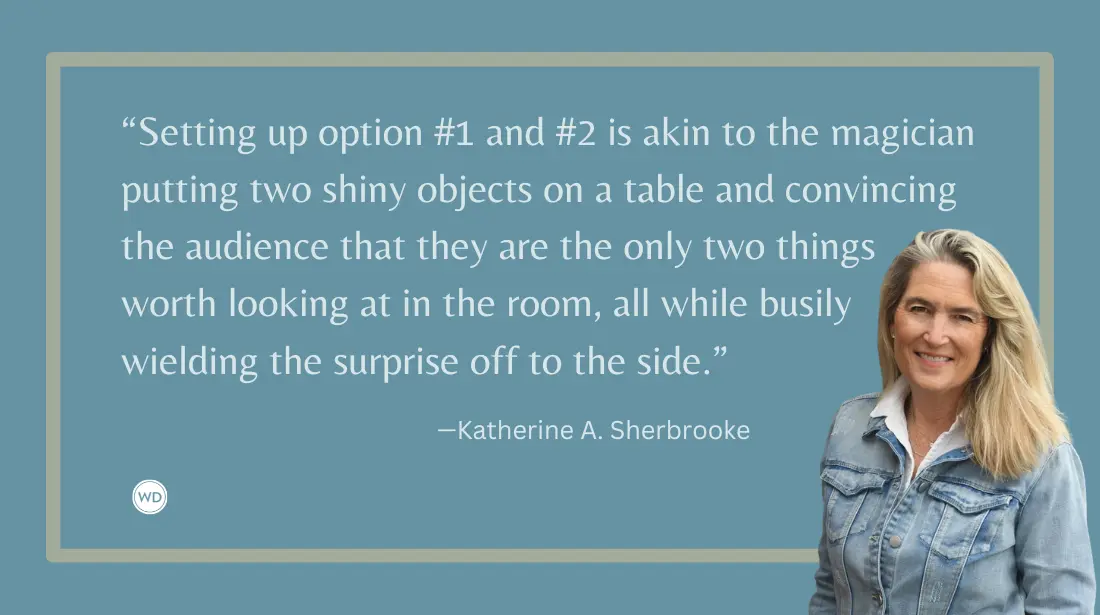
When a writer sets up Options #1 and #2, they are performing the literary equivalent of placing two shiny objects on a table. They convince the audience that these are the only two variables worth observing in the entire room, while quietly maneuvering the real solution off to the side.
| Storytelling Phase | The Magician’s Analogy | Narrative Execution |
|---|---|---|
| Setup | Placing two shiny objects on a table | Presenting an obvious binary choice (Option A vs. Option B) |
| Distraction | Forcing the audience to watch the hands | Keeping the reader emotionally invested in the debate of the binary |
| Sleight of Hand | Working behind the scenes | Quietly seeding moments, dialogue, and character interplay pointing elsewhere |
| The Reveal | The "Rabbit in the Hat" | Unveiling Door #3, prompting the reader to think: "Of course!" |
When executed correctly, the reader’s reaction is twofold:
- "I don’t know why I didn’t think of that."
- "Of course!"
The "What If?" Brainstorming Protocol
Because Door #3 cannot be an obvious or easily anticipated choice, inventing it requires deliberate, rigorous labor. Sherbrooke relies on an off-the-page brainstorming protocol designed to push past conventional brainstorming limitations.
- The Divergent List: Before drafting or during structural stalls, Sherbrooke compiles a bulleted list of radical, bizarre, or unconventional directions the story could take, strictly excluding Options #1 and #2.
- The Escalation Chain: For every wild idea, she interrogates the trajectory by asking successive levels of probing questions: “And then what?” followed by “And then what after that?”
- Pruning the Branches: While the vast majority of these conceptual branches hit dead ends and are discarded, writers inevitably strike a root system that generates rich narrative complications—signaling a viable Door #3.
Official Statements & Insights from the Author
Reflecting on the emotional toll and creative rewards of writing This Much Is True, Sherbrooke has been candid about why finding a third option was non-negotiable for Veronica’s story.
"I wanted to write this book in part because of the limited options typically available to survivors of sexual assault: keep quiet and deal with crushing emotional turmoil in private or seek accountability and deal with crushing emotional turmoil in public," Sherbrooke notes. "I desperately wanted a different and more satisfying option for Veronica. Only when I found door #3 was I ready to finally complete her story."
This commitment to agency over trauma underscores the deeper purpose of the Door #3 framework. It is not merely a structural trick designed to shock readers; it is a philosophical tool that allows characters to transcend systemic traps and reclaim autonomy through unexpected grace.
Future Outlook: The Legacy of Structural Innovation in Modern Fiction
As the literary landscape continues to evolve, contemporary readers grow increasingly sophisticated, easily spotting derivative tropes and formulaic plotting arcs. The demand for narrative subversion has never been higher, yet genuine surprise remains rare.
Katherine A. Sherbrooke’s contribution to the craft offers a vital roadmap for novelists navigating complex moral territory. By treating plotting as an exercise in architectural misdirection and rigorous divergent brainstorming, authors can elevate their work above standard melodrama. Whether applied to domestic dramas, historical fiction, or contemporary trauma narratives, the pursuit of Door #3 ensures that stories do not merely end—they resonate, lingering in the reader’s mind as both startling and inevitable.





Comments
Facebook App ID not configured. Please add it in the Customizer.