
Executive Overview
Following a deliberately slow-paced narrative setup in its first two outings, Prime Video’s The Rings of Power dramatically accelerates its thematic and structural velocity in Episodes 3 and 4, respectively titled “The Secret Fire” and “Gundabad.” These middle chapters break free from early-season expository stagnation, injecting high-stakes momentum, profound character transformations, and controversial narrative maneuvers into the sprawling canvas of the Second Age.
Where the season premiere leaned heavily into macro-scale world-building and transitional table-setting, this latest block shifts focus toward intense interpersonal dynamics, deep-seated mythos exploration, and stark sacrifices. Canonical expansions regarding the Istari (the Wizards), the tragic geopolitics of Númenor, and the complex inner mechanics of Sauron’s ascending empire collide with high-octane action sequences. Yet, this narrative acceleration is not without friction. Questions regarding character pacing, narrative economy, and the fidelity of its adaptations continue to shadow what is otherwise a visually stunning and narratively ambitious television event.
This review offers a comprehensive autopsy of Episodes 3 and 4, tracing the fracture lines of Númenor, the divine revelations of the Secret Fire, the brutal underworld of Gundabad, and the shifting loyalties that threaten to reshape Middle-earth forever.
Read Also
Detailed Chronology: Unraveling "The Secret Fire" and "Gundabad"
The Eastern Reach: Rhûn, the Dark Wizard, and the Secret Fire
The narrative in the East opens with a bold assertion of dominance as Khamûl returns to Rhûn to confront the enigmatic Dark Wizard, portrayed by Ciarán Hinds. Initially dismissive of the emissary, the Dark Wizard is forced to reckon with Khamûl’s burgeoning arcane might during a brief, high-tension magical confrontation. Khamûl issues a chilling ultimatum: the armies of Rhûn will soon mobilize under the banner of the Dark Lord Sauron. Unbeknownst to the power-brokers, this exchange is closely observed from the shadows by Tom Bombadil (Rory Kinnear) and Gandalf (Daniel Weyman).
Following a brush with a massive Oliphant, Gandalf seeks sanctuary in Bombadil’s remote hut, desperate for guidance on how to neutralize the Dark Wizard. Bombadil’s counter-intuitive counsel—suggesting that Gandalf’s purpose is not to destroy his adversary—triggers a rare flash of mortal temper from the wizard. This prompts Bombadil to threaten a retreat to the Withywindle.
What follows is a transcendental sequence: Gandalf experiences a searing vision of celestial light accompanied by a voice that formally identifies him as Mithrandir. The entity known as the Secret Fire reveals the primordial truth of the Istari: Gandalf is not the sole emissary dispatched to preserve Middle-earth. The Dark Wizard, formerly known in ancient histories as Pallando, was sent alongside a companion to safeguard Rhûn. Tragically, Pallando succumbed to hubris and darkness, murdering his partner—an atrocity that transformed a once-vibrant landscape into a barren wasteland. Gandalf’s true mandate is not to execute judgment upon Pallando, but to redeem him, as their combined strength is prerequisite to halting Rhûn’s military integration into Sauron’s dominion. Upon waking, Gandalf finds Bombadil departed, leaving behind a symbolic traveling hat.

Númenor’s Fractured Allegiance
On the western shores of Númenor, military mobilization is underway as Anárion (Andrew Richardson) drills recruits. His father, Elendil (Lloyd Owen), arrives with grave intelligence: a traitor operates within their ranks. Utilizing information relayed via Isildur from Eärien, the duo lays a trap to unmask the spy feeding intelligence to the faction loyal to Pharazôn.
Disguised operatives converge on the designated drop point, where Elendil confronts a cloaked figure. The spy is unmasked as Kemen (Leon Wadham). Despite Anárion’s intervention, Elendil is overpowered and taken prisoner.
Later, during transport, Kemen taunts Elendil with the devastating news of Eärien’s death. Rather than yielding to vengeance, Elendil attempts to pierce Kemen’s hardened exterior, appealing to his humanity and warning him that a lifetime spent chasing his father’s cruel validation will end in ruin. Kemen’s dismissal of the concept of a soul highlights the widening spiritual chasm between the Faithful—who remember the Valar—and the secular, imperialist majority of Númenor. This confrontation showcases Elendil’s defining heroic virtue: unyielding empathy.
The Decoys and the Trap of Gundabad
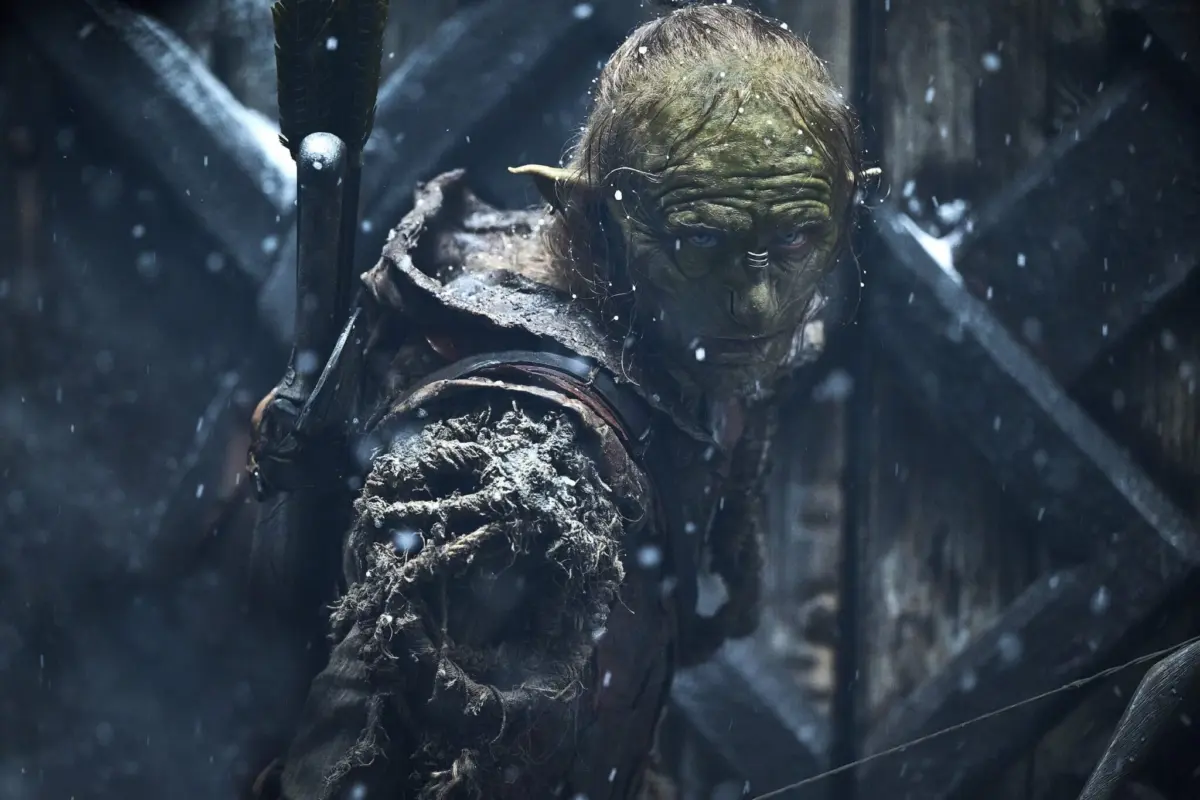
Deep within the frozen wilds, Galadriel, Arondir, and the reformed Orc Marnîkh (Adam Young) evade a tracking party of Sauron’s ring-bearing servants. Galadriel utilizes the concealed power of Nenya to cloak their presence. However, lingering grief over Bronwyn’s death and terror for Theo’s safety compromises Arondir’s focus, leading a suspicious Arondir to accuse Marnîkh of sabotage. Recognizing that Arondir’s emotional turmoil is a liability, Galadriel orders him to part ways, pressing forward with Marnîkh alone.
Simultaneously, Sauron interrogates two Elven captives, extracting critical coordinates regarding Marnîkh’s identity and the whereabouts of the last surviving Elven smith. He orders his beast saddled, preparing to enter the theater of war personally.
Back on the trail, Arondir uncovers definitive proof that Marnîkh’s previous actions were genuine, prompting a rare and humbling apology to the Orc. Reunited, the Elves and Marnîkh formulate a high-risk infiltration plan: the Elves will pose as Marnîkh’s prisoners to gain access to the heavily fortified stronghold of Gundabad.

The Fall of Durin and the Duels of Khazad-dûm
Beneath the mountains of Khazad-dûm, the Dwarven Lords relentlessly push for the distribution of the remaining rings. Queen Disa (Sophia Nomvete) acts as a voice of reason, reminding the assembly that King Durin III was driven to madness by his ring, invalidating his unilateral decree naming Durin IV as heir.
Seizing upon this legal loophole, Thrain challenges the succession. By ancestral Dwarven law, the dispute must be settled through trial by combat.
In private, Disa confesses a deeply buried secret to Durin: a past, one-night encounter with Thrain prior to her engagement, fearing Thrain will weaponize the revelation to destabilize Durin during the duel. Though shaken, the royal couple affirms the unbreakable foundation of their bond.
However, during the buildup to the combat arena, Durin’s son, Gamil (Lee Braithwaite), manipulates his father by claiming he witnessed Thrain engaging in intimate familiarity with Disa. Blinded by sudden rage, Durin hurls himself into the combat arena emotionally compromised. Thrain easily deflects the frenzied assault, subduing his brother while holding back a lethal blow. Durin is left unconscious on the stone floor as Disa and her children look on in horror, while the assembled Dwarven lords roar their approval for a new king.
The Storming and Tragedy of Gundabad
Inside the frozen citadel of Gundabad, Marnîkh bluffs his way into the prison sector, posing as a loyal general of the 73rd legion. He announces the capture of Galadriel and heralds Sauron’s imminent arrival, promising rewards for all. While Galadriel is dragged to an isolated cell, Marnîkh leads Arondir away under the guise of administering torture.
Instead, they navigate the deep cells to locate the targeted Elven smith, only to discover a corpse dead for weeks. They are intercepted by another Elven prisoner, Celeborn (Jamie Campbell Bower), who bargains his freedom in exchange for guiding them out.

Simultaneously, Anárion and his loyalists execute a daring rescue, ambushing Kemen’s transport carriage. Elendil restrains Anárion from executing Kemen, emphasizing mercy over bloodshed.
In Gundabad, Celeborn leads Arondir and Marnîkh toward an escape vector, but refuses to abandon Galadriel upon learning her identity. They locate her standing amidst piles of defeated Orcs; the reunion between Galadriel and her long-lost husband, Celeborn, is cut short as the fortress goes on high alert.
Cornered by an army of Orcs and Ring-bearers, Marnîkh sacrifices tactical safety to liberate fellow prisoners, enabling a desperate fighting retreat to the battlements. Galadriel fires a desperate distress signal, summoning Landroval, Prince of the Eagles. Though Landroval answers the call, Orc archers keep the great beast at bay.
Amidst the chaos, Arondir repeatedly saves Marnîkh’s life, but the reformed Orc is ultimately cut down by one of Sauron’s Ring-bearing lieutenants. The assailant removes his helm to reveal Theo.
Theo pleads with Arondir to flee, noting that Sauron’s primary targets are Celeborn and Galadriel. Arondir refuses to abandon the boy, begging him to cast aside the corrupting ring. Just as Theo wavers, Sauron arrives. Wielding absolute psychic dominion over the ring, Sauron forces Theo’s physical body to run Arondir through.
Seizing the tactical window, Celeborn grabs Galadriel and leaps from the crumbling tower, catching the talons of Landroval and soaring into the safety of the upper skies. Sauron and a catatonic Theo retreat into the fortress interior, leaving Arondir’s lifeless body in the falling snow.

Supporting Context & Metrics
The production metrics for Season 3 reflect an unprecedented financial investment by Amazon Studios, aiming to match or exceed the cinematic cadence of Peter Jackson’s legendary film trilogies.
- Budget & Scope: Estimated at over $60 million per episode, Season 3 utilizes massive practical sets combined with cutting-edge LED volume stagecraft, particularly evident in the expansive, desolate vistas of Rhûn and the claustrophobic, frost-rimed tunnels of Gundabad.
- Pacing Metrics: Episodes 3 and 4 represent a significant upward inflection in narrative density. Dialogue-to-action ratios shift from 70:30 in Episodes 1–2 to an even 50:50 split, satisfying viewer demand for plot progression while maintaining character-driven introspection.
- Character Mortality Index: The mid-season double-fatality of Marnîkh and Arondir marks the highest-profile character attrition in the series to date, signaling a shift toward high-stakes, Game of Thrones-esque unpredictability in the face of Sauron’s consolidation of power.
Official Statements & Creative Insights
Showrunners J.D. Payne and Patrick McKay, alongside key cast members, have offered vital commentary regarding the thematic pivots observed in Season 3:
"We always intended for the second and third seasons to strip away the illusion of safety that our heroes enjoyed in the First Age and early Second Age," Payne noted in a recent production roundtable. "When you look at characters like Arondir and Elendil, they represent the absolute best of mortal and immortal virtue. Pitting them against systemic, psychological corruption—like what we see with Kemen, Theo, and Pallando—allows us to test the very core of Tolkien’s thesis: that ordinary compassion is the ultimate counterweight to malice."
Jamie Campbell Bower, discussing his introduction as Celeborn, remarked on the secrecy surrounding his character’s long-awaited arrival:
"Keeping Celeborn’s re-emergence under wraps was a logistical nightmare, but dramatically, it was essential. His dynamic with Galadriel isn’t one of immediate romantic bliss; it’s forged in the fires of trauma, war, and separation. Finding each other in the literal jaws of Gundabad changes both of them fundamentally."
Future Outlook & Critical Assessment
As The Rings of Power hurtles toward the back half of its third season—with Episodes 5 and 6 slated for release on November 18th—critical conversations will undoubtedly center on the narrative casualties sustained in Gundabad.

While the introduction of Celeborn and the deeper exploration of the Blue Wizards (specifically the tragic fall of Pallando) enrich the broader legendarium, the premature removal of Arondir risks alienating viewers invested in the show’s original character arcs. Furthermore, the handling of Theo’s corruption via direct physical coercion rather than internal ideological seduction feels like a missed thematic opportunity for a series attempting to grapple with the seduction of power.
Nevertheless, the Númenorean political chess match, the fracturing of Khazad-dûm, and the emotional resonance of Elendil’s unwavering adherence to grace prove that The Rings of Power is operating at a higher dramatic ceiling than its sophomore outing. If the series can maintain the propulsive pacing of "The Secret Fire" and "Gundabad" while granting its remaining character arcs room to breathe, the descent into the darkness of the Second Age promises to be an unmissable television event.




Comments
Facebook App ID not configured. Please add it in the Customizer.