
Executive Overview
For centuries, the academic discipline of philosophy has been stereotyped as an isolated, esoteric pursuit. Confined to vaulted university lecture halls, heavy leather-bound journals, and quiet faculty lounges, formal philosophical inquiry has often struggled to bridge the gap between rigorous theoretical scholarship and the everyday concerns of the general public. However, a quiet cultural renaissance is underway in Cambridge, Massachusetts—a city historically defined by intellectual pedigree—where high-level metaphysical and epistemological debates are being served alongside pints of stout and plates of pub fare.
At The Plough and Stars, a beloved neighborhood pub renowned for its lively atmosphere, a new programming initiative known simply as “Philosophy Nights” has taken the local community by storm. Blending casual hospitality with serious intellectual discourse, these events have transformed a traditional tavern into a bustling modern-day agora. The overwhelming success of the series—highlighted by packed rooms, engaged crowds, and a staggering 120-person waitlist for upcoming events—signals a profound cultural appetite for accessible, public-facing philosophy.
This comprehensive report examines the phenomenon unfolding at The Plough and Stars, details the chronological development of the series, analyzes the broader socio-cultural context of public philosophy in academic hubs, and explores the expanding global movement of bringing academic rigor out of the ivory tower and into the neighborhood watering hole.
Read Also
Detailed Chronology: From Concept to Cultural Phenomenon
To understand how The Plough and Stars became an unlikely epicenter for contemporary philosophical debate, one must trace the trajectory of the series from its inception to its current, runaway success.
The Genesis of the Pub Philosopher
The idea of merging public discourse with tavern culture is hardly new—tracing its lineage back to the coffeehouses of Enlightenment-era London and the biergartens of Central Europe. Yet, adapting this tradition to a modern American pub requires a delicate balance of academic credibility and relaxed social energy.
The Plough and Stars, located in the heart of Cambridge’s vibrant culinary and cultural landscape, has long functioned as a community anchor. Recognizing an untapped community desire for substantive, low-stakes intellectual engagement outside of formal continuing education programs, organizers partnered with local academic luminaries to trial a series of informal talks.
The Inaugural Launch: Math, Certainty, and Pints
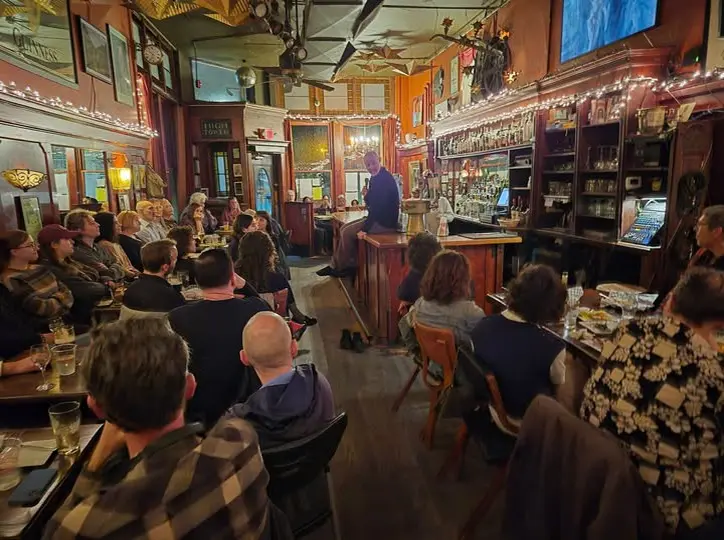
The series officially caught fire last month when the pub hosted its breakout event. Patrons piled into the establishment, quickly filling every available seat and spilling over into standing room only. The evening featured a lecture by renowned Massachusetts Institute of Technology (MIT) professor Agustín Rayo, who tackled the intricate and mind-bending intersections of mathematics and certainty.
Rather than delivering a dry, jargon-laden academic paper, Professor Rayo framed complex ontological and epistemological questions in a manner that was simultaneously intellectually rigorous and thoroughly accessible. Surrounded by the ambient noise of clinking glasses and murmurous conversation, the audience engaged in active, dynamic Q&A sessions that blurred the traditional hierarchy between lecturer and listener.
The Immediate Aftermath and Surging Demand
Following the success of the inaugural night, word spread rapidly across the Greater Boston academic and professional communities. The subsequent announcement of the pub’s next major installment—featuring Wellesley College philosopher Helena de Bres speaking on the perennial existential question, “What is meaning in life?”—triggered an unprecedented response.
Within days of the event going public, capacity limits were instantly reached. Reports from the organizers indicate that an astonishing 120 individuals are currently languishing on the waitlist, hoping for a last-minute cancellation to secure a spot. This extraordinary demand has forced organizers to reconsider venue logistics, ticketing strategies, and the overall frequency of the programming to accommodate a public suddenly hungry for existential reflection alongside their evening meals.
Supporting Context & Metrics: The Boston Intellectual Ecosystem and Beyond
While the success of The Plough and Stars is striking, it occurs within a unique geographic and cultural ecosystem.
The Greater Boston Academic Density
Cambridge and the broader Boston metropolitan area possess one of the highest concentrations of institutions of higher education in the world, including Harvard University, MIT, Boston University, Tufts, and Wellesley College. This creates a distinct demographic reality: a population deeply saturated with academics, researchers, students, and educated laypeople who possess a professional or personal penchant for intellectual stimulation.
However, attributing the success of “Philosophy Nights” solely to geographic demographics would be an oversight. Similar initiatives in less academic-centric cities suggest a broader, systemic shift in how the public consumes ideas. Modern audiences are increasingly fatigued by hyper-polarized digital spaces and are actively seeking physical, communal environments where nuanced, civil discourse can take place face-to-face.
Quantitative Metrics of Public Engagement
- Capacity Turnout: Initial events regularly max out venue fire codes, indicating an immediate, localized demand exceeding 100+ attendees per session.
- Waitlist Velocity: The 120-person waitlist for Helena de Bres’s upcoming talk on meaning in life demonstrates a conversion rate from interest to attendance that rivals major cultural and entertainment ticket sales.
- Demographic Diversity: Unlike university seminars populated strictly by enrolled undergraduates, the demographic breakdown at The Plough and Stars spans generations—uniting graduate students, tech workers, retired professionals, and local blue-collar patrons in a shared intellectual endeavor.
Official Statements and Academic Perspectives
The movement toward public philosophy reflects a growing consensus among modern academics that scholarship has an ethical obligation to step outside the university gates.
Dr. Agustín Rayo, reflecting on his experience speaking at the Cambridge pub, noted the unique energy of a non-traditional audience:
"When you lecture in a university hall, you are speaking to people who are there because they are fulfilling degree requirements or building a specific career path. When people pack into a pub after a long workday to listen to a talk on the nature of certainty, they are there purely out of a genuine, unadulterated curiosity about the world. That changes the entire dynamics of the room; the questions are sharper, more grounded, and infinitely more alive."
Philosophers across the region are increasingly viewing public engagement not as a dilution of their academic rigor, but as a vital stress-test for their ideas. If a philosophical concept cannot be explained clearly and compellingly to a room of pub-goers over a pint of ale, the argument may require further refinement.
Scholars specializing in public sociology and cultural anthropology point out that spaces like The Plough and Stars serve a crucial civic function. In an era marked by social fragmentation and loneliness epidemics, public philosophy nights offer a low-stakes, high-reward framework for community-building rooted in shared contemplation rather than partisan debate.
Future Outlook: The Global Public Philosophy Movement
As The Plough and Stars navigates its surging popularity and grapples with logistical challenges like waitlists and venue capacities, the broader implications for public philosophy are profound.
Expanding the Blueprint
The success in Cambridge begs a larger question: If philosophy can thrive in a pub setting here, where else can it take root? Across the globe, similar dining and drinking establishments have experimented with public lectures, science cafés, and philosophical salons—from Café Philosophique movements in Europe to localized pub-science nights across North America.
Yet, the organizers of the Cambridge initiative have issued an open call to the global community, asking fellow intellectuals and establishment owners to share their own local experiments in public-facing thought:
- What do these spaces look like in different cultural contexts?
- How are they navigating the balance between casual hospitality and intellectual depth?
- What economic and social models sustain these gatherings over the long term?
The Road Ahead for The Plough and Stars
For The Plough and Stars, the immediate future involves exploring scalable solutions to meet public demand. Whether that means expanding into larger spaces, increasing the frequency of events, or streaming discussions for broader accessibility, one thing is certain: the appetite for deep thought is robust.
Ultimately, the phenomenon at The Plough and Stars proves that human beings retain an innate, unquenchable desire to ask the big questions—who we are, what we know, and what makes life meaningful. By removing the academic gatekeepers and pairing deep inquiry with the warmth of neighborhood hospitality, Cambridge has reminded us that philosophy was never meant to be locked away in an ivory tower. It belongs right where the people are: sharing a table, raising a glass, and thinking together.





Comments
Facebook App ID not configured. Please add it in the Customizer.