
Executive Overview
In the ever-evolving landscape of contemporary fiction, authors constantly seek innovative methods to deepen reader immersion, challenge conventional narrative structures, and redefine the boundary between fiction and reality. Few literary devices possess the disruptive power of the fourth wall—the imaginary threshold separating the audience from the fabricated world of the characters. While traditional fourth-wall breaks are often utilized for comedic relief, dramatic irony, or brief authorial winks, dark romance author Hanna Harp has re-engineered this classic technique into a core narrative mechanism.
In her debut novel, Haunting the Hunter, and its highly anticipated sequel, Haunted Hearts (released today, October 27, 2026), Harp introduces a revolutionary premise: the reader is not merely an observer, but an active love interest within the story. This choice is far more than a marketing gimmick or a fleeting stylistic choice; it serves as the psychological lifeblood of her fictional universe. By casting the reader as a faceless, omnipresent entity that haunts the protagonist, Cade Halloway, Harp uses the fourth wall to explore profound themes of control, vulnerability, and surrender.
This deep-dive investigation explores the mechanics of Harp’s writing methodology, the psychological framework required to make a reader-as-love-interest dynamic function seamlessly, and the broader implications of blurring the lines between author, character, and audience in modern speculative romance.
Read Also
Detailed Chronology: The Evolution of a Boundary-Breaking Concept
To understand how Harp arrived at the architecture of the Bound Duet, one must examine the chronological progression of her artistic vision, which spans a decade of world-building and character refinement.
Phase 1: The Genesis of Immersion (Years 1–5)
Harp began constructing her fictional universe nearly ten years ago. From the outset, she recognized that the ultimate goal of reading is total immersion. Readers instinctively step into the shoes of protagonists, living thousands of lives between the covers of a book. However, Harp became fascinated by a counter-intuitive premise: What if the characters could sense the reader’s presence? What if the audience’s gaze was not passive, but actively altered the psychological trajectory and fate of the characters? This conceptual seed remained dormant while she honed her fundamental storytelling mechanics, adhering to the classic adage that hard work ultimately supersedes raw talent.
Phase 2: Deconstructing the Skeptic in Haunting the Hunter (Debut Release)
In her debut novel, Harp deployed the fourth-wall break as an aggressive character-development tool. Her protagonist, Cade Halloway, is introduced as an intractable skeptic. As a professional hunter constantly on high alert for danger, Cade controls every single facet of his environment.
To force Cade to relinquish control, Harp introduced the reader as an intangible entity haunting his periphery. Initially, Cade experiences mild dissociation and paranoia—standard physiological reactions for a hyper-vigilant man who feels a persistent gaze. However, as the haunting persists, the sensation shifts from a perceived threat to something soft, magnetic, and profoundly safe. By making safety feel synonymous with vulnerability, Harp weaponized the fourth wall to break down Cade’s emotional defenses until he actively began addressing the reader directly.
Phase 3: Establishing Stakes and Consent (The Lead-Up to Book 2)
As the narrative expanded into a multi-POV structure, Harp faced a critical logistical hurdle: ensuring that the reader mattered in a tangible, plot-altering way despite not having a voice to physically intervene. Her solution lay in the architecture of the alternating perspectives. Because the reader shares the visual and psychological field of view across multiple characters, the audience functions as a narrative bridge, passing vital information between characters at imperative plot junctions.
Furthermore, integrating the reader as a literal love interest required a meticulous ethical framework: consent. Because the reader is directly implicated in the narrative, Harp transformed the traditional trigger warnings page into an interactive contract. This page serves as a formal invitation, asking the reader to consent to the immersive dynamic before stepping into the world, thereby establishing a bold psychological tether between audience and protagonist long before the climax of the story.
Supporting Context & Metrics: Literary Precedents and Psychological Mechanics
Breaking the fourth wall is by no means a modern invention, but its application in the dark romance and romantasy genres represents a radical shift in reader-response theory.
Classical Antecedents
Throughout literary history, authors have experimented with acknowledging the reader to forge intimacy:
- Charlotte Brontë’s Jane Eyre: Employs direct address ("Reader, I married him") to create an unbreakable bond of confessional trust between narrator and audience.
- William Goldman’s The Princess Bride: Uses framing devices and direct authorial interjections to remind the reader of the storytelling construct.
- Michael Ende’s The Neverending Story: Blurs the boundaries of reality by having characters interact with books that mirror the reader’s physical reality.
The Psychology of Reader Investment
Harp’s methodology relies heavily on cognitive psychology and the emotional mechanics of romance tropes. In traditional romance, tension builds toward physical and emotional intimacy—the classic "friends-to-lovers" slow burn or the dramatic satisfaction when a hero is wounded and a villain reacts with fury. Harp translates these universal reader emotions inward.
When Cade feels the reader’s unease, excitement, or intense gaze, his reactions within the text mirror the physiological responses of the audience. By treating the reader’s psychological reactions as emotional signals within the narrative universe, Harp bridges the gap between passive consumption and active participation. Crafting this dynamic required extensive analysis of romance reading habits, psychological stress responses, and the fine line between romantic tension and psychological haunting.
Official Statements and Authorial Philosophy
In reflections on her creative process, Harp emphasizes that breaking boundaries is a necessity for writers striving to make an impact in crowded literary markets. Below are key insights extracted from her creative philosophy:
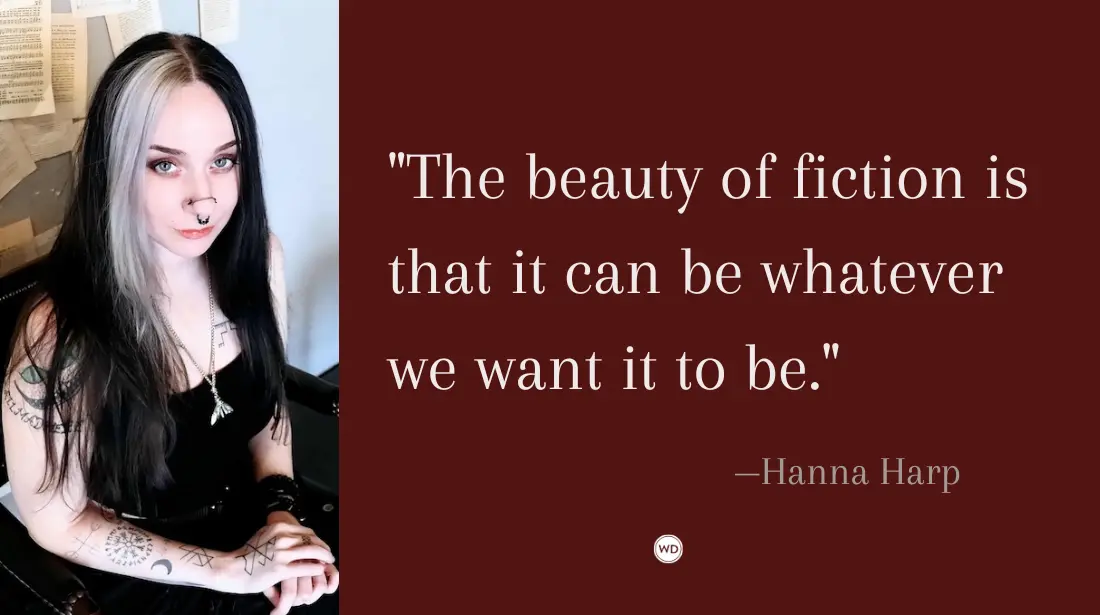
- On the Power of Fiction: "The beauty of fiction is that it can be whatever we want it to be. We build worlds, break boundaries, and ask the hard questions."
- On Overcoming Doubt: "Don’t wait for inspiration to strike; don’t wait for motivation to write that next chapter. Sit down and show up for yourself because you can do this. Constantly overthinking and questioning yourself does nothing but waste your time."
- On Crafting Innovative Tropes: "If you yourself are reading this article in the hopes that you might find tips of how to execute a fourth-wall break in your own story, start with what you already know. Think about how you feel when the tension finally breaks… We all know more about this concept than we realize."
Harp stresses that writers possess an arsenal of conceptual tools, but the most potent weapon remains discipline and emotional authenticity. Regardless of subgenre—whether dark romance, romantasy, dystopian sci-fi, or erotica—the fundamental mission of the author is to craft spaces where readers can lose, and ultimately find, themselves.
Future Outlook: The Release of Haunted Hearts and Beyond
The publication of Haunted Hearts today (October 27, 2026) marks a critical milestone for the Bound Duet and establishes a new benchmark for experimental romance writing. Book two promises to answer the lingering structural questions left by its predecessor: What are the ultimate emotional stakes when the reader is an active participant, and what is the final psychological payoff of a love story that defies the physical laws of its own universe?
As indie publishing and genre fiction continue to push boundaries, Hanna Harp’s work signals a growing appetite for metafictional storytelling. Modern readers no longer wish to remain passive spectators peering through a glass window; they demand to step through the frame, alter the course of fate, and become an indelible part of the narrative tapestry. For aspiring authors watching Harp’s trajectory, the message is unequivocal: abandon rigid outlines, silence self-doubt, and do not hesitate to break the walls down.


Comments
Facebook App ID not configured. Please add it in the Customizer.