
Executive Overview
Every June, the geography of American professional basketball maps a stark dichotomy onto the streets of New York. Early in the month, a victory parade cuts through Manhattan to celebrate the triumphant champions of the NBA Finals. Weeks later, across the East River in Brooklyn, a very different ritual takes place at the Barclays Center: the NBA Draft, an event engineered to process, categorize, and reward the league’s losers.
Yet, the economics of professional sports rarely permit simple definitions. Not all losses are created equal. Under the current framework of the NBA draft lottery, weighted odds transform last season’s on-court failures into valuable assets. Franchises like the Washington Wizards and the Utah Jazz mastered this arithmetic, converting grueling 2025–2026 campaigns into prime top-tier draft selections. Meanwhile, teams such as the Memphis Grizzlies and the Chicago Bulls rode pure statistical fortune upward in the selection order.
For these four franchises, the lottery was a triumph. But this draft carries historic significance beyond the fate of its top picks. Beginning next year, the NBA will institute sweeping lottery reforms designed to eradicate intentional tanking, making this class the final cohort to directly monetize systemic losing.
Read Also
Against this backdrop of impending regulatory shifts, the draft remains a curious hybrid of industry convention and public theater. It is an enterprise where corporate sponsorship eclipses athletic nostalgia, where information is commodified into split-second mobile alerts, and where fans participate in a hyper-mediated ecosystem that often feels entirely divorced from the game played on the hardwood.
Detailed Chronology: A Season of Misfortune and the Draft Night Unfolding
The anatomy of the modern draft cannot be understood without tracing the complex cascades of failure that position teams on the Barclays Center stage.
The Triumphs of Strategic Failure
The Wizards and the Jazz executed masterclasses in downward mobility during the 2025–26 season, securing the weighted mathematical favor required to command the draft’s upper echelon. Paired with the fortunate leaps of the Grizzlies and Bulls, these franchises form the final guard of "lottery champions" under the dying rules of an era that rewarded strategic uncompetitiveness.
The Decathlon of Nets Despair
Few organizations can rival the comprehensive misfortune experienced by the Brooklyn Nets. Their season unspooled on multiple fronts simultaneously:
- On-Court Collapse: They posted the third-worst record in the NBA.
- Draft Lottery Misfortune: Despite holding tied-best odds for the first overall selection, they plummeted to the sixth pick.
- Historical Wastage: Last year’s draft saw them burn an unprecedented five first-round selections—the most in modern draft history—on a rookie cohort seemingly powerless to stem the tide of losses.
- The Ghost of Super-Teams Past: The franchise continues to suffer the existential hangover of its short-lived, star-studded Kevin Durant, Kyrie Irving, and James Harden era from 2021–2022.
- Cultural Subjugation: They endure the indignity of sharing a media market with their cross-river landlords, the triumphant New York Knicks.
The Pacers’ Tragic Arc and Sacramento’s Vanished Beam
The Indiana Pacers offer a sobering lesson in the fragility of momentum. After defeating the Knicks in the 2025 Eastern Conference Finals and pushing the Oklahoma City Thunder to a grueling seven-game NBA Finals, star point guard Tyreese Haliburton suffered a torn Achilles tendon. Deprived of their floor general, the Pacers faltered through the subsequent season, sinking into a dismal tie with Brooklyn and Washington.
Compounding their misery, a mid-season trade forced them to surrender their draft position to the LA Clippers. Having slipped to the fifth pick, the protections safeguarding their selection evaporated—a standard mechanism in modern front-office transactions—leaving Indiana empty-handed in the first round. Next year, with a healthy Haliburton, the Pacers will attempt to resurrect the roster that nearly claimed a title. The Nets, conversely, return largely the same core that won just 23 percent of their games, banking entirely on internal rookie development and the addition of former Knick Julius Randle.
Rounding out this triad of woe are the Sacramento Kings. Holders of a 45.2 percent statistical probability of landing a top-four pick, the Kings watched their fortunes dissolve as they settled for the seventh selection. The cultural high of the 2022–2023 "Beam Team"—whose purple laser pierced the Sacramento sky after every home victory—has faded into familiar mediocrity.
Supporting Context & Metrics: The Mechanics of the Draft and the Information Economy
To look past the melodrama of the lottery is to examine the draft as a piece of industrial machinery. At its core, the draft is a convocation of young athletes shepherded onto a stage to don embroidered caps and embrace league executives before flashing cameras. It is the public-facing termination of a long, opaque pipeline of scouting, analytics, and backroom negotiation.
[Underlying Scouting & Analytics Pipeline]
          │
          ▼
[Front Office Backroom Negotiations]
          │
          ▼
[The Draft Lottery Algorithm (Weighted Odds)]
          │
          ▼
[The Barclays Center Spectacle (Industry Event as Public Theater)]
The Regulatory Labyrinth
Each selection grants a franchise the exclusive rights to sign a player to a standardized rookie contract. Regulated meticulously by the Collective Bargaining Agreement (CBA) between the NBA and the National Basketball Association Players Association (NBPA), these rights cannot compel a player to labor against their will, though decades have passed since a draftee publicly rejected an organization.
Operating alongside the draft is the league’s byzantine salary-cap structure. Terms like "salary aprons," "frozen draft picks," "Bird Rights," and various mid-level, traded-player, and disabled-player exceptions demand that modern fans possess an ad-hoc fluency in contract law and forensic accounting.
The Corporate Landscape of the Arena
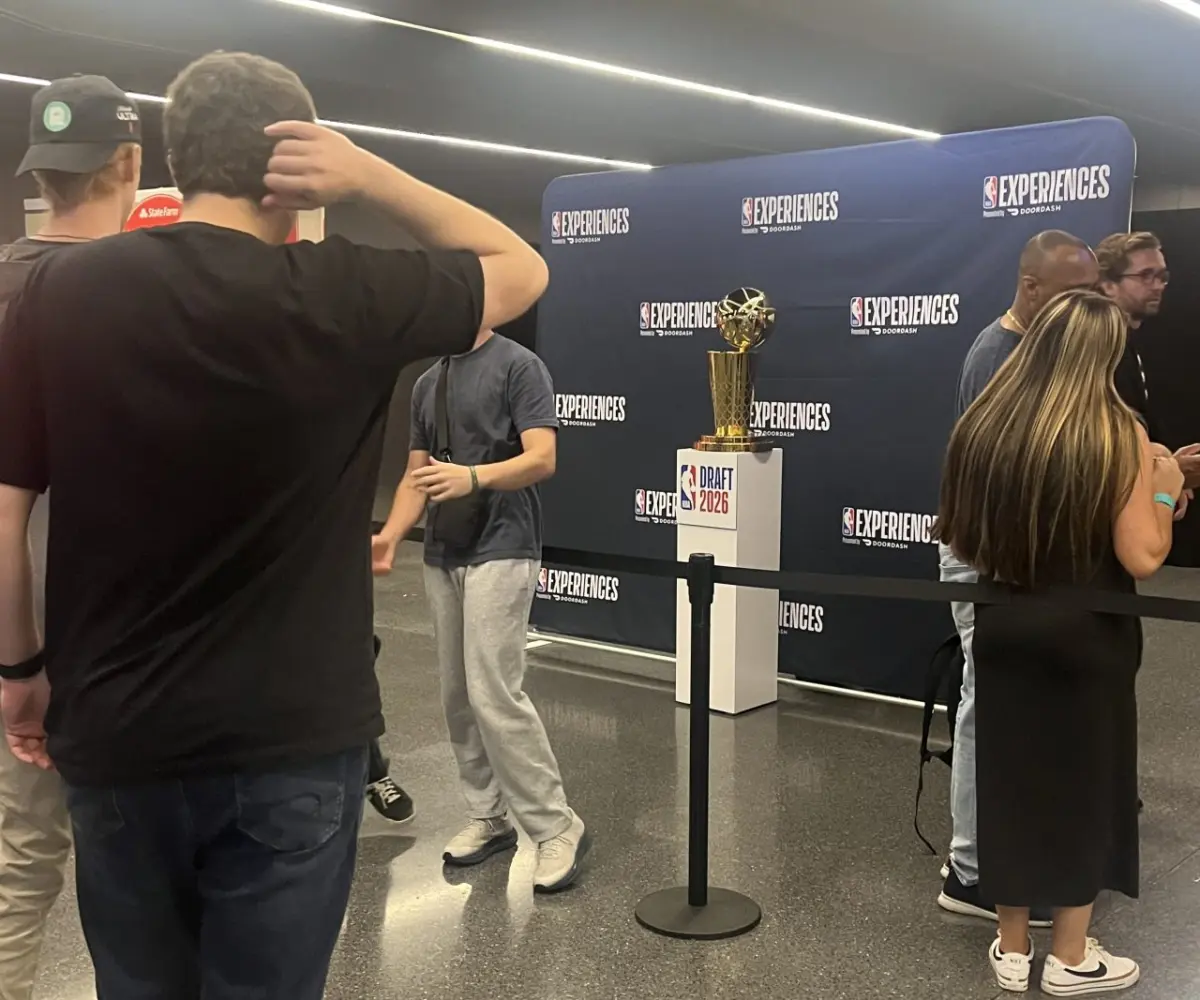
Inside the Barclays Center, the fan experience is thoroughly commodified. Walking through security gates branded by corporate sponsors, attendees are immediately funneled into interactive marketing activations. Visitors line up to take photographs with a glass-enclosed, allegedly authentic Rookie of the Year trophy, or pose beside a traveling Larry O’Brien Championship Trophy presented by corporate logistics partners.
The corporate saturation reaches its zenith with ubiquitous promotional giveaways, such as the smiling Jake From State Farm Funko Pop, ensuring that even the most visceral sports fandom is thoroughly cross-promoted.
The Mutation of Sports Journalism: From "Woj Bombs" to Real-Time Speculation
Nowhere is the modern transformation of the NBA more apparent than in its media ecosystem. The league has effectively bifurcated into two parallel products: the physical game of basketball and the relentless, 24-hour soap opera of league business.
For years, the journalism of this psychodrama was dominated by Adrian Wojnarowski, whose "Woj bombs" pioneered a transactional, access-driven model of news-breaking. Upon Wojnarowski’s retirement—prompted in part by a disillusionment with the transactional void of modern sports reporting ("Nobody gives a shit. Nobody remembers in the end. It’s just vapor")—his mantle was assumed by Shams Charania.
Operating under the intense scrutiny of digital platforms and deeply intertwined with sports betting markets, Charania’s real-time leaks represent the absolute convergence of journalism, social media brand promotion, and market manipulation. On draft night, even inside the arena, the traditional drama of the podium announcement was routinely hollowed out by push notifications, fantasy basketball alerts, and aggregators delivering draft selections minutes before commissioner Adam Silver stepped to the microphone.
Official Statements & Policy Shifts
The landscape of professional basketball governance is undergoing its most significant structural evolution in decades.
- The Death of Tanking: League executives have formally acknowledged that the traditional lottery incentives encourage systemic uncompetitiveness. By announcing the upcoming structural overhaul of the lottery system, the NBA is effectively slamming the door on an era where losing could be systematically leveraged into guaranteed franchise salvation.
- Regulatory Compliance: The league office, alongside player representation agencies, continues to tighten protocols governing information flow. In response to concerns regarding sports gambling integrity and the premature leaking of draft selections and trade configurations, the NBA has exerted increased oversight over media personalities operating within league venues.
While the league strives to maintain the illusion of competitive integrity on the floor, the economic reality remains tied to the speculative entertainment complex that drives modern engagement.
Future Outlook: Navigating the Post-Tanking Era
As the lights dim at the Barclays Center and the crowds filter out into the Brooklyn night, the league faces a horizon of radical uncertainty.
The elimination of the traditional lottery incentives next year forces front offices to abandon decades-old blueprints built around intentional losing. Franchises can no longer rely on a mathematical descent to the bottom of the standings to secure foundational talent. Instead, general managers must navigate an increasingly complex salary-cap landscape, relying on player development, shrewd asset management, and cultural stability rather than the lottery gods.
For the four "lottery champions" of this cycle—the Wizards, Jazz, Grizzlies, and Bulls—the pressure is immediate. They represent the final beneficiaries of a dying system, tasked with converting their newly acquired draft capital into sustainable on-court success before the rules change beneath their feet.
Meanwhile, the fans continue to cycle through arenas, caught between the corporate packaging of the modern sports entertainment complex and the enduring, irrational hope that this year, finally, their team might stop losing. Long is the way and hard, that out of Hell leads up to light.





Comments
Facebook App ID not configured. Please add it in the Customizer.