
Executive Overview
In the pantheon of 1980s cinema, few cultural artifacts loom as large, neon-drenched, and ubiquitously recognized as Ivan Reitman’s 1984 supernatural comedy-blockbuster, Ghostbusters. As part of an ongoing critical retrospective examining the golden age of 1980s fantasy and speculative filmmaking—an era characterized by unbridled practical wizardry, tonal audacity, and a distinct lack of the hyper-polished, focus-grouped sheen of 2000s franchise filmmaking—Ghostbusters stands alongside Tim Burton’s Beetlejuice as a dual pillar of fantasy-horror-comedy.
Yet, four decades after its theatrical debut, evaluating Ghostbusters requires navigating a complex labyrinth of collective nostalgia, formal cinematic achievement, and modern cultural reassessment. Written by Dan Aykroyd and Harold Ramis, the film successfully fused hard-science parapsychological jargon with blue-collar blue-collar blue-collar blue-collar blue-collar blue-collar Blue-collar blue-collar labor dynamics, transforming Manhattan into a playground for spectral insurrection.
While its visual effects, production design, and genre-defining high-concept premise remain masterclasses of studio filmmaking, a modern critical lens exposes structural flaws. The film’s pacing, dated comedic rhythms, recurring instances of mid-1980s “sex-pest” humor, and libertarian, Reagan-era bureaucratic skepticism present friction for contemporary audiences. Nevertheless, its monumental footprint on pop culture—spawning an empire of animated series, merchandising juggernauts, contentious reboots, and modern legacy-quels—cements its status as an unshakeable milestone in cinematic history.
Read Also
Detailed Chronology: The Genesis and Fall of New York
The narrative architecture of Ghostbusters relies on a masterclass of escalating stakes, transitioning seamlessly from academic satire to apocalyptic urban disaster.
Act I: Academia, Eviction, and Enterprise
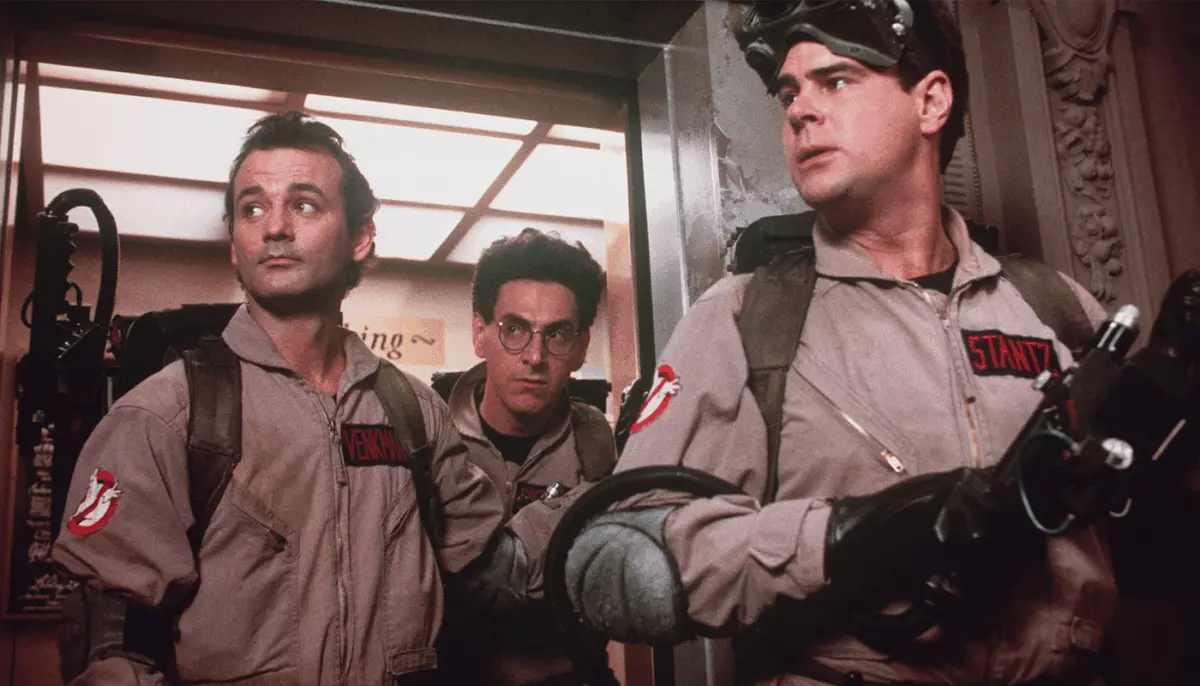
The story introduces three eccentric parapsychology professors at Columbia University: the wry, cynical, and openly opportunistic Peter Venkman (Bill Murray); the wide-eyed, excitable true believer Ray Stantz (Dan Aykroyd); and the deadpan, hyper-rational mastermind Egon Spengler (Harold Ramis). Utilizing heavy-duty, university-funded hardware, they attempt to map and capture metaphysical anomalies.
When university dean Dr. Filner unceremoniously cuts their funding and expels them from the ivory tower for academic malfeasance, the trio pivot out of necessity. They mortgage Ray’s childhood home, acquire a dilapidated, decommissioned Tribeca firehouse at 14 North Moore Street, and establish the world’s first paranormal extermination service.
Concurrently, classical cellist Dana Barrett (Sigourney Weaver) and her neurotic accountant neighbor Louis Tully (Rick Moranis) experience terrifying incursions by a demonic entity within their Midtown apartment complex at 55 Central Park West. Venkman’s initial investigation yields no physical proof of ghosts, but sparks an immediate, asymmetric romantic fixation on Dana.
Act II: Expansion, Containment, and Catastrophe
As supernatural activity spikes exponentially across New York City—prompted by a hidden architectural conspiracy engineered by the long-dead occultist and architect Ivo Shandor—the burgeoning business expands. They hire a cynical, deadpan secretary, Janine Melnitz (Annie Potts), and recruit a pragmatic, down-to-earth everyman, Winston Zeddemore (Ernie Hudson), to handle the overwhelming operational demands.
Danger escalates when Dana and Louis are possessed by Zuul and Vinz Clortho, demonic demigods serving Gozer the Destructor, an ancient Sumerian entity. Complicating matters further, Walter Peck (William Atherton), an aggressive bureaucrat from the Environmental Protection Agency (EPA), investigates the team’s illegal, high-voltage nuclear containment grid located in their basement. Backed by a court order, Peck forcibly shuts down the grid, releasing thousands of captured specters into the Manhattan atmosphere.
Act III: The Destructor Takes a Form
With the city plunged into chaos and the demonic minions uniting to open a dimensional portal on the roof of 55 Park West, the imprisoned Ghostbusters are released by a desperate Mayor. Armed with unlicensed nuclear accelerators, the team scales the skyscraper to confront Gozer.
Presented with the metaphysical choice to dictate the avatar of their own destruction, Ray inadvertently visualizes a beloved childhood mascot: the towering, gigantized Stay-Puft Marshmallow Man. After a destructive rampage through the city streets, the Ghostbusters execute a desperate gamble, crossing the volatile particle streams of their proton packs to rupture the dimensional rift. The gambit succeeds, banishing Gozer back to the nether realms, saving New York, and cementing the team’s legacy as heroes.
Supporting Context & Metrics: Box Office Dominance and Critical Standing
Commercially, Ghostbusters was an undisputed juggernaut. Released by Columbia Pictures in the summer of 1984, it grossed over $295 million domestically during its initial run, ultimately finishing as the second-highest-grossing film of the year, trailing only Axel Foley’s Beverly Hills Cop. Through subsequent re-releases, its lifetime global box office gross has surpassed $300 million unadjusted, making it one of the most profitable comedy investments in Hollywood history.
Critical reception upon release was largely enthusiastic, recognizing the film’s unique alchemy of special effects and deadpan comedic delivery. The film secured two Academy Award nominations—Best Visual Effects (supervised by Richard Edlund) and Best Original Song (Ray Parker Jr.’s iconic, chart-topping theme song)—alongside BAFTA wins in equivalent categories.
Comparative Financial & Critical Metrics (1984 Blockbusters)
| Film Title | Domestic Box Office | Critical Reception (Rotten Tomatoes / Metacritic) | Academy Award Nominations |
|---|---|---|---|
| Beverly Hills Cop | $234.8 million | 83% / 66 | 1 (Best Original Screenplay) |
| Ghostbusters | $295.2 million | 95% / 71 | 2 (Visual Effects, Original Song) |
| Indiana Jones and the Temple of Doom | $179.9 million | 84% / 57 | 2 (Visual Effects, Original Score) |
Official Statements and Retrospective Critical Analysis
Evaluating Ghostbusters four decades after its release requires reconciling its foundational cultural brilliance with elements that have aged poorly.
The Comedy and Chemistry Deficit
While individual performances remain iconic—notably Harold Ramis’s austere intellect and Rick Moranis’s physical, SCTV-honed neuroses—the film’s comedic pacing can feel sluggish to modern viewers accustomed to rapid-fire contemporary joke delivery. Bill Murray’s signature 1980s persona—the charming, unapologetic, borderline-harassing cynic—reads considerably darker today.
Furthermore, Sigourney Weaver’s performance suffers from structural misogyny embedded in the script; despite her considerable dramatic talents, Dana Barrett is ultimately reduced to a classic damsel-in-distress vehicle trapped in a romance characterized by an absence of genuine chemistry with Murray’s Venkman.
Art Deco Masterpieces and Practical Magic
Where Ghostbusters remains entirely unassailable is its visual and practical craftsmanship. Under the direction of Ivan Reitman and the wizardry of visual effects supervisor Richard Edlund, the film avoids the digital sterility of modern blockbusters.
The monsters were brought to life using practical puppets, animatronics, stop-motion, and optical compositing. Legendary horror illustrator Bernie Wrightson contributed significantly to the creature designs, ensuring that specters like Library Ghost, Slimer, and the terror dogs walked a razor-thin line between genuinely terrifying and darkly whimsical.
The architectural design of 55 Central Park West—blending brutalist Art Deco stonework with ancient Egyptian motifs—serves as a masterclass in world-building, grounding cosmic horror in the everyday geography of Midtown Manhattan. Even Gozer’s final incarnation—an androgynous, David Bowie- and Grace Jones-inspired avatar clad in a translucent, bubble-encrusted romper—remains a triumph of transgressive 1980s villain design.
Future Outlook: The Franchise Afterlife and Indelible Pop Culture Footprint
The legacy of Ghostbusters extends far beyond a single cinematic masterpiece, evolving into an omnipresent corporate and cultural multi-media empire.
Sequels, Reboots, and Legacyquels
The franchise has experienced multiple iterations over the decades:
- Ghostbusters II (1989): A direct, lighter sequel that traded atmospheric New York grit for comedic set-pieces involving river-of-slime municipal threats.
- The Real Ghostbusters (1986–1991): An acclaimed Saturday-morning animated series that expanded the mythos, alongside its darker 1997 successor, Extreme Ghostbusters.
- Ghostbusters: Answer the Call (2016): Paul Feig’s gender-swapped reboot starring Melissa McCarthy, Kristen Wiig, Leslie Jones, and Kate McKinnon. Despite facing severe online backlash from toxic segments of the fandom, the film has undergone significant critical reassessment as a genuinely inventive, fast-paced comedy.
- The Jason Reitman Legacyquels (Afterlife and Frozen Empire): Direct continuations helmed by Ivan Reitman’s son, which pivoted the franchise toward sentimental, high-budget fan service that often prioritized generational reconciliation over fresh narrative risks.
Industry Impact
Beyond its own immediate branding—which saturated grocery store shelves with Ecto Cooler and dominated video game platforms from the Commodore 64 to modern VR—Ghostbusters proved that high-concept, genre-bending, effects-heavy comedies could achieve monumental commercial success. Without its blueprint, the green-lighting of subsequent pop-culture milestones like Back to the Future, The Mask, and the structural DNA of the modern Marvel Cinematic Universe would be unimaginable.
Ghostbusters didn’t just capture ghosts; it captured lightning in a bottle, establishing a cinematic template that Hollywood has spent the last forty years trying—and rarely managing—to replicate.





Comments
Facebook App ID not configured. Please add it in the Customizer.