
Executive Overview
The traditional television "hangout sitcom"—a foundational pillar of American broadcast comedy for over three decades—is undergoing a structural and thematic reinvention. Long defined by high-volume episode orders, pristine urban real estate, and low-stakes romantic entanglements, the genre is adapting to the cultural and economic realities of Generation Z. Central to this wave is Adults, a comedy series created by the writing duo Ben Kronengold and Rebecca Shaw, which recently debuted its second season.
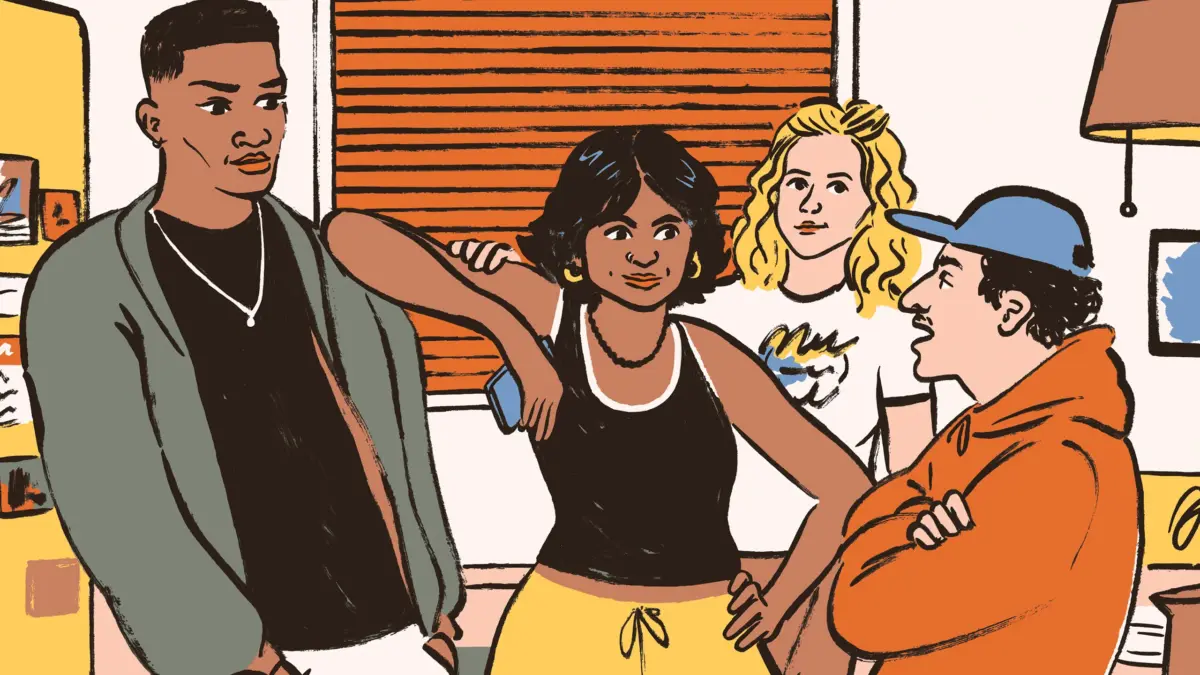
Adults follows five twentysomething housemates navigating extended adolescence in outer Queens. The show opens its second season with a sequence that epitomizes contemporary youth culture: "the Scrub." In this opening scene, the core cast gathers in their living room to systematically delete potentially damaging past social media posts—ranging from cringeworthy political dance tributes to tone-deaf YouTube lists—under the pragmatic directive to "bury your past before it buries you."
This scene signals a broader transition in television comedy. Where earlier classics relied on central gathering spots like coffee shops or bars to foster camaraderie, contemporary entries mirror an era constrained by gig-economy labor, housing insecurity, and digital hyper-awareness. Alongside parallel offerings such as Rachel Sennott’s acerbic I Love LA and Mindy Kaling’s Not Suitable for Work, Adults represents a targeted attempt to recalibrate the multi-character ensemble comedy for an audience whose transition into adulthood is defined by side quests rather than traditional career and life milestones.
Read Also
========================================================================================
                      GENRE EVOLUTION: HANGOUT SITCOM LANDSCAPE
========================================================================================
 ERA          FLAGSHIP TITLES             DOMINANT HOUSING & SETTING   SEASON LENGTH
----------------------------------------------------------------------------------------
 1990s        Friends                     Unrealistically Spacious     22–24 Episodes
                                          West Village Apartment       (Broadcast Model)
----------------------------------------------------------------------------------------
 2000s        How I Met Your Mother       Upper West Side Apartment /  22–24 Episodes
                                          Neighborhood Bar             (Broadcast Model)
----------------------------------------------------------------------------------------
 2010s        Girls, Broad City,          Greenpoint Apartments,       10–12 Episodes
              New Girl                    Lofts, Outer-Borough Rental  (Cable/Early Stream)
----------------------------------------------------------------------------------------
 2020s (Gen Z) Adults, I Love LA,         Outer Queens Family Home /   8–10 Episodes
              Not Suitable for Work       Inherited Floral Living Room (Streaming Model)
========================================================================================
Detailed Chronology: The Architectural Evolution of the Hangout Sitcom
The structural framework of the modern hangout sitcom was established three decades ago through a simple pitch that altered television history.
       [1994] NBC Pitches "Friends"
       "When you're single and in the city, your friends are your family."
                         │
                         ▼
       [2005–2011] Network Refinements
       "How I Met Your Mother" & "New Girl" maintain 22-ep broadcast format.
                         │
                         ▼
       [2012–2014] Cable/Prestige Transformation
       "Girls" & "Broad City" introduce cringe realism, feminism, shorter seasons.
                         │
                         ▼
       [Present] Gen Z Recalibration
       "Adults" & "I Love LA" adapt format for gig economy, digital anxiety, shorter orders.
The Broadcast Golden Age (1994–2010)
In the early 1990s, screenwriters David Crane and Marta Kauffman presented a concept to NBC based on a simple premise: for young adults navigating city life alone, friends serve as a primary family structure. The resulting series, Friends (1994), became a massive ratings success. Its structural model relied on three core components:
- Idealistic urban settings.
- Educated yet underemployed characters experiencing low-stakes misadventures.
- 22-to-24-episode broadcast network orders that allowed long-form character development.
This formula directly inspired subsequent network successes, including How I Met Your Mother (2005) and New Girl (2011), both of which maintained the multi-cam or single-cam broadcast structure centered on shared living spaces.
The Prestige & Cable Pivot (2012–2019)
By the early 2010s, cable networks and premium streaming platforms began modifying the format. The debut of Lena Dunham’s Girls on HBO in 2012 and Abbi Jacobson and Ilana Glazer’s Broad City on Comedy Central in 2014 introduced explicit realism, cringe comedy, and focused social satire.
These shows scaled back season orders to 10–12 episodes and shifted away from broad network appeal. However, they retained the urban playground motif, positioning New York City as an accessible backdrop for personal exploration.
The Gen Z Streaming Recalibration (2020–Present)
The contemporary landscape reflects broader structural shifts in the media industry. Shortened season lengths (often 8 to 10 episodes) on streaming platforms have reduced the screen time available for casual character interactions. Concurrently, creators are retooling the format to address a generation raised during digital permanence and economic instability.
Within this new cohort, Adults functions as a direct counterpart to Rachel Sennott’s I Love LA. Where Sennott’s project mirrors the cynical, self-interested tone of Seinfeld, Kronengold and Shaw’s Adults retains the warm, ensemble-driven core of Friends, updated for a generation facing distinct financial and social realities.
Supporting Context & Metrics: Sociological & Economic Shifts
The divergence between classic and contemporary hangout comedies is underscored by distinct economic shifts, changing social behaviors, and altered production models.
========================================================================================
                   COMPARATIVE SITCOM METRICS & SOCIOECONOMIC INDICATORS
========================================================================================
 METRIC                   CLASSIC ERA (e.g., Friends)   GEN Z ERA (e.g., Adults)
----------------------------------------------------------------------------------------
 Dominant Housing         Spacious West Village Duplex  Inherited Queens Family Home
 Primary Gathering Spot   Central Perk Coffee Shop      Living Room Couch / Kitchen
 Employment Profile       Entry-Level Corporate / Chef  Gig-Economy / Unemployed
 Primary Social Risk      Awkward Romantic Rejection    HR Scrutiny / Social Media Exposure
 Defense Mechanism        Open Emotional Confrontation  "The Scrub" / "Mind Wiping"
 Sexual & Social Norms    Strictly Heteronormative      Fluid / Casual Inclusivity
========================================================================================
1. Housing Deprivation and Real Estate Realism
The physical settings of hangout sitcoms have progressively reflected modern housing constraints:
- 1990s (Friends): Monica and Rachel reside in an expansive, sunlit West Village apartment.
- 2010s (Girls): Hannah and Marnie live in a modest Greenpoint, Brooklyn apartment—a location already becoming cost-prohibitive for real-world young adults.
-
Present (Adults): The ensemble lives in the childhood home of Samir (Malik Elassal), located in outer Queens. The house is furnished with his parents’ floral patterns and carved wood furniture.
Samir’s parents are indefinitely touring national parks, leaving him to sublet room by room to his peers for free while working as a food-delivery driver. The setting underscores a broader reality: for contemporary twentysomethings, private urban real estate is increasingly out of reach, forcing social lives inward to shared domestic spaces.
2. Labor Precarity and the "Side Quest" Mentality
In Adults, traditional career ambitions are replaced by transient labor and gig work:
- Samir freely interrupts his delivery shifts to play video games with underage clients who ordered alcohol.
- Billie (Lucy Freyer), a former academic overachiever, suffers from "gifted-child syndrome," spending her days submitting dozens of job applications without response.
- Life is presented as a series of low-stakes side quests, delaying long-term career choices.
3. Digital Permanence and Social Curation
Unlike previous generations whose youthful mistakes disappeared into unrecorded history, Gen Z characters operate under constant digital visibility. The necessity of "the Scrub" in the Season 2 premiere reflects a genuine anxiety: the risk that past online activity might undermine future employment options.
Official Statements & Creative Perspectives
Industry analysts and show creators emphasize that updating the hangout comedy requires re-examining classic tropes through a modern lens.
                  ┌──────────────────────────────────────────┐
                  │          BEN KRONENGOLD & REBECCA SHAW   │
                  │             (Creators of *Adults*)       │
                  └────────────────────┬─────────────────────┘
                                       │
            ┌──────────────────────────┴──────────────────────────┐
            ▼                                                     ▼
┌──────────────────────────────┐                       ┌──────────────────────────────┐
│       ARCHETYPAL INNOVATION  │                       │      THE EMOTIONAL BUFFER    │
│  "You think you're the first │                       │   "Mind wipe" protocols      │
│  people to be young and      │                       │   protect against social     │
│  adorable in New York?"      │                       │   and career exposure.       │
└──────────────────────────────┘                       └──────────────────────────────┘
Meta-Awareness and Archetype Construction
Creators Ben Kronengold and Rebecca Shaw directly acknowledge the long history of New York-based youth comedies. In one episode, a veteran guest character played by Girls star Zosia Mamet confronts the lead group, asking:
"You think you’re the first people to be young and adorable in New York?"
To address this legacy, the show introduces refreshed character dynamics:
- Anton (Owen Thiele): A compulsive charmer obsessed with creating instant, deep connections with casual acquaintances. In a corporate environment, his lack of traditional professional boundaries leads to workplace complications, such as casually using overly intimate slang during a presentation and attempting to normalize it company-wide.
- Billie (Lucy Freyer): A portrait of post-academic burnout, reliant on digital spaces that validate former potential over present productivity.
- Issa (Amita Rao): An overconfident college friend whose aggressive social demeanor drives much of the group’s chaotic energy.
- Paul Baker (Jack Innanen): A Canadian, sexually fluid, soft-spoken partner to Issa. Paul Baker’s status is tested when the group discovers he maintains a secret, hyper-masculine secondary friend group—dubbed the "Shame Friends."
Social Dynamics and Identity Politics
The series handles identity without performative earnestness. Rather than emphasizing diversity as a central narrative point, Adults integrates queer relationships, fluid sexuality, and multicultural backgrounds naturally into the group dynamic.
This approach is highlighted in the Season 2 premiere during an interaction between Paul Baker’s "Shame Friends" and the main ensemble. The secondary group clumsily attempts to perform modern sensitivity—wearing a "Directed by Greta Gerwig" t-shirt and declaring, "I have mental health!"—satirizing superficial social performance while highlighting the core cast’s easy familiarity.
The Vulnerability Deficit
Despite its sharp observations, industry critics note that Adults reveals a key difference between modern streaming comedies and classic broadcast sitcoms. Where Friends or New Girl built emotional investment through open vulnerability over long seasons, modern short-form comedies often feature characters who use defensive humor to guard against exposure.
In Adults, when characters reveal deep personal secrets, they frequently instruct the listener to perform a "mind wipe"—to acknowledge the secret, then act as though it was never shared. This reflects a self-protective habit:
"Like the Scrub, it’s a self-protective gesture, designed to mitigate risk. But we can get to know the characters only so well when they’re doing their best not to know themselves."
Future Outlook: The Trajectory of Modern Television Comedy
As Adults progresses through its second season—incorporating expanded storylines such as guest appearances by Raven-Symoné as Anton’s older sister and plotlines exploring quarter-life anxieties—it illustrates both the strengths and structural constraints of the modern sitcom.
========================================================================================
                      FUTURE SITCOM LANDSCAPE: STRATEGIC PROJECTIONS
========================================================================================
 CHALLENGE / TREND        BROADCAST MODEL (PRE-2010)     STREAMING REVIVAL (POST-2020)
----------------------------------------------------------------------------------------
 Volume & Syndication     200+ Episodes; High           30–40 Episodes Total; Limited
                          Syndication Residuals          Syndication Value
 Narrative Arc           Slow-Burn Character Arcs       Rapid, High-Concept Arcs
 Economic Representation Idealized/Aspirational         Precarity / Domestic Realism
 Cultural Footprint       Broad Mass Consensus          Targeted Niche Demographics
========================================================================================
1. Structural Constraints of the Streaming Model
The transition from 22-episode broadcast seasons to 8-to-10-episode streaming runs poses challenges for character-driven comedy. Without the narrative space provided by filler episodes and long seasons, modern sitcoms must establish emotional depth quickly while maintaining rapid comedic pacing.
2. A Shift Toward Narrative Progress
The second season of Adults shows signs of moving beyond pure episodic situational humor toward structured character development. Storylines addressing Billie’s quarter-life crisis—amplified by meeting a younger teenager using her old fake ID—and Anton’s family dynamics suggest the series is building a more sustainable narrative baseline.
3. Industry Implications
The success of shows like Adults and I Love LA demonstrates that the hangout sitcom remains a viable television format. However, its future relies on adapting to new constraints:
- Reframing economic limitations as central narrative elements rather than background details.
- Replacing broad consumer lifestyle themes with authentic representations of contemporary youth culture.
- Balancing digital hyper-awareness and comedic detachment with real emotional stakes.
While Adults may not fully restore the multi-season broadcast model of past eras, it offers a functional template for how streaming platforms can sustain the hangout comedy: by focusing on the specific anxieties, domestic realities, and social defense mechanisms of a new generation.





Comments
Facebook App ID not configured. Please add it in the Customizer.