
Executive Overview
For decades, the exhaustive chronicles of the Star Trek universe have introduced viewers to myriad general orders, directives, and operational regulations. Yet few carry the catastrophic and systemic weight of General Order 24. First brought to light in the iconic Star Trek: The Original Series installments “A Taste of Armageddon” and “Whom Gods Destroy,” this extreme protocol authorizes the complete eradication of all biological life on a targeted planetary body.
While referenced sparingly throughout 60 years of television history—and subtly adapted by Captain Benjamin Sisko in the harrowing Deep Space Nine episode “For the Uniform”—General Order 24 has remained a chilling specter in Starfleet lore. This legacy reached a dramatic and unexpected crescendo in the eighth episode of Star Trek: Strange New Worlds Season 4.
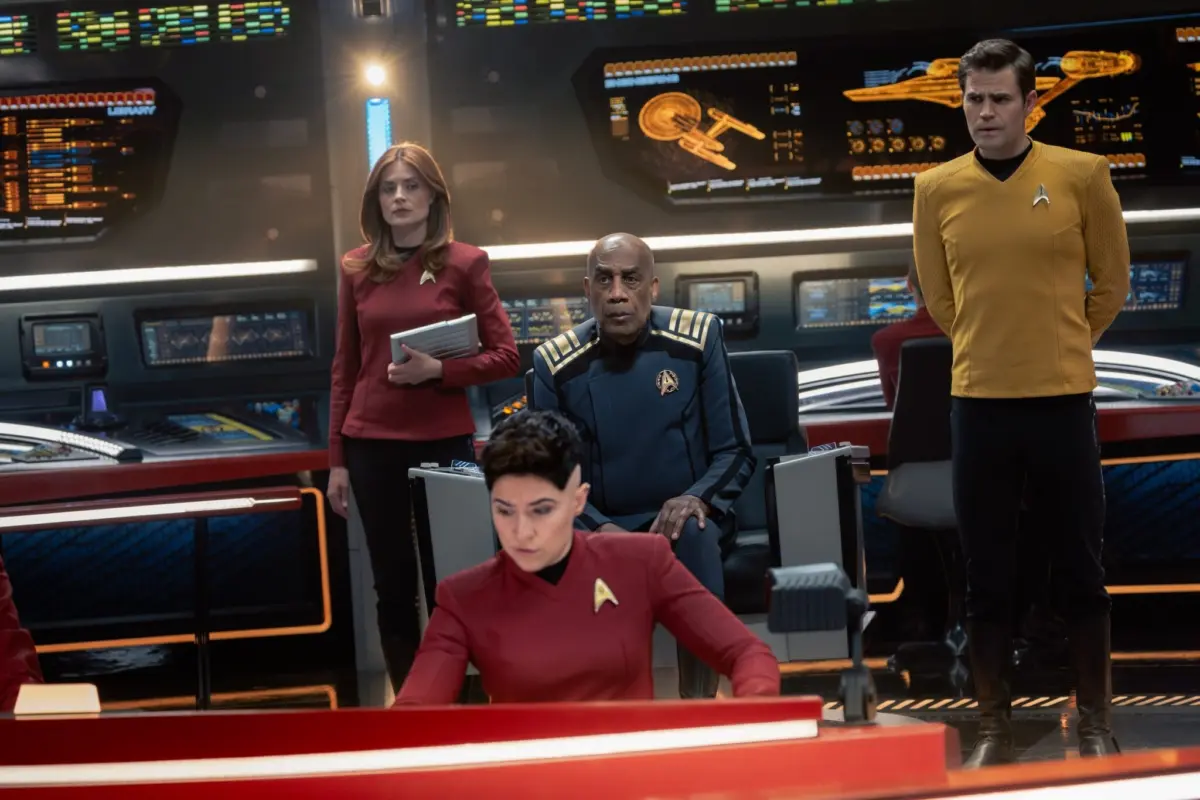
Centering on the arrival of the celebrated war hero Admiral Simon Reeger (portrayed with magnetic complexity by Joe Morton) aboard the USS Enterprise, the episode investigates the corrosive nature of unbridled authority, generational trauma, and the dangerous intersection of personal vengeance and military command. This report provides a comprehensive analysis of the narrative events, character arcs, structural parallels, and broader thematic implications surrounding Admiral Reeger’s tenure, the history of the Kirk family, and the harrowing reactivation of Starfleet’s most draconian mandate.
Read Also

Detailed Chronology: The Commandeering of the Enterprise
The crisis unfolds while Captain Christopher Pike, Number One (Una Chin-Riley), Nyota Uhura, Nurse Christine Chapel, and Cadet Asha are conducting an away mission within a hazardous, subterranean cave network. Because geological interference completely disables standard subspace communications and transporter functionality, the Enterprise is momentarily left without its primary command staff.
In this vulnerable vacuum steps Admiral Simon Reeger. Hailed as a decorated tactician for his decisive victory against the Klingon Empire during the engagement at Zeta Reticuli, Reeger initially projects a diplomatic and polished demeanor. He demonstrates unexpected familiarity with the crew, greeting Spock, La’an Noonien-Singh, and Erica Ortegas by name. However, beneath this velvet glove lies an unforgiving iron fist. Claiming an urgent, time-sensitive directive to intercept a fleeing vessel responsible for a terrorist atrocity that claimed thousands of lives, Reeger abruptly commandeers the flagship.
Because Pike and Number One are unreachable, the highest-ranking officer physically present on the vessel is a visiting officer: Lieutenant James T. Kirk, who is temporarily resting aboard before returning to his post on the USS Farragut. Reeger promptly appoints Kirk as his temporary First Officer for the operation.

Escalation and Ethical Breaches
As the chase commences, the Enterprise pursues an invisible adversary equipped with an impenetrable cloaking device. Though visual sensors are blind, the enemy ship leaves a fleeting subspace wake that the flagship can track. Early warning signs of Reeger’s psychological instability begin to manifest immediately:
- Neglect of Protocol: Reeger fails to consider leaving a communication buoy behind to inform Captain Pike of the vessel’s departure, a critical oversight corrected only after La’an Noonien-Singh prompts him.
- Aggression Toward Civilians: When a neutral cargo vessel crosses their path—raising the risk that its civilian sensors might compromise the Enterprise’s hidden approach—Reeger orders La’an to fire a slow-moving torpedo to disable the craft. Though executed with surgical precision, the act represents an unambiguous violation of Starfleet ethics: firing upon an unarmed, non-hostile civilian ship.
The Invocation of General Order 24
The situation deteriorates further when the fugitive ship plunges into the atmosphere of an inhabited planet home to approximately 5,000 innocent civilians. Unable to track the vessel’s atmospheric trajectory, and desperate to neutralize the threat before it escapes, Reeger takes a step that shocks the bridge crew: he formally issues General Order 24, commanding the Enterprise to systematically annihilate all life on the surface below.
Supporting Context & Metrics: The Kirk Family Legacy and Trope Subversion
The "Crazy Admiral" Trope in Context
Television history has long relied on the dramatic trope of the rogue, hyper-aggressive, or mentally compromised senior flag officer—a narrative device that proliferated extensively throughout Star Trek: The Next Generation (appearing in episodes such as “Too Short a Season,” “Ensign Ro,” “The Drumhead,” and “The Pegasus,” as well as the feature film Star Insurrection).

Recent additions to the franchise, however, have largely pivoted toward stable mentors such as Admiral Cornwell in Discovery, Admiral Vance in Discovery and Starfleet Academy, and Captain Christopher Pike/Admiral Robert April in Strange New Worlds. The introduction of Admiral Reeger serves as a deliberate throwback to the volatile flag officers of the 24th-century era, subverting the audience’s initial goodwill toward Joe Morton’s charismatic portrayal.
Unraveling the Kirk Family History
Unlike the 1960s television landscape, which prioritized episodic resets over deep continuity, modern serialized storytelling allows Strange New Worlds to systematically unpack the complex history of the Kirk family.
Through investigative work by Jim Kirk and insights provided by Dr. Joseph M’Benga—who served as a medical officer aboard the USS Constitution during the Battle of Zeta Reticuli—the narrative exposes a dark historical cover-up:

- The True Hero of Zeta Reticuli: While Admiral Reeger sustained a head injury in sickbay during the engagement, it was actually George Samuel Kirk Sr. (Reeger’s First Officer) who orchestrated the tactical maneuvers that secured the victory.
- Institutional Sabotage: Resenting the younger officer for overshadowing his reputation, Reeger seized the credit and systematically stalled George Sr.’s career, denying him a ship command. Furthermore, Reeger repeatedly manipulated leave schedules to prevent George Sr. from visiting his family, explaining the emotional distance the Kirk brothers experienced growing up.
- A Tragically Noble Silence: In a heartbreaking twist, George Sr. had deliberately chosen to keep quiet, allowing Reeger to maintain his glory—unaware that the Admiral would weaponize that magnanimity to punish the family name.
Official Statements & Narrative Interventions
The escalation on the bridge forces a confrontation between institutional obedience and moral imperative. When Kirk realizes that Reeger’s unyielding drive for total destruction is fueled by personal grief—it is revealed that Reeger’s entire family perished in the terrorist attack committed by the fugitive ship—he takes decisive action.
The Cordrazine Gambit
Recognizing that direct appeals to reason are useless against the unhinged admiral, Kirk executes a high-stakes bluff:
- He alters the ship’s internal telemetry to simulate a catastrophic feedback loop, warning Reeger that firing upon the planet will simultaneously destroy the Enterprise.
- When Reeger flies into a rage—holding a phaser to Kirk’s head and demanding that Spock perform a mind-meld to extract override codes (a request Spock firmly and ethically refuses)—Dr. M’Benga intervenes.
- It is revealed that Kirk has covertly administered a dose of cordrazine—a potent, highly volatile neuropharmaceutical painkiller famously associated with Dr. McCoy’s psychological breakdown in “The City on the Edge of Forever”—into Reeger’s coffee.
Dr. M’Benga willingly falls on his sword, taking official blame for the poisoning to protect Kirk’s career, ensuring that an officer who performed a necessary, moral intervention is shielded from military prosecution.

The B-Story: The Andorian Piracy Threat and Uhura’s Rise
Running parallel to the bridge crisis is an equally compelling subplot involving the landing party. Trapped in the cave network, Pike, Number One, Uhura, Chapel, and Cadet Asha confront a distress signal that turns out to be a trap laid by Andorian pirates led by a ruthless commander (portrayed with sleazy perfection by Currie Graham).
- The Negotiation: Pike’s pragmatic offer to simply purchase the weapons from the pirates underscores his diplomatic leadership style, contrasting sharply with Reeger’s absolute refusal to entertain alternative perspectives.
- Uhura’s Tactical Brilliance: Forced to interface the pirate comms with Starfleet protocols, Uhura seemingly compromises her position before executing a brilliant countermeasure: transforming the system into a high-intensity sonic frequency designed to incapacitate sensitive Andorian antennae.
- Promotion: Recognizing her exceptional heroism under fire, Pike and Number One officially promote Uhura to Lieutenant Junior Grade after only two and a half years as an ensign—a well-earned promotion that cheekily avenges decades of Starfleet career stagnation for junior personnel. Meanwhile, Cadet Asha, wounded during the skirmish and disillusioned by the violence, elects to resign from Starfleet entirely.
Future Outlook & Thematic Resonance
The fallout from Admiral Reeger’s attempted implementation of General Order 24 leaves deep scars across the Enterprise crew. While the rogue admiral is ultimately neutralized and medically relieved of duty by Dr. M’Benga, the invisible terrorist vessel remains at large, posing an active and unspecified threat to Federation security.
Beyond the immediate tactical danger, this harrowing episode cements several core truths for the crew of the Enterprise:

- The Cost of Leadership: The narrative provides a profound meditation on the psychological burdens of command, contrasting Captain Pike’s collaborative, empathetic leadership style with the tyrannical, isolated pathology of Admiral Reeger.
- The Weight of Secrets: By illuminating the sacrifices and systemic injustices faced by George Samuel Kirk Sr., the series deepens the emotional foundation of James T. Kirk, bridging the gap between his roguish early career and the iconic captain he is destined to become.
- The Resilience of Ethics: Ultimately, the episode demonstrates that Starfleet’s highest ideals are preserved not through blind obedience to ancient, catastrophic regulations like General Order 24, but through the moral courage of individuals willing to risk their careers to protect the innocent.
As Star Trek: Strange New Worlds continues its critically acclaimed run, the exploration of foundational lore proves that the franchise’s past remains fertile ground for complex, contemporary storytelling.




Comments
Facebook App ID not configured. Please add it in the Customizer.