
Executive Overview
For every aspiring and seasoned author, the revision cave is a perilous landscape. It is here, amid the graveyard of deleted scenes and tortured syntax, that manuscripts are either forged into literary triumphs or stripped of their pulsing heartbeats. Yet, a fundamental misconception plagues the revision process. Authors routinely conflate two entirely distinct operations: editing the book versus editing themselves.
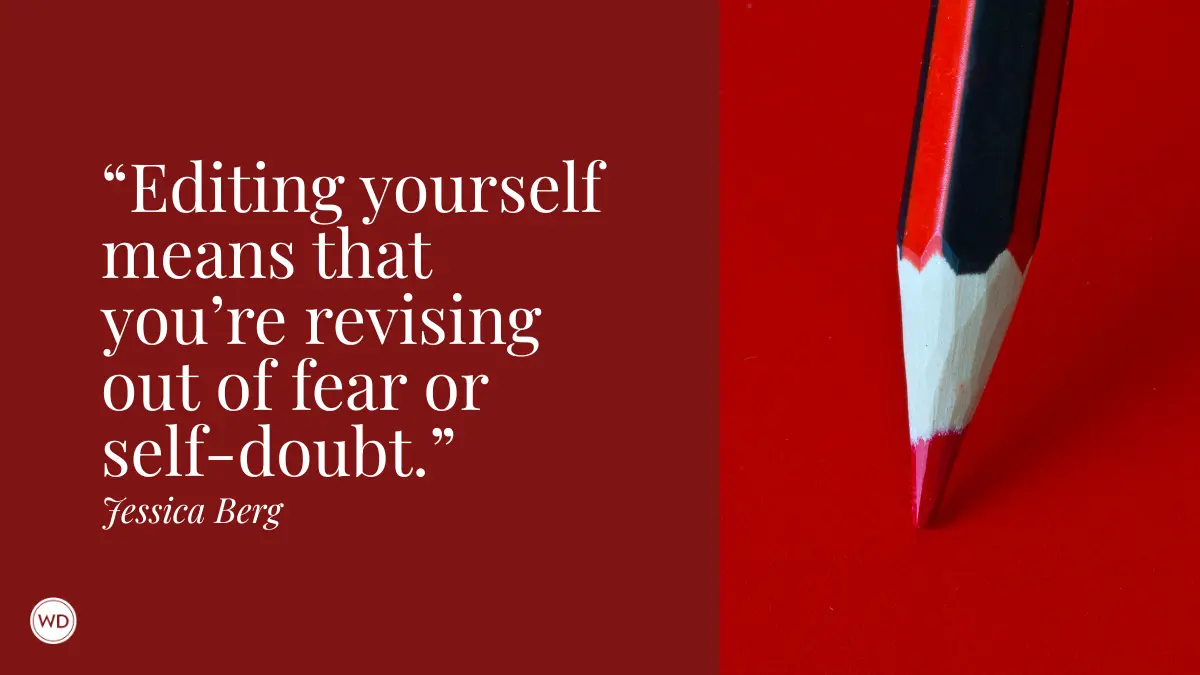
In the high-stakes environment of traditional publishing, where rejection letters sting and market trends loom large, the line between constructive craft refinement and preemptive self-censorship blurs. Editing a book is an act of artistic service—it is the meticulous labor of ensuring the prose serves the narrative architecture, flows seamlessly on the page, and achieves maximum emotional resonance. Conversely, editing yourself is a psychological retreat. It is revision driven by fear, insecurity, and the paralyzing dread that your most idiosyncratic, authentic creative choices will make your work stand out for all the wrong reasons.
This article dissects the invisible trap of preemptive self-censorship. Drawing insights from literary agents and publishing professionals—including perspective from Rosecliff Literary Founder and Agent Jessica Berg—we examine why authors unconsciously sand down their characters’ rough edges, how this homogenization threatens the modern marketplace, and what actionable methodologies writers can employ to protect their authentic voice while still satisfying the rigorous demands of the traditional publishing machine.
Read Also
Detailed Chronology of the Revision Trap: From Blank Page to Sanitized Manuscript
To understand how self-censorship infiltrates a manuscript, one must trace the psychological evolution of an author over the lifecycle of a book project.
Phase I: The Fearless Inception
During the initial drafting phase, authors typically operate in a state of uninhibited flow. The characters are messy, unlikable, morally grey, and delightfully chaotic. The prose bears the unfiltered fingerprints of the creator’s psyche. At this stage, the writing is dangerous, alive, and fiercely original because the author is writing solely for the joy of discovery.
Phase II: The Critique Chamber
Problems begin to materialize the moment the manuscript leaves the author’s solitary workspace and enters the critique ecosystem—beta readers, critique partners, and freelance editors. While external feedback is an indispensable tool for structural development, it introduces a dangerous variable: external expectations.
As notes accumulate regarding pacing, plot holes, and reader sympathy, the author begins to internalize external anxieties. “Will the reader hate this protagonist?” “Is this scene too weird?” “Does this dialogue sound marketable?” Slowly, the knife of revision shifts from tightening the narrative arc to neutering the protagonist’s eccentricities.
Phase III: The Trad-Pub Conformity Squeeze
The final psychological descent occurs when the author sets their sights on traditional publishing acquisition. Staring at bookstore shelves filled with homogenized bestsellers, an understandable survival instinct kicks in. Writers want their books to sell, and the quickest route to marketability appears to be conformity.
Scenes are muted. Provocative character flaws are smoothed over. Edgy dialogue is sanitized. By the time the manuscript lands on an agent’s desk, it has often undergone a silent, systemic bleaching process—erasing the very distinctive spark that would have captured an agent’s attention in the first place.
Supporting Context & Metrics: The Cost of Homogenization in Publishing
The modern literary marketplace is an ecosystem driven by competing imperatives: commercial viability versus artistic innovation. Industry insiders note a troubling paradox: while publishers constantly state they are hunting for "fresh voices" and "breakout hooks," submission piles are increasingly flooded with risk-averse, hyper-sanitized manuscripts that mirror last season’s commercial hits.
The Death of the "Messy" Protagonist
Literary agents read hundreds of manuscripts a year, and their radar is finely tuned for authenticity. When characters are sanded down to ensure universal likability, the narrative loses its friction. Conflict requires friction; flat, agreeable characters create narrative stagnation.
Industry data and qualitative agent feedback consistently highlight that manuscripts are rarely rejected because a character is too flawed or too weird. On the contrary, agents frequently reject projects because the characters have become indistinguishable cogs in a predictable plot machine. When beta reader feedback systematically irons out a protagonist’s jagged edges to avoid offending hypersensitive readers, the emotional payoff of their transformation arc is completely neutralized.
The Psychology of Preemptive Self-Censorship
Why do writers sabotage their own work? Psychologists and publishing veterans point to several root causes:
- Imposter Syndrome: The pervasive belief that one’s natural instincts are inherently flawed and must be corrected to match an imaginary industry standard.
- Rejection Trauma: The subconscious desire to preemptively neutralize any element in the text that an agent, editor, or reviewer might weaponize in a rejection letter.
- The "Likability" Fallacy: The unfounded fear that readers cannot emotionally invest in a story unless the protagonist is morally upright, polite, and universally admired.
Official Perspectives: Navigating Craft Versus Fear
To unpack the subtle boundary separating structural editing from self-censorship, industry experts emphasize the critical role of intention. On the surface, both processes look identical. An author sits before a glowing screen for hours, staring at a single sentence. Words are swapped out, commas are excised, adverbs are slaughtered, and entire paragraphs are transposed.
The physical mechanics of revision do not change whether you are operating from a place of artistic vision or psychological terror. The divergence lies entirely within the author’s internal motivation.
"When you feel this urge to thin the edges, ask yourself if it’s truly needed. Do you want to make the character more likeable because you’re worried your readers won’t connect? Or do you want to make the character more likeable to increase the chances of publication? One is a craft choice and the other is a choice operating from the place of fear."
— Literary Industry Consensus on Character Revision
When an editor or agent encounters a manuscript where the weirdness has been scrubbed away, their reaction is swift. Instead of leaning in with excitement, they experience a palpable sense of fatigue. The manuscript reads like a carbon copy of a hundred other submissions. Consequently, the project is quietly moved to the rejection pile.
Protecting your manuscript’s unique fingerprint requires ruthless self-awareness during the revision cycle. You must interrogate your own edits: Am I cutting this because it weakens the structural integrity of the scene, or am I cutting it because I am afraid of what an anonymous reviewer on Goodreads might say?
Methodological Solutions: The Two-Pass Revision Framework
Recognizing the trap of self-censorship is only half the battle; authors need concrete, mechanical guardrails to prevent their anxieties from bleeding into their prose. To safeguard your manuscript from your own insecurities, industry professionals recommend implementing a strict, compartmentalized two-pass revision methodology.
Pass One: The Structural and Architectural Pass
During your initial major revision pass, your sole mandate is to evaluate the macro-level elements of the story:
- Scene structure and pacing
- Stakes, tension, and narrative momentum
- Character arcs, internal motivation, and external obstacles
The Golden Rule of Pass One: You are strictly forbidden from altering your narrative voice, toning down your characters’ controversial choices, or smoothing over their moral failings.
This phase is dedicated exclusively to making the mechanics of the story work. If a plot hole exists, patch it. If a scene drags, tighten it. But do not touch the idiosyncratic stylistic choices that define your artistic voice. Treat the structural architecture as sacred terrain that is immune to your self-doubt.
Pass Two: The Line-Level and Sentence Pass
Once the macro-structure is rock-solid, transition to the micro-level work. This is where you examine sentence flow, word choice, syntax, and rhythm.
The Golden Rule of Pass Two: If you find yourself cutting a bold metaphor, an unlikable character trait, or a stylistically daring sentence solely because you suspect "someone else might not like it," you are legally bound to put it back on the page.
By separating structural evaluation from voice-polishing, you trick your psychological defenses. You allow yourself to fix genuine narrative flaws without giving your internal critic the opportunity to systematically castrate your unique literary identity. One pass protects the story on the page; the other protects the author from their own worst enemy—fear.
Future Outlook: The Evolution of Authentic Storytelling
As the publishing industry navigates an increasingly crowded and automated landscape, the value of authentic, irreplaceable human voice will only appreciate. In an era where algorithmic content generation threatens to flood the market with competent yet soulless prose, an author’s unique "weirdness" is their greatest commercial asset.
Writers who learn to master the distinction between editing their craft and editing themselves will not only produce more resilient, memorable manuscripts; they will also reclaim the joy of creation. Revision should never be an exercise in flattening your artistic fingerprint to fit a corporate mold. Instead, it should be the rigorous, loving process of sharpening your distinct vision until it cuts straight through the noise of the global marketplace.
Note for Writers: For those looking to dive deeper into the craft of revision and manuscript development, industry leaders continue to offer immersive educational experiences. For instance, writers seeking direct mentorship can join Rosecliff Literary Founder & Agent Jessica Berg alongside WD Editor-in-Chief Amy Jones for an upcoming weeklong writing retreat in Tuscany, offering unparalleled guidance in the heart of Italy’s literary landscape.



Comments
Facebook App ID not configured. Please add it in the Customizer.