
Executive Overview
Certain constants are woven into the fabric of American life: death, taxes, LeBron James taking the floor on opening night, and a pervasive, unshakable public conviction that crime is spiraling out of control. Since Gallup began tracking American perceptions of national crime in 1989, a majority of respondents have consistently reported that crime was worse than the year prior—with only three exceptions: 2000, 2001, and 2025. Even during that historic dip in 2025, 49 percent of polled Americans still insisted that violent crime was on the rise. It stands as perhaps the definitive modern manifestation of negativity bias: our hardwired psychological inclination to grant cognitive dominance to frightening headlines over empirical progress.
Yet, the raw data paint a vastly different, deeply encouraging picture. Federal figures released by the FBI reveal the astonishing magnitude of this perceptual skew. The American murder rate, which crested at a terrifying 10.2 per 100,000 residents in 1980, plummeted to an estimated 4.1 per 100,000 in 2025. This matches the historic lows recorded in 1955 and 1956—the lowest levels ever systematically measured in the United States. Simultaneously, the broader violent crime rate—encompassing murder, rape, robbery, and aggravated assault—dropped by 9.7 percent in a single year, marking the single steepest annual decline since J. Edgar Hoover led the bureau in 1936.
While the statistical reality of the drop is undeniable, the underlying catalysts remain a subject of intense debate among criminologists and policymakers. Analysts agree that there is no singular, tidy explanation for these nationwide historic lows. Proposed drivers range from the tapering off of pandemic-era social upheavals and federal economic relief to declining adolescent alcohol consumption and improved local policing tactics. Yet, for every favored theory, glaring counter-evidence emerges.
Read Also
Nevertheless, researchers can look to one specific urban center where targeted intervention programs have been rigorously measured, yielding concrete proof of success: Baltimore. For half a century—and famously immortalized across five award-winning seasons on HBO—Baltimore served as the nation’s tragic shorthand for unmitigated urban violence. Today, it offers a replicable masterclass in how to dismantle it.
Detailed Chronology: From the Brink of Crisis to Historic Lows
To understand the magnitude of Baltimore’s turnaround, one must confront the depths of its past. For the better part of the last decade, Baltimore routinely recorded more than 300 homicides annually, maintaining a grim baseline of over 200 killings a year for half a century. In July 2015 alone, 45 people were murdered—a staggering toll for a municipality numbering roughly 600,000 residents.
The turning point, however, has been both dramatic and sustained:
- The 2020 Pivot: Following the social upheaval of 2020, city leaders, community organizers, and law enforcement synchronized disparate intervention strategies.
- The 2025 Milestone: Baltimore concluded 2025 with 133 homicides—its lowest total since 1977 and a staggering 60 percent reduction from its 2020 peaks.
- The 2026 Trajectory: Through the first eight months of 2026, the city registered just 60 murders, with the police department targeting an end-of-year total kept strictly under the 100-homicide threshold.
This extraordinary regression from the brink was not born of a single policy, but rather a synchronized convergence of three distinct tactical pillars: harm reduction, aggressive investigative work, and focused deterrence.
The Three-Pronged Strategy
First, Mayor Brandon Scott’s Group Violence Reduction Strategy (GVRS) identifies the micro-demographic of individuals most statistically likely to commit a shooting or become a victim—two heavily overlapping populations. Outreach workers and law enforcement interface directly with these individuals, delivering a dual message: your criminal activities are actively monitored, but immediate social support, housing assistance, and job training are readily available.
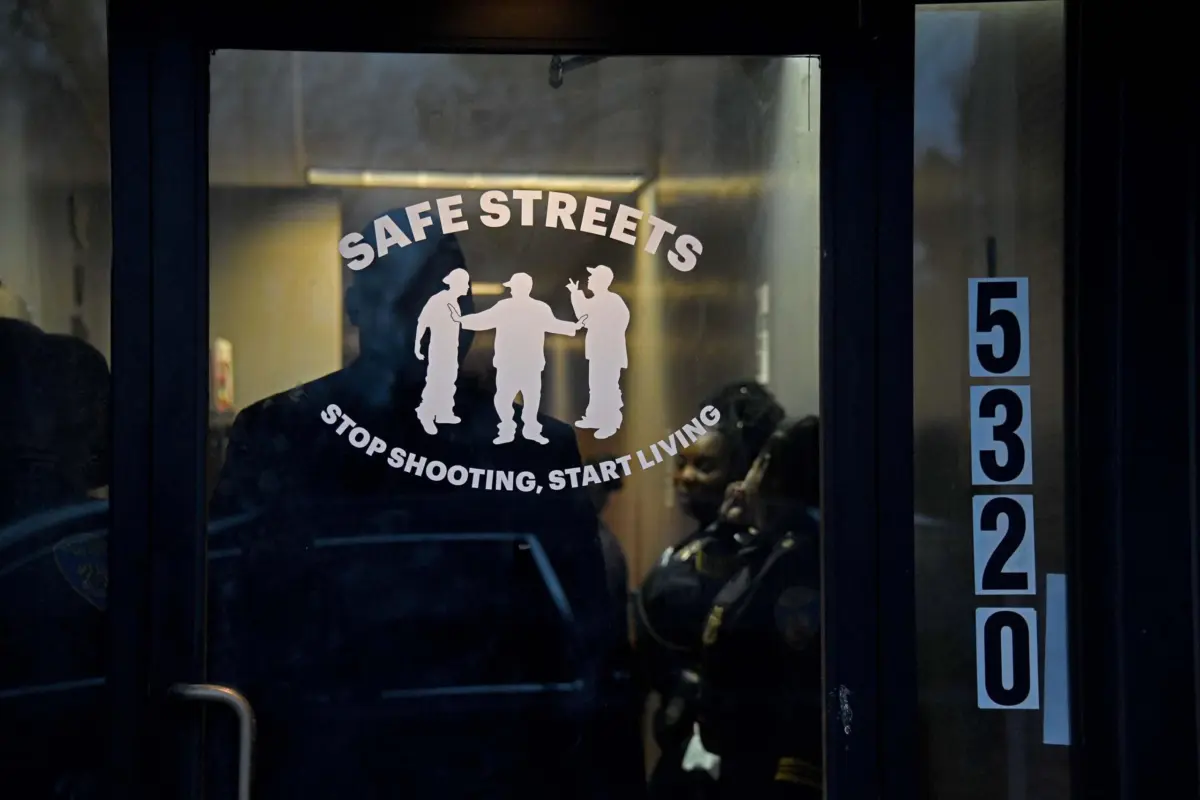
Second, the long-running Safe Streets program deploys credible community messengers into neighborhoods to intercept interpersonal beefs before they manifest as gunplay.
Third, these preventative measures are complemented by a decidedly traditional, tough-on-crime component. The Baltimore State’s Attorney’s Office secured over 2,100 convictions across various gun-related violent crime categories starting in 2023, resulting in the incarceration of more than 1,700 high-risk offenders. Simultaneously, the city’s homicide clearance rate surged to 60 percent by mid-2026, while the non-fatal shooting clearance rate jumped more than 12 percentage points year-over-year. Criminologists have long maintained that the certainty of apprehension deters criminal activity far more effectively than the severity of potential prison sentences—a principle proving vital to violence reduction nationwide.
Supporting Context & Metrics: Isolating the Variables
Proving that a municipal program directly caused a drop in crime, rather than mere coincidence or external socio-economic shifts, is notoriously difficult. Medical trials rely on control groups; cities rarely afford such luxuries. However, Baltimore inadvertently created a natural experiment.
When the Group Violence Reduction Strategy rolled out in 2022, it was deployed exclusively within the city’s notoriously violent Western District, leaving the rest of the municipality as an accidental control group.
A team of independent economists and criminologists seized upon this rollout. By comparing crime rates in the Western District against matched Baltimore neighborhoods lacking the program, researchers discovered that over an 18-month period, fatal and non-fatal shootings in the intervention zone ran approximately 30 percent lower than the control neighborhoods. Killings fell by a comparable margin, though statistical rarity precluded definitive modeling on deaths alone. Crucially, this reduction was not achieved by scaling back law enforcement; arrests for serious violent crimes actually rose by 81 percent.
The Epidemiology of Violence
Baltimore’s modern strategy borrows heavily from two intellectual frameworks born outside traditional criminology:
- The Public Health Model: In the 1980s and 90s, physician Dr. Gary Slutkin fought tuberculosis in San Francisco, cholera in Somali refugee camps, and HIV/AIDS across sub-Saharan Africa. Returning to Chicago in 1995—a year the city recorded over 800 homicides—Slutkin analyzed local shooting maps and experienced an epiphany. The clusters, timelines, and transmission routes of urban gun violence mirrored infectious diseases. Positing that violence was a contagion, Slutkin argued it must be treated like an epidemic: identify the primary vectors, interrupt the transmission cycle, and alter the environmental conditions that foster spread. This foundational model became Cure Violence Global, directly inspiring Baltimore’s Safe Streets.
- Focused Deterrence: Pioneered in Boston during the mid-1990s by criminologist David Kennedy, this approach revealed a stark reality: roughly 61 gangs comprising about 1,300 members—accounting for less than 1 percent of the city’s youth demographic—were directly tied to at least 60 percent of youth homicides. By convening these specific individuals alongside law enforcement, prosecutors, and community elders to outline unequivocal legal consequences alongside off-ramps, urban gun violence plummeted.
The power of these integrated methodologies is mirrored globally. In the early 2000s, Glasgow, Scotland, was internationally stigmatized as the murder capital of Europe. In response, the Strathclyde Police established a Violence Reduction Unit grounded in the premise that violence is a preventable public health crisis. Interventions ranged from dispatching trauma surgeons into public schools to graphically illustrate the anatomical devastation of knife wounds, to stationing hospital-based outreach workers at patient bedsides to intercept retaliatory violence during the critical golden hours post-trauma. By 2024–25, Scotland recorded just 45 homicide victims—the lowest figure since comparable record-keeping began in 1976—and solved every single case.
Official Statements and Institutional Perspectives
Despite localized successes, national experts urge caution against oversimplification. Adam Gelb, president and CEO of the Council on Criminal Justice, emphasizes that there is no singular, universal explanation for the historic nationwide decline in homicides. Similarly, data analyst Jeff Asher—who tracked the nascent stages of this decline before mainstream recognition—notes that every prominent candidate theory carries persistent blind spots.
Furthermore, empirical evaluations of street-level interventions yield mixed results. A comprehensive 2023 study examining a comparable street-outreach initiative in Boston found no discernible statistical effect on community violence levels. Meanwhile, the latest evaluations of Baltimore’s Safe Streets initiative across 11 sites showed promising metrics—such as a 42 percent drop in youth homicides and a 21 percent reduction in youth shootings—yet statistical variance prevents researchers from entirely ruling out random fluctuation, with individual sites displaying divergent trajectories.
Dr. Emily Owens, a prominent criminologist at the University of California, Irvine, argues that the broad, cross-jurisdictional nature of the crime decline—affecting large metropolises and small towns alike, under both Democratic and Republican local administrations—suggests that macro-level societal shifts are at play, superseding the localized impact of municipal policy tweaks. Moreover, sustainability remains a looming threat: many of the high-performing community violence intervention programs across the U.S. were initially catalyzed by billions of dollars in federal pandemic relief funds, a financial wellspring that is rapidly drying up.
Future Outlook: The Pump Handle Analogy
To contextualize the uncertainty surrounding the current crime drop, historians often point to an 1854 cholera outbreak in London’s Soho district. At the time, hundreds of residents were dying, and medical science had yet to identify the microscopic pathogen responsible for the disease. Dr. John Snow, a local physician, mapped the fatalities and noticed they clustered tightly around a public water pump on Broad Street. Without knowing the exact etiology of cholera, Snow successfully convinced the local parish board to remove the pump handle.
The dying stopped immediately in Soho—long before the bacterium Vibrio cholerae was officially identified 29 years later.
As America navigates the complexities of falling violent crime rates, post-pandemic adjustments, and shifting municipal strategies, the lesson of Soho resonates. We may not yet possess a unified, mathematically sealed formula that fully explains why crime is plummeting across America’s cities. But whether through Baltimore’s synchronized Group Violence Reduction Strategy, Glasgow’s trauma-informed public health approach, or smarter, data-driven policing, the human toll of violence is abating. And in the ledger of public safety, saving lives today takes precedence over waiting for perfect theory tomorrow.




Comments
Facebook App ID not configured. Please add it in the Customizer.