At the Buffalo AKG Art Museum, a modest 40-by-30-inch painting titled Uncle’s Crossing (2022) has captured the imagination of critics and visitors alike. Created by Los Angeles-based artist Karla Diaz using thinned-out acrylic, the canvas depicts two mustached Latino men, one carrying the other on his shoulders. Its joyful, casual composition masks a harrowing and deeply controversial subject: Diaz’s late uncle, who worked as a coyote—an operative who guides undocumented immigrants across the United States border.
Uncle’s Crossing is just one of many provocative, boundary-pushing works featured in "Let Us Gather in a Flourishing Way," an ambitious, medium-focused painting survey that closes its run at the Buffalo AKG Art Museum this weekend. Curated by Andrea Alvarez, the exhibition brings together 58 contemporary Latinx artists whose works interrogate political borders, challenge disciplinary boundaries, and dismantle historical stereotypes.
Far from a monolithic representation of Latinx art, the exhibition serves as a heterogeneous, expansive mosaic. Encompassing everything from unconventional textile installations and adobe pathways to monumental figurative canvases, "Let Us Gather in a Flourishing Way" represents a watershed moment for contemporary art museums. As the show prepares to depart on a national tour to institutions in Iowa, Phoenix, and Seattle, its impact extends far beyond its physical galleries, signaling a permanent shift in how major American museums collect, exhibit, and contextualize Latinx art histories.
Detailed Chronology: The Genesis of a Landmark Exhibition
The intellectual origins of "Let Us Gather in a Flourishing Way" date back nearly a decade, rooted in a deliberate institutional strategy to diversify the Buffalo AKG Art Museum’s curatorial vision and permanent collection.
2018–2021: Research and Curatorial Inception
Andrea Alvarez joined the Buffalo AKG Art Museum as a curatorial fellow in 2018. Tasked with finding ways to introduce contemporary Latinx art to Western New York, Alvarez began laying the groundwork for a major institutional intervention. Following her promotion to assistant curator in 2021, the project entered its active development phase.
Alvarez embarked on an extensive research journey, conducting studio visits across the United States and Puerto Rico—from Los Angeles and Miami to Chicago, Phoenix, and Texas. During these travels, she homed in on the discipline of painting, recognizing that the museum’s robust 20th-century painting holdings would provide visitors with an accessible entry point to engage with contemporary innovations.
Summer 2024: Finalizing the Checklist and Collaborative Selection
By the summer of 2024, Alvarez finalized the roster of 58 artists. Eschewing top-down curatorial mandates, she deliberately involved the artists in selecting which specific works would represent them. Because artists from different regions—such as the diaspora in Los Angeles versus the Caribbean—were being placed in direct dialogue within shared galleries, Alvarez wanted to grant them agency over their presentation while maintaining ultimate curatorial cohesion.
March 6 – September 6, 2026: The Buffalo AKG Run
The exhibition officially opened to the public on March 6, 2026, occupying the third floor of the museum’s Jeffrey E. Gundlach Building. Featuring works spanning multiple generations and aesthetic practices, the show quickly established itself as a critical triumph, drawing record-breaking attendance and national acclaim before closing on September 6, 2026.
Supporting Context & Metrics: Breaking the Mold of Traditional Surveys
Painting surveys have historically formed the backbone of contemporary art museum programming, though they have seen a decline in recent years. "Let Us Gather in a Flourishing Way" breathes new life into the format, expanding the definition of what constitutes a "painting" today.
Expanding Materiality
Curator Andrea Alvarez intentionally selected works that challenge the traditional boundaries of oil or acrylic on canvas or linen. Key examples include:
Moises Salazar Tlatenchi’s Cruising Queens (2024): A queer reimagining of George Washington crossing the Delaware, complete with a handcrafted crocheted frame.
Manuela Gonzalez’s Inanna (2024): A diamond-shaped diamond pattern constructed from painted textiles, nodding to the traditions of hard-edge abstraction pioneered by Frank Stella and Mary Heilmann.
Nery Gabriel Lemus’s Querida Niña Migrante and This Is the Air We Breathe (both 2020): Installations consisting of 15 painted floor mats laid directly on the gallery floor.
Discussing these material choices, artist Sarah Zapata noted that textiles are foundational to the very existence of painting. By incorporating fiber arts, woven structures, and unconventional substrates, the exhibition honors the labor-intensive histories of marginalized communities while subverting Western fine-art hierarchies.
Thematic Microcosms
Rather than presenting a linear narrative, Alvarez organized the exhibition into seven thematic sections, including:
Identity/Place: Investigating the reciprocal relationship between topography and human habitation.
Pinturx: A gender-neutral adaptation of the Spanish word for "painter," encompassing diverse genres.
Community: Examining community as both a noun and a verb, highlighting blood relations and chosen families as networks of survival.
(New) Histories: Subverting the legacy of traditional history painting.
Abstractions: Pushing non-representational art into unexpected conceptual territories, such as Kristopher Raos’s close-up studies of the Cheer laundry detergent logo.
Bodies & Figures: Showcasing intimate portraits, such as Salomón Huerta’s still lifes pairing a revolver with a glass of milk or pan dulce, which honor the artist’s relationship with his father.
Official Statements and Curatorial Vision
The exhibition’s intellectual framework is deeply intertwined with poetry and literature, specifically drawing inspiration from former U.S. Poet Laureate Juan Felipe Herrera.
The Power of Spanglish and Poetry
Alvarez drew the exhibition’s title from Herrera’s 2008 poem, "Let Us Gather in a Flourishing Way." Reading Herrera’s fluid integration of Spanglish provided a profound epiphany for the curator.
"I started to understand the poem as a celebration of abundance, as this invitation to gather together," Alvarez explained. "As I was trying to figure out the title of the exhibition, I realized that was exactly what I was doing: inviting these artists to be present in their fullest expression in the galleries."
To commemorate the exhibition, the museum commissioned Herrera to write a new poem, So Many Years We Dreamed the Colors / Tantos años soñamos los colores (2024), which is inscribed directly onto the gallery walls and reproduced in the exhibition catalog.
Dismantling Stereotypes
For decades, outsider perceptions of Latinx art have been shackled to restrictive tropes: colorful, figurative, and folkloric. Alvarez noted that the artists featured in the exhibition have largely liberated themselves from these historical obligations.
"There are going to be people who walk through the exhibition with certain expectations that they will be surprised to see the breadth of work that they encounter," Alvarez remarked. "The exhibition does do the work of undoing some of those stereotypes."
Confronting Political Realities and Historical Trauma
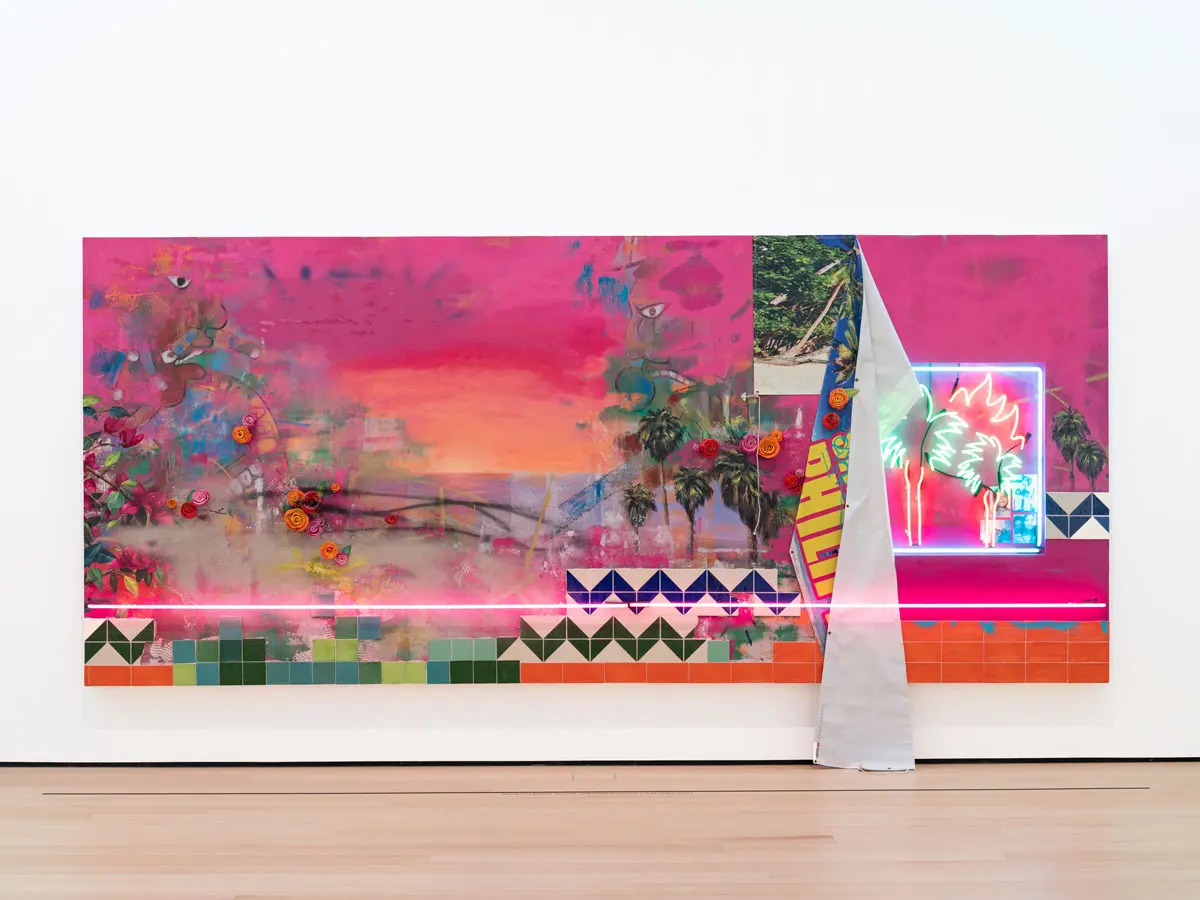
Several site-specific commissions explicitly link historical oppression to contemporary socio-political crises, such as immigration enforcement and mass deportations.
rafa esparza’s Tratos: Después de Pedro Valtierra Entre Redadas (2025–26): An adobe painting supported by a steel armature, inspired by photographer Pedro Valtierra’s 1998 documentation of the aftermath of the Acteal Massacre in Chiapas. The installation invites visitors to walk a path embedded with a coiled U.S. flag, while depicting historical scenes of Spanish colonizers whipping Indigenous people alongside modern ICE raids in Los Angeles and Chicago.
Guadalupe Maravilla’s Pupusa Retablo (2023): Depicts women preparing traditional Salvadoran pupusas while addressing personal trauma and early lessons in assimilation during his family’s displacement in the 1980s.
Justin Favela’s St. Maarten (1972), After Marisol (2025–26): Part of the artist’s ongoing "piñata murals" series, initiated in response to an art professor’s reductive prompt to "make something about being Mexican." Favela uses paper and glue to construct monumental works that appropriate institutional art histories while reclaiming cultural symbols.
Future Outlook: A National Tour and Permanent Legacy
As "Let Us Gather in a Flourishing Way" concludes its run in Buffalo, its journey is only beginning.
The National Tour
The exhibition will embark on a multi-city national tour, bringing its vital discourse to:
The Des Moines Art Center (Iowa)
Phoenix (Arizona)
Seattle (Washington)
During its upcoming iteration at the Des Moines Art Center, Justin Favela will create a brand-new piñata mural responding directly to a piece in that institution’s permanent collection.
Institutional Acquisition and Lasting Impact
Crucially, the Buffalo AKG Art Museum has treated the exhibition not as a temporary event, but as a transformative commitment to its permanent collection. Beginning in 2022, the museum initiated a series of acquisitions in anticipation of the show, starting with Patrick Martinez’s Promised Land (2022), followed by works from Guadalupe Maravilla, Ilana Savdie, and Eamon Ore-Giron.
Since the exhibition opened in March 2026, the museum has expanded its holdings to include pieces by Felipe Baeza, Yvette Mayorga, Salomón Huerta, and Alfonso Gonzalez Jr.’s towering billboard painting, Abogados Tierra Caliente.
Andrea Alvarez stresses that "Let Us Gather in a Flourishing Way" should be viewed as a starting point rather than a definitive endpoint:
"This is just the tip of the iceberg," Alvarez concluded. "By design, the project gives people a peek into the discipline, and it’s an invitation to want to learn more. This exhibition is not a comprehensive survey—I am resisting the word ‘survey’ because that comes with the connotation that it’s a complete story."
In a political and social climate marked by increasing division and polarized debates over borders and identity, the urgent, human-centered message of "Let Us Gather in a Flourishing Way" ensures its resonance will endure for years to come.




Comments
Facebook App ID not configured. Please add it in the Customizer.