
By Global Heritage & Historical Analysis Desk
Published: August 2026
Executive Overview
In an era when modern royal institutions spend millions on strategic communications, crisis management, and public image overhauls, it is easy to assume that sophisticated public relations is a modern invention. Yet, nearly three centuries ago, Queen Caroline of Brandenburg-Ansbach masterminded a brilliant, albeit eccentric, campaign of image management.
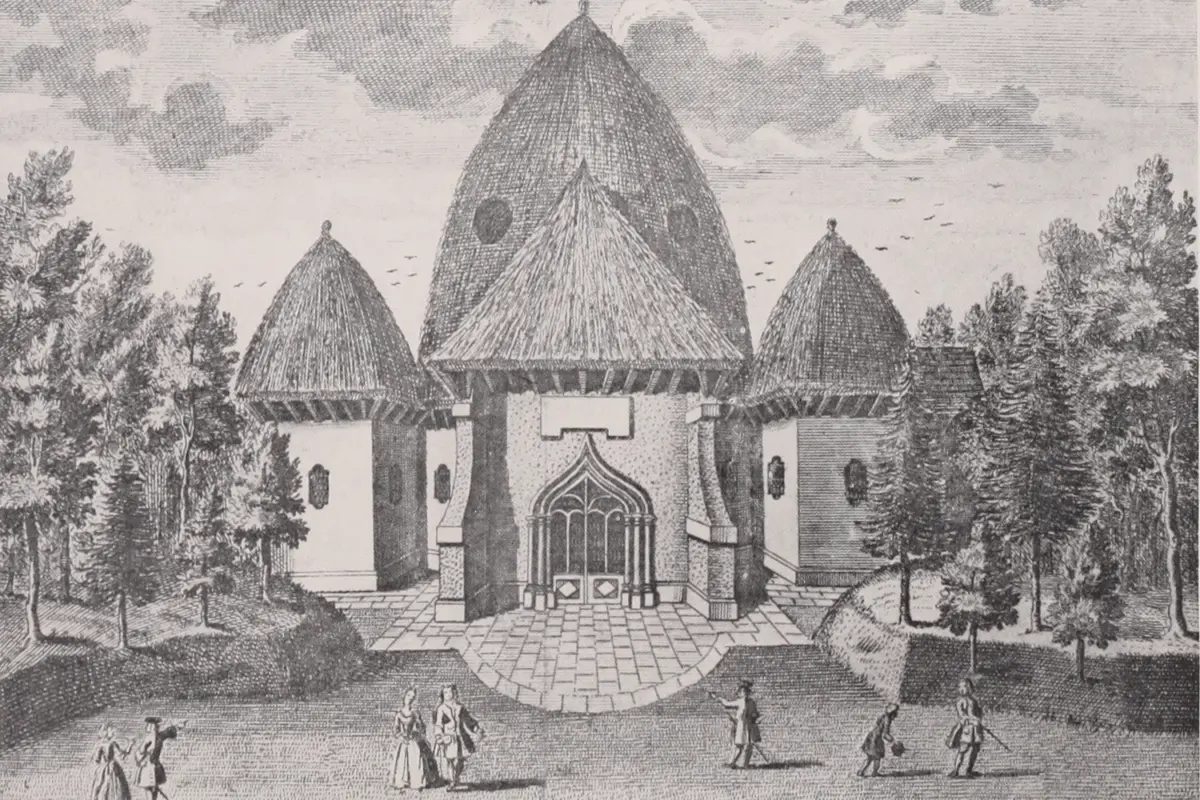
Faced with the existential challenge of embedding a foreign, newly installed German dynasty into the cultural bloodstream of Great Britain, Caroline bypassed traditional political channels. Instead, in 1735, she commissioned an architectural folly in the gardens of Richmond Palace known as Merlin’s Cave.
Read Also
Filled with wax figures of the legendary wizard Merlin, ancient prophets, and Arthurian icons, the thatched Gothic structure was designed to link the House of Hanover directly to Britain’s deeply rooted mythological heritage.
Far from being a mere whimsical garden ornament, Merlin’s Cave functioned as a sophisticated piece of 18th-century statecraft. It bridged the gap between a suspicious British public and a foreign-born monarchy, attempted to heal fractious domestic royal feuds, and preempted the existential threats posed by Jacobite opposition.
/https://tf-cmsv2-smithsonianmag-media.s3.amazonaws.com/filer_public/13/70/1370f852-7dce-4a95-839d-a51ca90c6d55/merlins-garden.png)
This analysis examines how Caroline operationalized folklore to solidify dynastic survival, exploring the historical mechanics of myth-making, political opposition, and the timeless truth that royal legitimacy relies as much on narrative control as it does on military or legislative power.
Detailed Chronology: The Road to Merlin’s Cave (1714–1738)
To understand the profound political risk and necessity of Caroline’s initiative, one must trace the timeline of the House of Hanover’s precarious foothold in Great Britain.
- August 1714: The Hanoverian Accession
Following the death of Queen Anne and the enactment of the Act of Settlement 1701—which barred Catholics from the throne—the British crown passed to the German House of Hanover. Elector Georg Ludwig ascended the throne as King George I. He arrived in Britain as a middle-aged monarch who spoke little English, favored his native Hanover, and relied heavily on German advisors, immediately exposing the new dynasty to charges of being foreign occupiers. - September 1715 & March 1719: The Jacobite Uprisings
Sensing deep vulnerability among the British populace, supporters of the exiled Stuart dynasty (known as Jacobites) launched bloody, albeit ill-fated, armed rebellions in Scotland and northern England to restore James Francis Edward Stuart (the "Old Pretender") to the throne. Though suppressed, these uprisings proved that the domestic threat to Hanoverian rule was kinetic and ongoing. - June 1727: Accession of George II
George I died, and his son ascended as King George II, alongside his brilliant, politically astute wife, Queen Caroline. While George II continued his father’s tense relationship with the British cultural elite, Caroline immediately recognized the urgent need for a cultural strategy to anchor her family’s legitimacy. - The Early 1730s: The Prince of Wales Schism
A volatile, highly public feud erupted between King George II and his eldest son, Frederick, Prince of Wales. This generational fracture threatened to shatter the veneer of national stability, handing powerful ammunition to opposition Tories and satirists. - 1735: The Commission of Merlin’s Cave
Seeking a unifying cultural symbol that transcended party lines and foreign ties, Queen Caroline commissioned architect William Kent to build Merlin’s Cave in the royal gardens at Richmond. Populated with wax effigies of Merlin and historical British figures, the grotto instantly became the talk of London. - September 1735: Cultural Resonance and Satire
Writers and poets, such as Jane Brereton, published works framing Merlin’s presence as a prophetic call for dynastic harmony—specifically urging Prince Frederick to reconcile with his royal parents. Simultaneously, opposition journalists like Nicholas Amhurst (writing as Caleb D’Anvers in The Craftsman) savaged the grotto, linking the wizardly imagery to Prime Minister Robert Walpole’s perceived political wizardry and corruption. - November 1737: The Death of Queen Caroline
Queen Caroline passed away at the age of 54, leaving a profound vacuum in the cultural and political management of the Hanoverian court. While Merlin’s Cave remained a tourist attraction for decades, its sharpest political utility faded with its visionary creator.
Supporting Context & Metrics: The Geopolitics of Myth
The decision to utilize Arthurian legend was not a random aesthetic choice; it was a calculated response to specific demographic, political, and cultural metrics of 18th-century Britain.
The Legitimacy Deficit
In 1730, the Hanoverian dynasty had occupied the British throne for a mere 16 years. Statistically and generationally, living memory still recalled the Stuart reign. The Jacobite network maintained underground loyalty networks spanning the Scottish Highlands, parts of northern England, and even within elements of the London Parliament.
[The Hanoverian Dilemma (1730s)]
  ├── Foreign Roots: Perceived as German interlopers (George I & II language barriers)
  ├── Domestic Factions: Active Jacobite threat (Stuart loyalists, armed uprisings)
  └── Internal Strife: Severe public feud between King George II and Prince Frederick

[Caroline's Counter-Strategy: Merlin's Cave]
  ├── Non-Dynastic Myth: Arthurian legend belongs to all of Britain, not a single bloodline
  ├── Cultural Diplomacy: Translating intellectual European court experience into British patriotism
  └── Prophetic Framing: Merging past heritage with future success via the figure of Merlin
Why Arthurian Legend?
Previous monarchs—such as the Plantagenets (including Henry II)—had weaponized Arthurian myth to assert imperial dominance over Wales, Scotland, and Ireland by claiming direct lineage or discovering Arthur’s supposed bones at Glastonbury Abbey.
/https://tf-cmsv2-smithsonianmag-media.s3.amazonaws.com/filer_public/13/70/1370f852-7dce-4a95-839d-a51ca90c6d55/merlins-garden.png)
However, Caroline’s challenge was different. She could not claim direct blood descent from Arthur. Instead, she utilized the neutrality of myth. Arthur and Merlin belonged to the deep, shared history of the island, superseding the bitter dynastic rivalries of Tudors, Stuarts, and Hanoverians. By erecting a monument to Merlin, Caroline signaled that the House of Hanover was not replacing British history, but serving as its rightful continuation.
Intellectual Backing from Continental Courts
Unlike her husband, who notoriously declared that he "hated all boets and painters," Caroline was deeply intellectual. Raised in the sophisticated, culturally progressive courts of Berlin and Hanover, she possessed a vast personal library. She was well-versed not only in Arthurian romances circulating across Europe but also in the historical genealogies linking her own dynastic lineage (the House of Guelph) to medieval English royalty. She translated this intellectual capital into spatial architecture at Richmond.
Official Reactions and Contemporary Debate
The unveiling of Merlin’s Cave triggered an immediate polarization of British public opinion. The grotto—a thatched, Gothic structure containing moving or static waxworks—was viewed through wildly contrasting lenses depending on political allegiance.
The Whig-Court Perspective: Harmony and Prophecy
To Caroline and her political allies, notably Prime Minister Sir Robert Walpole, the grotto was an exercise in civic mythology. Poets and court chroniclers were mobilized to frame the exhibit as a blessing on the realm.
In her 1735 poem, Merlin: A Poem Humbly Inscribed to Her Majesty, Jane Brereton wrote of the wizard’s effigy looking toward the future of the nation, explicitly imploring Prince Frederick to heal the royal rift:
/https://tf-cmsv2-smithsonianmag-media.s3.amazonaws.com/filer_public/f8/0d/f80d2f09-9af7-4c9c-9361-314934fcdd31/caroline-and-george-ii.png)
"To Brunswick’s race let endless blessings flow,
And pay the debt that Britain has to owe…"
Through this interpretive framework, Merlin was cast not as a pagan sorcerer, but as a wise counselor forecasting the eternal security and prosperity of Protestant Britain under the Hanoverians.
The Tory-Jacobite Backlash: Puppetry and Witchcraft
Conversely, the political opposition viewed Merlin’s Cave as an absurdity ripe for ridicule. Nicholas Amhurst, editing the fiercely anti-government journal The Craftsman, led a campaign of sustained mockery.
Art historians and literary scholars, such as Amanda S. Meixell, note that opposition figures quickly weaponized the grotto against Robert Walpole. Merlin—the mysterious wizard pulling strings behind the scenes—was maliciously conflated with Walpole, the "prime minister-wizard" whose financial schemes (such as the contentious Excise Bill of 1733) were depicted as dark, unnatural magic foisted upon an unwitting British public.
Critics dismissed the inhabitants of the grotto as "a great many strange puppets," arguing that the German queen had cheapened ancient British mythology into a glorified cabinet of curiosities. Yet, as historians point out, this intense backlash was proof of the installation’s success: in politics, being hated or mocked is infinitely preferable to being ignored. The opposition understood the message clearly enough to feel the need to dismantle it.
Future Outlook: The Enduring Legacy of Royal PR
Queen Caroline’s deployment of Merlin’s Cave offers a fascinating blueprint for modern public relations, demonstrating that soft power has always been the ultimate guarantor of hard rule.
As modern monarchies worldwide navigate shifting public sentiment, generational transitions, and intense media scrutiny, the core lesson of 1735 remains unaltered: legitimacy cannot be sustained by institutional inertia alone. It requires active storytelling.
Caroline understood that to make a foreign dynasty feel native, a monarch must weave their house into the foundational myths of the land. Whether through 18th-century Gothic grottoes filled with wax wizards or 21st-century digital campaigns, multimedia storytelling, and cultural patronage, the survival of an institution depends on who controls the narrative of national identity.
Merlin’s Cave may have eventually weathered away into history, but the strategy it embodied—leveraging cultural heritage to anchor political survival—remains a cornerstone of statecraft to this day.
Based on original research by Amy Louise Blaney (University of Wolverhampton) published via The Conversation and contextualized by historical archives.




Comments
Facebook App ID not configured. Please add it in the Customizer.