
Executive Overview
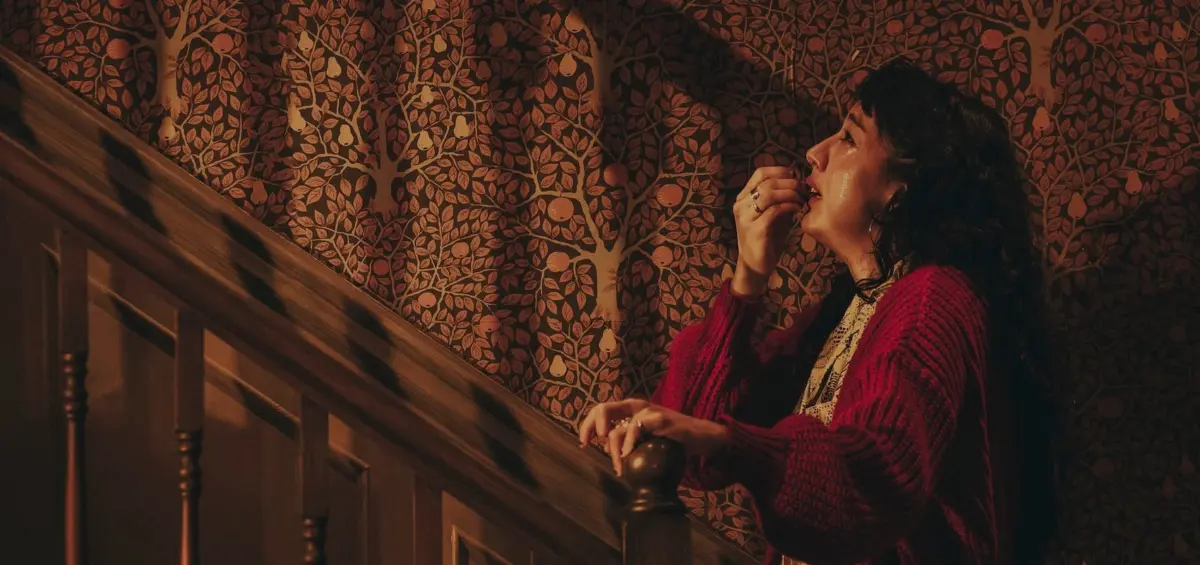
The iconic horror franchise that revolutionized the found-footage cinematic genre with low-budget scares and high-octane dread has made an unexpected, critically acclaimed leap to the Broadway stage. Currently terrifying audiences at New York City’s historic August Wilson Theatre, Paranormal Activity—written by playwright Levi Holloway—transfers the chilling mythology of the seven-film series into a live theatrical medium. Yet, this adaptation is far more than a simple exercise in jump-scares and theatrical sleight-of-hand.
At its core, Holloway’s script and the ensuing production grapple with existential, theological, and psychological anxieties that transcend the traditional boundaries of the horror genre. The play does not merely ask whether God and demons are real; it confronts a far more disturbing premise: What happens when God is not absent, but impotent?
Set against a backdrop of domestic displacement, psychological fracture, and occult obsession, the narrative follows James and Louise, a married couple whose relocation from Chicago to London exposes them to malevolent forces that prey upon their deepest secrets and unresolved traumas. As the production unfolds, it systematically strips away every line of defense—interpersonal trust, modern skepticism, psychological rationalization, and traditional faith—leaving characters and audiences alike stranded in a nihilistic void.
Read Also
Scheduled to run through January 3, the production has established itself as a monumental theatrical achievement, blending extraordinary performances, technical mastery, and profound philosophical questions. This review-analysis explores the architecture of the play’s terror, the breakdown of its characters under supernatural duress, the theological implications of its bleak conclusion, and why this journey into darkness ultimately fails to extinguish the very faith it seeks to challenge.
Detailed Chronology: The Descent into London’s Darkness
The narrative architecture of Paranormal Activity on stage is meticulously constructed, unfolding through a series of escalating psychological and supernatural disruptions that mirror the disintegration of its central characters.
Act I: Relocation and Fractured Realities
The play introduces audiences to James and Louise (Lou)—affectionately referred to as Lou—a married couple who have recently made the transatlantic move from Chicago to London. The transition is far from smooth. Almost immediately, the audience is made aware that Lou is suffering from severe cognitive and psychological anomalies, specifically "loss of time" and harrowing mental breakdowns.
Lou attributes these episodes not to a neurological or psychological condition, but to persistent paranormal activity plaguing their new home. James, functioning initially as the pragmatic, skeptical foil, struggles to accept Lou’s explanations, viewing her experiences as internal fictions born of an active imagination. Deeply invested in the contemporary spiritualist movement, Lou holds a core conviction that upends traditional ghost stories: it is not places that are haunted, but people.
As the weeks progress, the supernatural manifestations cease to target solely Lou. James himself becomes a focal point for malevolent forces, pushing the couple to seek external intervention.
The Séance with Etheline Cotgrave
Desperate for answers, Lou turns to an authority figure she trusts almost religiously: Etheline Cotgrave, a famous podcaster specializing in the occult and the paranormal. Cotgrave arrives at the London home, orchestrating a ritualistic atmosphere by setting up candles, probing the couple about the state of their relationship, and gently compelling Lou to confront her past.
Lou opens up about a defining childhood trauma: the house fire that claimed the lives of her parents when she was a young girl. Cotgrave issues a stern warning to the couple, emphasizing that deceit is useless because the spirits already possess absolute knowledge of the truth. Utilizing a specialized piece of electronic equipment designed to bridge the spirit world and the physical realm, Cotgrave attempts to translate the chaotic audio static into coherent speech.
The device spits out fragmented, evocative words: burning, fire, pain. Cotgrave hastily concludes that the entity communicating through the device is Lou’s late mother.
The revelation triggers a visceral, explosive reaction from Lou. She insists, and eventually screams, that the entity is categorically not her mother. This vehement denial appears to enrage the unseen presence, which in turn provokes a sudden, defensive fury in Cotgrave herself. Snapping under the pressure, Cotgrave shouts, "This is all bullshit!" before hastily packing her equipment and storming out of the house.
The Infiltration of Trust
Following Cotgrave’s departure, the boundary between reality and demonic possession dissolves entirely. One character after another begins to act with erratic, chilling malice, leaving the audience paralyzed by uncertainty regarding who is under supernatural thrall and who remains uncorrupted.
The psychological warfare reaches a fever pitch when James receives a FaceTime call from his mother, currently in Boca Raton, Florida. In a deeply unsettling exchange, she instructs James to "eat a bullet" because he is "rotten." Mere minutes later, his mother inexplicably appears on their London doorstep. The terror of the digital interaction vanishes, replaced by an eerie normalcy as she leads James in the Lord’s Prayer, earnestly asking God to search her heart.
(It is only later, at the play’s harrowing conclusion, that the audience realizes the full extent of the deception: the figure of James’s mother was entirely co-opted, possessed by the malicious entity haunting their home.)
The Final Reckoning and Psalm 91
Throughout the narrative, James’s worldview undergoes a violent evolution. He begins the play as a staunch atheist, seeking refuge in secular rationalism. As the haunting intensifies and physical laws begin to warp around him, he turns desperately to the Bible for protection. By the climax, he finds himself grappling with a terrifying theological paradox, asking what term applies to someone who knows with absolute certainty that God exists, yet refuses to place their faith in Him.
Following a cryptic code left behind by the ghost, James is drawn to Psalm 91:5. With trembling hands, he reads the ancient text aloud to ward off the encroaching dark:
"You will not fear the terror of night,
nor the arrow that flies by day,
nor the pestilence that stalks in the darkness,
nor the plague that destroys at midday.
A thousand may fall at your side,
ten thousand at your right hand,
but it will not come near you."
The promise of the psalm is absolute protection against the terrors of the night. Yet, in a devastating subversion, the play’s climax demonstrates that "it" does come near James. The entity breaches his defenses, ultimately claiming his life.
Lou, too, falls completely under demonic thrall. In her possessed state, she asks James if he has ever been to confession. In a final, desperate bid for human connection and divine mercy, secrets are laid bare. James confesses a dark truth from his past: he caused the death of a young girl in a drunk-driving accident when he was younger.
Yet, this sacred act of confession offers no sanctuary. Instead of invoking divine mercy, the utterance of his deepest evil becomes the precise instrument the ghost uses to exact its ultimate revenge.
Supporting Context & Metrics: Theatrical Triumphs and Audience Reception
To understand the cultural and artistic weight of Paranormal Activity on Broadway, one must examine the production within the broader landscape of modern theatrical horror and audience sociology.
| Metric / Dimension | Production Detail |
|---|---|
| Venue | August Wilson Theatre, New York City |
| Playwright | Levi Holloway |
| Source Material | Paramount Pictures’ seven-film Paranormal Activity franchise |
| Thematic Focus | Spiritual impotence, trauma, existential nihilism, the occult |
| Scheduled Run | Through January 3 |
| Primary Setting | A newly purchased home in London, England (relocated from Chicago) |
The Broadway Environment and Audience Dynamics
Horror on stage is a notoriously difficult genre to master. Unlike cinema, where camera angles, editing, and sound design can manufacture immediate, visceral terror, live theater relies on practical effects, soundscapes, pacing, and the raw vulnerability of actors performing mere feet from an audience. Levi Holloway’s script succeeds precisely because it anchors supernatural terror in deeply relatable human frailties: marital friction, unaddressed grief, and the paralyzing fear of losing one’s mind.
However, the live audience environment introduces fascinating sociological dynamics. At several performances, nervous laughter ripples through the theater during moments invoking biblical scripture or expressions of faith in a savior God. This discomfort points to a broader cultural ambivalence toward institutional religion and supernatural theology in contemporary secular spaces.
Despite moments of lapsed theater etiquette—a persistent challenge for modern Broadway productions—the audience remains utterly captivated. The emotional investment in the characters’ twists and turns demonstrates that the play’s foundational stakes resonate powerfully with contemporary theatergoers.
Official Statements and Critical Perspectives
While major institutional statements from the production team have focused primarily on the technical achievements of bringing a found-footage horror franchise to the stage, critical and theological responses to the play have been deeply divided.
Playwright Levi Holloway’s Vision
In interviews regarding his approach to the adaptation, Holloway emphasized that relying solely on jump-scares would render a multi-hour theatrical experience hollow. Instead, he sought to expand the psychological dimensions of the original films. By shifting the geographical context—moving the couple from the familiar American suburbs to the historically layered, Gothic weight of London—Holloway infuses the narrative with a sense of ancient, inescapable history.
The play posits that modern secularism is ill-equipped to deal with archaic evil. When characters attempt to combat supernatural phenomena with self-help psychology, podcasters, or surface-level skepticism, the play exposes these tools as hopelessly inadequate.
The Theological Critique
From a theological standpoint, cultural critics have pointed out that Paranormal Activity operates within a uniquely bleak universe. Unlike traditional horror narratives rooted in Judeo-Christian theology—such as The Exorcist, where evil is ultimately checked by the intervening power of a sovereign God and the authority of the Church—Holloway’s adaptation presents an universe of absolute theological vacuum.
In this play, God is not merely distant; He is impotent. The recitation of scripture (Psalm 91) fails to protect. Confession of sin does not cleanse or liberate; it weaponizes the sinner’s guilt against them. The chilling takeaway for the audience is a profound nihilism: love, trust, and faith are not shields against the dark, but vulnerabilities that the dark exploits.
Future Outlook: The Run Through January 3 and Cultural Legacy
As Paranormal Activity continues its strictly limited engagement at the August Wilson Theatre through January 3, its legacy within the theatrical and horror landscapes is already cementing itself.
Commercial and Critical Longevity
The production proves that high-concept horror can successfully transition from cinema to the stage without losing its psychological edge. Industry analysts anticipate that the show’s success will pave the way for other cinematic thrillers to explore live theatrical adaptations, provided they possess the scriptwriting depth demonstrated by Holloway. The technical achievements—ranging from disorienting sound design to seamless practical illusions—have set a new benchmark for Broadway stagecraft in the thriller genre.
The Deeper Philosophical Aftermath
Beyond box office receipts and critical accolades, the play leaves audiences with a lingering philosophical question regarding the nature of belief.
While the production leans heavily into nihilism, leaving its characters crushed beneath an all-encompassing darkness, perceptive viewers often walk away with a counter-intuitive theological reflection. The horror depicted on stage relies entirely on the premise that supernatural forces possess real, active agency. Yet, within traditional orthodox theology, true demonic entities cannot interface with the sacred without trembling.
As observers of the human condition note, the very terror the play inspires—the desperate desire to be saved, known, protected, and loved by something greater than ourselves—mirrors the exact motivations underlying authentic spiritual devotion. In its quest to terrify audiences with the prospect of an impotent divine, Paranormal Activity inadvertently reaffirms the profound, inescapable human hunger for a transcendent redemption that darkness cannot overcome.




Comments
Facebook App ID not configured. Please add it in the Customizer.