
Executive Overview
As the United States barrels toward a high-stakes midterm election cycle, political capital and national media attention are increasingly congregating on a state that was once the quintessential American bellwether: Iowa. Long celebrated for its tradition of independent-minded politicking, the Hawkeye State has shifted firmly into the Republican column over the past decade. Yet, a political anomaly is unfolding within its borders that is capturing the attention of strategists nationwide.
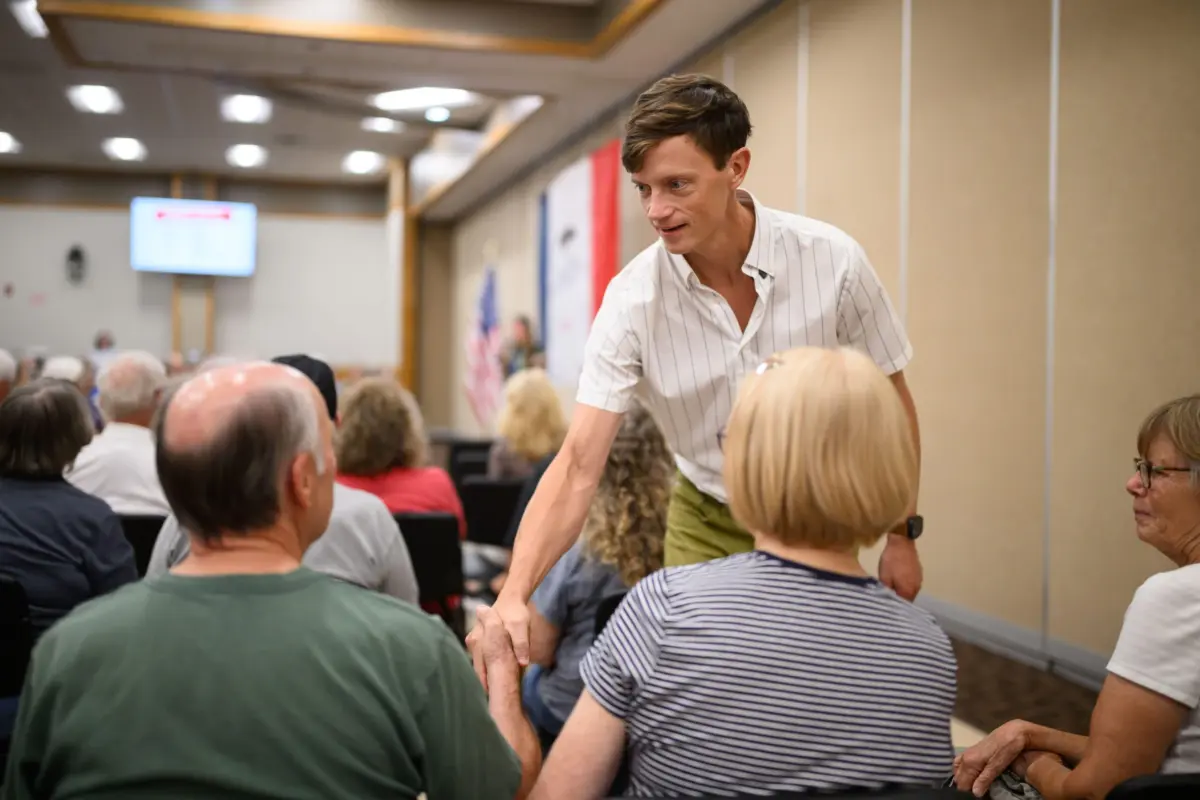
At the center of this phenomenon is Rob Sand, the state’s Democratic Auditor, who is currently outpacing his Republican opponent, Zach Lahn, in the race for the governor’s mansion. Sand’s campaign is operating against historical headwinds—most notably, a formidable voter registration advantage enjoyed by the Iowa GOP and a drought of Democratic gubernatorial victories dating back to 2006.
Sand’s strategic blueprint rejects the caustic, high-octane partisanship that has come to define modern American politics. Instead, he has championed a radical pragmatism: an explicit rejection of red-blue tribalism, a localized focus on government corruption, a hard-hitting accountability push targeting corporate agriculture and chemical giants over public health crises, and an unyielding commitment to bridging the bitter divides fracturing families and communities.
Read Also
Beyond the marquee gubernatorial matchup, Iowa is hosting fiercely contested Senate and House races that could ultimately tilt the balance of power in Congress. To parse the complex undercurrents driving Iowa’s political evolution, political experts and analysts are looking closely at whether Sand’s playbook offers a viable blueprint for Democrats attempting to claw their way back into relevance across a rapidly reddening Midwest.
Detailed Chronology: The Evolution of Iowa’s Political Landscape
To understand why the 2026 midterm elections in Iowa carry such profound national significance, one must trace the state’s dramatic political realignment over the last twenty years.
The Swing-State Era (2008–2012)
Not long ago, Iowa was viewed as a primary battleground of American presidential politics. Characterized by a politically fluid, working-class electorate that prized personal connection over party loyalty, the state twice cast its electoral votes for Barack Obama in 2008 and 2012. Voters in rural counties and industrial hubs alike felt comfortable splitting their tickets, supporting Democrats at the federal and state levels while maintaining conservative fiscal leanings.
The Trump Realignment (2016–2024)
The political tectonic plates shifted decisively beginning in 2016. Donald Trump’s populist, anti-establishment messaging struck a powerful chord with Iowa’s predominantly white, non-college-educated working-class communities. Trump carried the state comfortably in 2016, 2020, and again in subsequent cycles, accelerating a nationwide trend where rural and semi-rural regions systematically abandoned the Democratic Party. Over this same period, the Iowa state legislature fell under a decade of unyielding one-party Republican rule, cementing the state’s status as a reliably red stronghold.
The 2026 Midterm Crucible
By mid-2026, cumulative economic pressures—compounded by controversial federal policies, sweeping tariff regimes, and significant legislative cuts to safety-net programs—began to breed voter fatigue. Polling data consistently showed President Trump underwater in the state, with majorities expressing deep dissatisfaction with rising living costs and declining healthcare access.
Seizing on this localized discontent, Democratic candidates like Rob Sand for governor and Josh Turek for the U.S. Senate launched strategic offensives. Sand formalized his statewide listening tour, systematically visiting all 99 Iowa counties and building a persona rooted not in partisan grievance, but in community solidarity, administrative accountability, and cross-partisan outreach. By the summer of 2026, public opinion polls reliably placed Sand ahead of Republican nominee Zach Lahn, setting the stage for a historic showdown that could redefine Midwestern electoral politics.
Supporting Context & Metrics: The Anatomy of a Reversal
The political turbulence in Iowa is not an isolated local event; it is a microcosm of a broader demographic and economic realignment reshaping America’s industrial core.
The Demographic Shift
The working-class, non-college-educated white electorate that once formed the backbone of the New Deal coalition has shifted dramatically toward the Republican Party across the entire "Rust Belt" and Upper Midwest. States like Ohio, Michigan, Wisconsin, and Pennsylvania have all experienced variations of this realignment. Consequently, when political analysts observe Iowa, they are looking at a bellwether for the entire region. If Democrats can figure out how to stop the bleeding—or reverse the tide entirely—in environments like Iowa, the strategic implications will echo from the Great Lakes to the Monongahela Valley.
Economic Pressures and Policy Fallout
The primary battleground of the 2026 midterms is economic. Iowans across the political spectrum are grappling with the harsh realities of a volatile cost-of-living crisis. Key economic stressors driving voter sentiment include:
- Tariffs and Trade: Federal trade policies and tariffs have heavily impacted Iowa’s agricultural and manufacturing sectors, driving up the costs of raw materials, equipment, and everyday consumer goods.
- Healthcare Infrastructure: The ripple effects of federal policy changes—specifically the deep Medicaid funding cuts enacted through the 2025 budget reconciliation bills—have destabilized local healthcare access. Across rural Iowa, community clinics have faced shuttering or severe operational cutbacks, forcing residents to travel vast distances for basic medical care.
- Corporate Accountability: Public health data highlighting Iowa’s elevated cancer rates has mobilized voters against big agriculture and large chemical corporations, giving independent-minded candidates a powerful club with which to demand regulatory reform.
Polling Dynamics and Voter Enthusiasm
Despite the Iowa GOP’s comfortable voter registration advantage, recent polling metrics compiled by major aggregators indicate a distinct enthusiasm gap. While national Republicans attempt to tie local Democrats to unpopular federal policies, state-level candidates like Sand have successfully localized the debate. By keeping the focus squarely on kitchen-table issues, state governance, and institutional corruption, Sand has peeled away crucial segments of the independent electorate and disgruntled moderate Republicans.
Official Statements & Expert Analysis
To gain deeper insight into the mechanics of this political shift, Today, Explained co-host Noel King recently sat down with Laura Belin, publisher and prominent reporter for the authoritative Iowa political journal Bleeding Heartland. Their discussion illuminated the unique strategy propelling Sand’s campaign and the broader lessons it holds for the national Democratic Party.
Localizing the Campaign vs. Nationalizing the Referendum
When asked whether Democrats are running directly against Donald Trump, Belin noted a distinct tactical divergence among candidates:
"Most of the Democrats are not running directly against Trump. Rob Sand, the candidate for governor, hardly talks about Donald Trump at all. He really focuses on statewide issues… Josh Turek, the candidate for Senate, is running [on] the idea that [Republican Senate nominee] Rep. Ashley Hinson has just been a rubber stamp for policies that have hurt Iowa, whether that be the war in Iran [or] tariffs. It’s more running against the Republicans who have been a puppet rather than running against Donald Trump himself."
Rejecting the Politics of Outrage
Unlike many modern political campaigns that seek to mobilize voters through grievance and ideological purity tests, Sand has pioneered an unconventional town-hall format that disarms partisan hostility:
"He does not strike an angry note. And he’s not really part of this whole debate between progressives and moderates or centrists in the party. He’s really tried to chart, I would say, a completely different course of saying that he wants to get back to common-sense government, focusing on the issues that people can agree on… At the beginning of every town hall, he asks people to raise their hands if they’re a registered Republican or a registered independent, and then he asks everybody to applaud for those people. He has everybody in the room sing the first verse of ‘America the Beautiful’ together."
Belin emphasized that Sand frames the crisis of hyper-partisanship not as an abstract policy failure, but as a deliberate social wound inflicted by political elites:
"The way he frames it is that two private clubs, as he frames the major parties, he says, ‘They’re trying to make us hate people we used to love. And I’m sick of it. I’m sick of the division.’… Sometimes he asks for a show of hands: How many of you have had a family relationship or a longtime friendship disrupted over the last 10 years because of politics? There are always a lot of hands that go up."
The Challenge of Replication
While national political observers are eager to bottle Sand’s success and export it to other red states, Belin offered a cautionary note regarding the unique personal biography required to pull off such a campaign:
"I don’t know how easy it would be to replicate Rob Sand. He grew up in a small town; he grew up hunting and fishing. He talks about his faith. I don’t know that everybody would be able to pull that off so naturally. But… if Democrats can find a way to turn things around in those types of areas—working-class communities that are predominantly white—there could be lessons that apply to other states."
Future Outlook: Implications for the November Midterms and Beyond
As the calendar pages turn closer to November, the political landscape in Iowa serves as both a laboratory and a warning sign for the rest of the nation.
The Battle for Congress
The outcome of Iowa’s hyper-competitive House and Senate races will play an outsized role in determining which party controls Capitol Hill in the next legislative session. If candidates like Josh Turek can successfully leverage voter anger over healthcare cuts, tariffs, and economic stagnation, Democrats may well punch above their weight in regions long written off as unwinnable. Conversely, a resilient Republican machine that successfully nationalizes the races around broader cultural anxieties could reassert absolute dominance.
The Future of Midwestern Democratic Strategy
Rob Sand’s potential victory—or even a remarkably close loss that outperforms historical baselines—will force a thorough re-evaluation of the Democratic Party’s electoral playbook. For years, conventional wisdom dictated that Democrats in red states must either lean heavily into national progressive orthodoxy or attempt to out-conservative their opponents on social wedge issues.
Sand offers a third path: ruthless administrative competence combined with radical civic empathy. By calling out corruption, defending public health, refusing to play the game of cultural polarization, and treating political opponents as human beings first and partisans second, he has demonstrated that a bridge-building populist message can resonate deep within the American heartland.
Whether this "love-thy-neighbor" campaign can scale beyond the borders of Iowa remains the ultimate unanswered question of the 2026 midterm cycle. But as political strategists of all stripes pore over the polling data from Des Moines to Dubuque, one reality is unmistakably clear: the roadmap for winning back rural America is being rewritten in real-time, and the entire nation is watching.




Comments
Facebook App ID not configured. Please add it in the Customizer.