
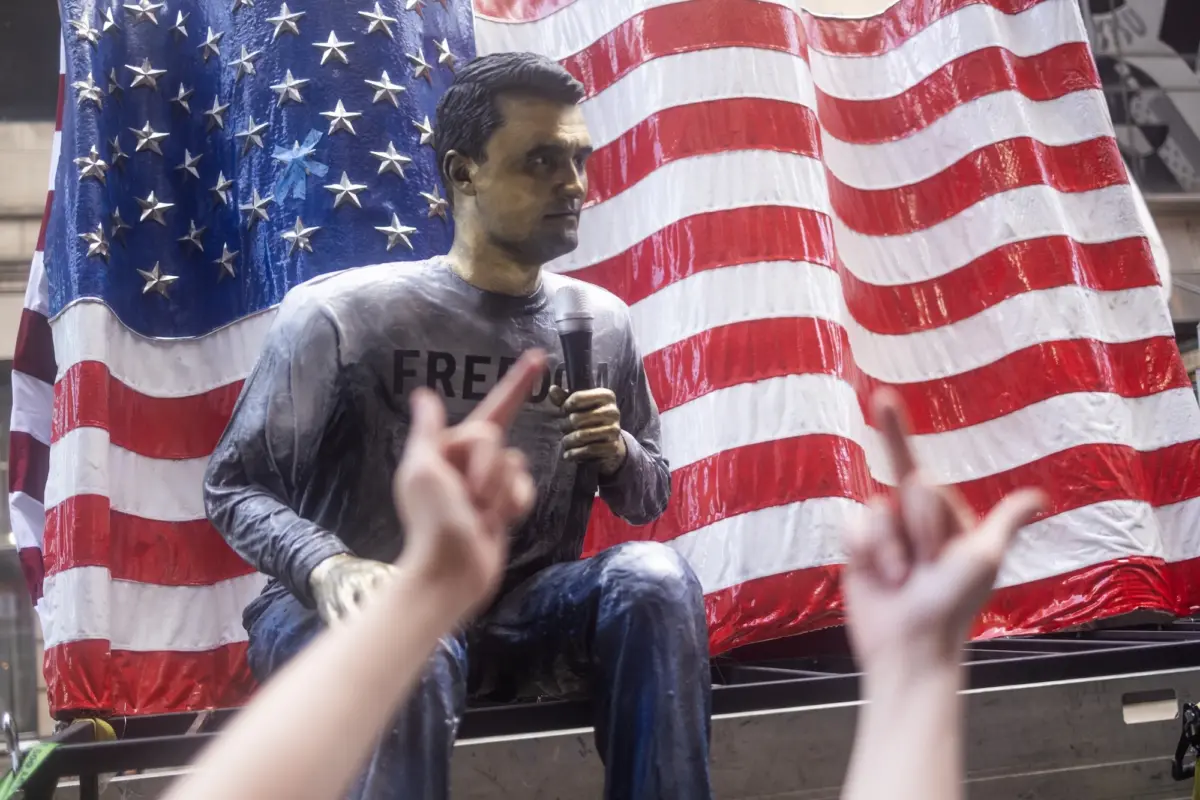
NEW YORK — A high-stakes public spectacle unfolded in the heart of Manhattan on Thursday afternoon, as Italian-American sculptor Sergio Furnari unveiled an unauthorized, life-size bronze memorial dedicated to the slain right-wing activist and Turning Point USA founder, Charlie Kirk.
The public unveiling—staged in the bustling, densely populated corridor of Times Square—rapidly devolved into a volatile confrontation characterized by aggressive shouting and physical shoving matches. Video footage widely circulated by Al Jazeera and other international media outlets captured the immediate chaos, illustrating how deeply the legacy of the polarizing conservative figure continues to polarize the American public one year after his high-profile assassination.
The volatile demonstration underscores a broader, lingering cultural and political fracture in the United States, raising critical questions regarding public art permitting, freedom of expression, political violence, and the fierce battle lines drawn over public mourning and accountability.
Read Also
Executive Overview
Thursday’s flash mob and subsequent clash in Times Square mark a dramatic escalation in the ongoing cultural fallout stemming from the death of Charlie Kirk. Kirk was assassinated precisely one year prior—at 2:23 p.m. on September 11, 2025—while delivering a speech before an audience of roughly 3,000 people at Utah Valley University.
The installation of the bronze memorial was deliberately timed to coincide with this somber anniversary. However, rather than serving as a quiet moment of reflection or unified remembrance, the event transformed into a microcosm of America’s hyper-polarized political landscape. Furnari, who self-funded the $100,000 sculpture, transported the artwork on the bed of a pickup truck. The unpermitted monument was unveiled for only a brief window before being hastily driven away to evade escalating hostility and potential municipal intervention.
The incident has brought several contentious threads into sharp national focus:
- The Intersection of Art and Partisanship: Furnari’s pivot from apolitical public art—such as his famous homages to working-class New York history—to politically charged monuments.
- The Legal Proceedings: The ongoing criminal case against 23-year-old Tyler Robinson, accused of carrying out the assassination.
- The Battle Over Empathy and Free Speech: The stark contrast between the artist’s stated calls for empathy and Kirk’s own documented rhetoric regarding empathy and gun violence.
- The Digital and Physical Retaliation: The severe professional and social repercussions faced by critics of Kirk in the months following his death, amplified by prominent political figures.
Detailed Chronology: The Unveiling and Clashes in Times Square
The 2:23 p.m. Revelation
At exactly 2:23 p.m. on Thursday, traffic and pedestrian flow in Times Square were abruptly disrupted. According to visual documentation from Getty Images and news crews on the scene, a pickup truck carrying a shrouded object pulled to a temporary halt. Sergio Furnari, accompanied by a small contingent of supporters—prominently featuring right-wing activist Jake Lang, a convicted participant in the January 6, 2021, U.S. Capitol attack who served four years in federal prison—unveiled the bronze statue.
The timing was meticulously planned to mirror the exact minute Kirk was fatally struck down a year prior in Orem, Utah.
Rapid Escalation to Physical Conflict
The unveiling immediately drew a mixed crowd of curious tourists, adamant Kirk supporters, and vocal detractors. Almost instantly, verbal altercations erupted between onlookers who viewed the statue as an inflammatory provocation and supporters defending the memorial under the banner of free speech.
Within minutes, the argument escalated past rhetoric. Video footage captures several individuals shoving one another as police and security attempted to establish a perimeter. Recognizing the rapidly deteriorating security situation and the lack of municipal permits for the installation, handlers quickly secured the bronze statue back onto the bed of the pickup truck, which departed the scene immediately. The entire public exhibition lasted only minutes, yet it left a lasting impression on the chaotic afternoon commute in Midtown Manhattan.
Supporting Context & Metrics: The Monument, the Costs, and the Creator
Sergio Furnari’s Gamble
Sergio Furnari is best known in New York artistic circles for his large-scale sculptures celebrating working-class history, most notably his famous homage to the 1932 photograph Lunch Atop a Skyscraper, which depicts ironworkers resting high above Manhattan.
However, his latest venture represents a stark departure into contemporary political iconography. In interviews leading up to the unveiling, Furnari revealed to The Guardian that he personally financed the bronze memorial at a cost of $100,000. The artist initially harbored grand ambitions, hoping to raise millions of dollars to fund a nationwide tour of the statue.
Yet, those financial expectations fell flat. Expressing immense frustration with the public response to his fundraising efforts, Furnari remarked to The Guardian, "People are cheap, man… it’s disgusting how cheap they are."

From Apolitical to Partisan
Furnari’s journey toward creating the monument was marked by internal hesitation. Speaking with Fox News earlier in the week, the artist admitted his initial reaction when approached with the concept was dismissive: "No way. I cannot get involved with politics."
However, Furnari stated that his perspective shifted dramatically due to what he perceived as callous public treatment directed toward Kirk’s grieving widow and parents in the wake of the assassination. He argued that basic human decency should supersede partisan lines: "No matter your politics, you should have a little bit of empathy."
This sentiment struck many observers as ironic, given Kirk’s own public disdain for the concept during his lifetime. In a widely cited 2022 speech, Kirk explicitly rejected the notion, stating: "I can’t stand the word empathy, actually. I think empathy is a made-up, new-age term that… does a lot of damage."
Furthermore, Furnari doubled down on his political admiration for the late activist during his Fox News appearance, asserting, "He would have been a great president."
Official Statements and Legal Updates
The Prosecution of Tyler Robinson
While the streets of New York played host to theatrical demonstrations of grief and grievance, the legal machinery addressing Kirk’s murder continues to grind forward in the state of Utah.
Tyler Robinson, 23, remains the sole accused gunman in the assassination. Robinson has been formally charged with aggravated murder. On September 1, a Utah state judge presided over a crucial evidentiary hearing, ruling that prosecutors had presented more than sufficient evidence to move the case forward to trial. The next major court appearance in the proceedings is officially scheduled for October 23, where defense and prosecution teams are expected to address further pre-trial motions.
The Defense of Free Speech vs. Retaliatory Culture
Furnari has repeatedly insisted to media outlets that the bronze monument serves a dual purpose. "It’s a monument to Charlie," Furnari told Fox News, "but it’s a monument to freedom of speech."
This framing, however, sits uneasily against a backdrop of intense suppression of speech directed at Kirk’s critics. Following the activist’s death in September 2025, a wave of internet users, academics, and private citizens faced severe professional and personal repercussions for posting unsympathetic or mocking commentary online.
Much of this digital backlash was fueled by Kirk’s vocal defenders, who frequently highlighted the irony of his death by gunshot against his past commentary on gun control. Following a 2023 school shooting, Kirk infamously remarked: "I think it’s worth to have a cost of, unfortunately, some gun deaths every single year so that we can have the Second Amendment to protect our other God-given rights."
When social media users pointed to these past statements following his assassination, right-wing activists launched extensive doxxing campaigns, successfully hounding numerous individuals out of their employment and subjecting them to credible death threats. High-profile political figures actively encouraged these punitive measures; notably, Vice President J.D. Vance publicly urged his followers on social media to report dissenting citizens directly to their employers, a move that critics argued severely undermined the very principles of free expression now invoked by Furnari to defend his sculpture.
Future Outlook
The unauthorized Times Square unveiling serves as an ominous indicator of the political turbulence likely to characterize the United States as the 2026 midterm elections approach and as the legal trial of Tyler Robinson unfolds in Utah this autumn.
For Sergio Furnari, the failed fundraising campaign and the hostile reception in New York suggest that his ambitions of taking the $100,000 memorial on a nationwide tour face steep, if not insurmountable, logistical and security hurdles. Municipal authorities in major metropolitan areas are increasingly unlikely to grant permits for installations that act as immediate lightning rods for civil unrest.
Ultimately, the bronze monument to Charlie Kirk stands not as an artifact of national healing, but as a hard metallic monument to the enduring polarization of American society—a testament to an era where even memorialization is fiercely contested terrain, and where the boundaries of free speech, empathy, and political violence remain perilously undefined.

Comments
Facebook App ID not configured. Please add it in the Customizer.