For well over a century, the monumental arches, sprawling sandstone quadrangles, and academic prestige of Stanford University have stood as a testament to the ambitions of its namesake founder, Leland Stanford. Yet, for generations, the narrative of how one of the world’s premier academic institutions came to be has remained deliberately partial, heavily skewed toward the railroad tycoon and Gilded Age statesman.
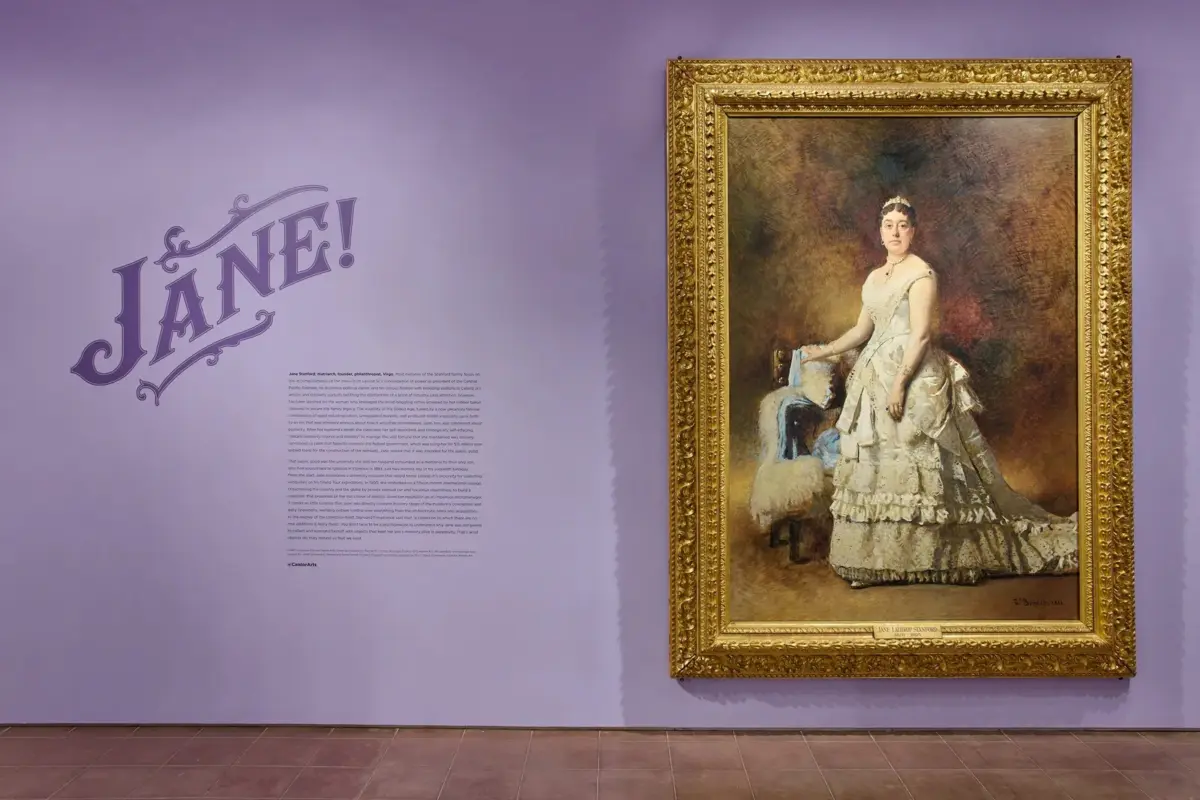
Now, a groundbreaking and expansive new exhibition at the Cantor Arts Center seeks to fundamentally rewrite that history. Titled Jane! and scheduled to run through May 18, 2028, the showcase thrusts Stanford University’s founding matriarch out of the historical shadows and into the glaring light she so richly deserves. Featuring dozens of rare, never-before-exhibited artifacts—ranging from bizarre family heirlooms and custom art pieces to death masks and plaster casts associated with a sprawling murder plot—the exhibition explores Jane Stanford in all her complexity: a travel-loving, globetrotting philanthropist, a grieving mother transformed by devastating loss, and a formidable institutional leader who met a tragic, violent end by strychnine poisoning.
Curated by Patrick R. Crowley, with contributions from campus heritage experts and historians, Jane! peels back the layers of Victorian mythmaking, university politics, and historical cover-ups. It paints a portrait of a woman who was "so formidable, peculiar, and unexpectedly human," transforming the prototype of the modern founder into a flesh-and-blood figure whose fingerprints remain stamped on every acre of the California campus.
Detailed Chronology: From Gilded Age Opulence to Tragedy
The Seeds of Wealth and Early Beginnings
Long before she became the architect of a university, Jane Lathrop was born in 1828 into a large, prominent family in Albany, New York. In 1850, she married Leland Stanford, a sharp-minded lawyer whose career trajectory would map directly onto the explosive expansion of the American West. Leland amassed a staggering fortune through his leadership role in the burgeoning railroad industry, eventually serving as the eighth governor of California and later as a United States Senator.
The peak of Leland’s corporate and political dominance arrived on May 10, 1869, at Promontory Summit, Utah. As president of the Central Pacific Railroad, Leland drove the ceremonial "Golden Spike" that symbolically and physically united the nation through the first transcontinental railroad. The family’s wealth skyrocketed, unlocking an era of elite global travel, fine art collecting, and unmatched social influence. Jane stood shoulder-to-shoulder with her husband through this meteoric rise, learning the levers of corporate power and high-society governance alongside him.
The Cataclysmic Loss of Leland Jr.
Despite their immense wealth, the Stanfords’ world was shattered in 1884. While the family was touring Europe on an extended holiday, their only child, 15-year-old Leland Stanford Jr., contracted typhoid fever in Athens, Greece. The teenager, deeply enamored with classical antiquities and architecture, succumbed to the illness abroad, plunging his parents into an unrecoverable abyss of grief.
Faced with an unimaginability empty future, Jane channeled her profound sorrow into a radical vision of public philanthropy. As Isabelle Rogers, an assistant registrar at the Cantor Arts Center, observes, Jane felt that "they didn’t have a child anymore, and so she thought that all of California could be her children."
To immortalize their son, the couple resolved to build a world-class university bearing his name: The Leland Stanford Junior University, which officially opened its doors to students in 1891. Furthermore, the grieving parents established the Leland Stanford Jr. Museum (now the Cantor Arts Center) in 1894, intentionally designing its facade to mimic the National Archaeological Museum in Athens—the very city where young Leland’s health had first failed.
Sole Stewardship and the Shadow of Murder
Following Leland’s death in 1893, Jane Stanford was left to steer the fledgling university largely on her own. In an era when female leadership in higher education was virtually nonexistent, Jane stepped into the executive vacuum with fierce determination. She made critical financial decisions, dictated institutional policies, and protected the endowment during devastating economic downturns.
However, her formidable management style frequently brought her into bitter conflicts with the university’s first president, David Starr Jordan, who chafed under her oversight.
The climax of Jane’s turbulent later years arrived on January 14, 1905, inside her opulent San Francisco mansion. After taking a routine sip of mineral water, Jane was gripped by violent, agonizing vomiting. Only her personal secretary, Bertha Berner, and her maid were present in the house at the time. Subsequent chemical analysis confirmed the worst: her drinking water had been spiked with a lethal dose of strychnine, a harsh commercial rat poison.
Terrified and acutely aware that someone within her inner circle wanted her dead, Jane fled San Francisco for an extended voyage to Japan, stopping first in Hawaii. On February 28, 1905, at the Moana Hotel in Honolulu, Jane took a dose of bicarbonate of soda to soothe her digestion. Within moments, she was convulsing in agony, dying just hours later. An autopsy unequivocally detected fatal quantities of strychnine in her system.
Yet, university president David Starr Jordan immediately moved to control the narrative. Rejecting the autopsy findings, Jordan cabled the press to declare that Jane had died of natural heart failure. This institutional cover-up calcified into the official history for nearly a century, suppressing dark truths about murder, greed, and institutional self-preservation.
Supporting Context & Metrics: Unseen Artifacts and Historical Reexaminations
The Jane! exhibition leverages a staggering array of physical evidence—some items newly pulled from university archives, others recovered from forgotten attics—to reconstruct the psychological landscape of the co-founder.
Key Exhibition Highlights and Artifacts
The Last Breakfast Ceramics: A striking piece by contemporary ceramicist David Gilhooly depicting Leland Jr.’s final meal—bacon, eggs, and toast—capturing the morbid yet deeply human obsession the family maintained around the boy’s untimely death.
The Jewel Collection Painting: An 1898 canvas by Astley D.M. Cooper depicting Jane’s legendary, multi-million-dollar collection of jewels, which she later sold off to permanently fund the university’s operational budget during financial crises.
The Suspects’ Relics: The exhibition features objects tied directly to the leading suspects in her murder: a set of plaster hands initially misattributed to Jane but later proven to belong to President David Starr Jordan, and a long-forgotten mosaic portrait of personal secretary Bertha Berner discovered in an attic near the campus.
Death Masks: Somber, hyper-realistic death masks of both Jane Stanford and young Leland Jr., bearing witness to the Victorian obsession with spiritualism and physical preservation.
The Lingering Mystery of the Strychnine
For decades, historians accepted Jordan’s heart-failure narrative. However, landmark historical investigations by medical scholars Robert W.P. Cutler and W.B. Carnochan in the early 2000s, followed definitively by Stanford historian Richard White in his 2022 book Who Killed Jane Stanford?, shattered the century-old silence.
White’s meticulous archival research revealed that contemporary press coverage of Jane’s death was chaotic, contradictory, and clearly manipulated. White presents a compelling case implicating Bertha Berner as the poisoner, motivated by potential financial gain or personal grievances, while identifying David Starr Jordan as an "accessory after the fact" who covered up the homicide to shield the university from catastrophic scandal and protect his own administrative authority.
Official Statements and Institutional Perspectives
The unveiling of Jane! marks a profound institutional reckoning for Stanford University, as modern administrators and archaeologists work to restore the matriarch to her rightful place in campus lore.
"There are some objects in there that are works by well-known artists, but then there are also some really strange, bizarre family heirlooms and keepsakes,"
— Patrick R. Crowley, Exhibition Curator, Cantor Arts Center
Describing Jane as "so formidable, peculiar and unexpectedly human," Crowley emphasizes that the exhibition deliberately breaks away from the sanitized, marbleized portraits of nineteenth-century industrialists to explore the messy emotional realities of grief and power.
Laura Jones, director of Stanford’s heritage services and the official university archaeologist, underscores the shared nature of the university’s creation, pushing back against historical narratives that exclusively credit Leland.
"She and Leland started out with very little wealth, and they developed massive wealth and power and influence. And she learned about that alongside him,"
— Laura Jones, University Archaeologist
Jones notes that when Leland died, Jane "was prepared as a widow to take on that role of making the decisions" about the institution’s future trajectory.
"She’s huge as a philanthropist, and she doesn’t really get recognized for that. People talk all the time now at Stanford about ‘founders.’ All our students want to found something or build something. And she really is our prototype."
— Laura Jones
Future Outlook
By keeping Jane! on display through May 2028, the Cantor Arts Center has ensured that students, scholars, and international visitors will engage with a deeply humanized, morally complex origin story for years to come.
The exhibition does more than simply display rare artifacts or reopen a century-old murder investigation; it forces an institutional introspection. As modern generations of entrepreneurs, students, and technologists walk the Stanford quadrangles chasing the quintessential "Silicon Valley founder" dream, they are now invited to look backward at the original prototype: a woman who turned personal devastation into enduring public good, navigating the pinnacles of wealth, the depths of grief, and the dark corridors of betrayal.
Through Jane!, the university is finally embracing its entire history—flaws, poison, and all.

/https://tf-cmsv2-smithsonianmag-media.s3.amazonaws.com/filer_public/cb/f5/cbf53a8f-ab25-4f04-9809-58da970031e4/2026-07_jane_gc-4-web.jpg)
/https://tf-cmsv2-smithsonianmag-media.s3.amazonaws.com/accounts/headshot/IMG_7600-edit-v2.png)
:focal(1500x1000:1501x1001)/https://tf-cmsv2-smithsonianmag-media.s3.amazonaws.com/filer_public/cb/f5/cbf53a8f-ab25-4f04-9809-58da970031e4/2026-07_jane_gc-4-web.jpg)
/https://tf-cmsv2-smithsonianmag-media.s3.amazonaws.com/filer_public/04/9d/049d1eb9-1c67-4577-a6ff-562c1f7bc7e4/mosaic.png)
/https://tf-cmsv2-smithsonianmag-media.s3.amazonaws.com/filer_public/c5/92/c5920bad-a7a1-405a-998e-8eb181e8a40b/jls14897_cdp-pub_angel.jpg)
/https://tf-cmsv2-smithsonianmag-media.s3.amazonaws.com/filer_public/91/19/911943c8-65db-4727-8472-c9a7c4d406a0/jls18217_cdp-pub_portrait.jpg)
/https://tf-cmsv2-smithsonianmag-media.s3.amazonaws.com/filer_public/37/65/3765fd26-99f1-41ce-adf4-f98e9202dd97/leland.jpg)
/https://tf-cmsv2-smithsonianmag-media.s3.amazonaws.com/filer_public/41/6e/416e4309-595b-4fe7-9232-bd9aa2cbb6ba/199153_gilhooly_breakfast-2.jpg)


Comments
Facebook App ID not configured. Please add it in the Customizer.