In 2022, a weathered cardboard box materialized without warning on a United Service Organizations (USO) reception desk in New York City. Inside lay a remarkable, fragile archive: more than 300 handwritten letters, postcards, and V-Mails dispatched from the front lines of World War II. Penned by a young 23-year-old New York soldier known universally as "Speedy," the correspondence documented an ocean-spanning romance with his wife, Frances, who waited anxiously back home in the Bronx.
For years, the origins of the donation remained completely unknown. Who had dropped off the cache? What had happened to Speedy and Frances after the guns finally fell silent in 1945? The collection eventually migrated to the USO’s headquarters in Virginia, where archivist and historian Michael Case took up the mantle of investigating the mysterious trove.
What followed was an international, multi-year sleuthing effort involving major news outlets, digital archives, historical publicity campaigns, and a dedicated amateur genealogist in California. Ultimately, the quest broke open, allowing researchers to trace living relatives who provided the missing human dimension to Speedy’s evocative prose. These breakthroughs transformed a nameless pile of paper into a vivid narrative of love, endurance, and everyday resilience amid global catastrophe.
Detailed Chronology: From the Bronx to the Battlefields of Europe
1. The Making of a Soldier: 1942
Louis "Speedy" Weber’s journey into the United States military began in the early months of America’s involvement in World War II. Just a year into his marriage with Frances, Speedy found himself abruptly uprooted from his life in New York.
Like millions of draftees, he had to learn the grueling mechanics of survival in uniform: waking before dawn, scrubbing kitchen floors until sunset, enduring the standard 1.5-inch military haircut, and keeping perpetually busy to stave off the crushing weight of homesickness.
On June 17, 1942, Speedy captured this psychological defense mechanism in a letter to Frances:
"I don’t feel as blue as I did yesterday. They don’t give me a minute to think about anything but Army life, and in a way that’s the best thing for me, because if I stopped to think about home I’d go nuts."
With his deployment imminent, Speedy embarked for Europe, carrying his pen and paper as his primary tethers to the life he had left behind.
2. The Mysterious 2022 USO Donation
Eighty years after those early dispatches, the paper trail landed back in New York—this time as an anonymous donation. In 2022, an unlabelled box containing upward of 300 letters arrived at a USO office.
Institutional archives frequently take in memorabilia, but Michael Case noted that this acquisition was entirely unprecedented. While most contributions consist of a stray photograph, a pin, or a service button, this box offered an uninterrupted, granular look into an ordinary soldier’s psychological landscape over years of deployment.
Moving from New York to the USO headquarters in Virginia, the collection became Case’s passion project. He began reading through the entries, struck by Speedy’s distinct literary voice—what Case terms "everyday elegant." Despite likely never completing higher education, the young soldier possessed a natural flair for drama and emotional authenticity, stamping his correspondence with evocative location markers like "somewhere in England,""somewhere in France," and "somewhere in Luxembourg," and closing with his signature sign-off: "You are always in my heart."
3. Public Appeals and Digital Archives
For months, the paper trail stalled. In 2024, the USO partnered with the Washington Post to cross-reference census records, establishing that Speedy and Frances had lived in close proximity in New York in 1940, both born to immigrant families. Yet, despite publication, the leads yielded no direct family connections.
The breakthrough campaign arrived in May 2026. The USO formally digitized a curated selection of the letters on its online portal, "Letters Home." To amplify the launch—coinciding with promotional pushes for war-era cinematic dramas like Pressure—the organization enlisted actor Andrew Scott to publicly read excerpts of Speedy’s correspondence. Staffers hoped the media saturation would finally jar someone’s memory.
4. The Genealogist’s Breakthrough: August 2026
While the public broadcasts did not immediately prompt a direct descendant to step forward, they caught the attention of Matthew Brown, an amateur genealogist based in California. Leveraging digital databases like Ancestry.com, Brown cross-referenced demographic details and pinpointed a promising living relative: Arthur Serota.
Brown forwarded the name to Washington Post reporter Joe Heim, who tracked down Serota in Los Angeles. When contacted, Serota was entirely unaware of the newly discovered letter archive, but he held deep, foundational memories of the man who wrote them.
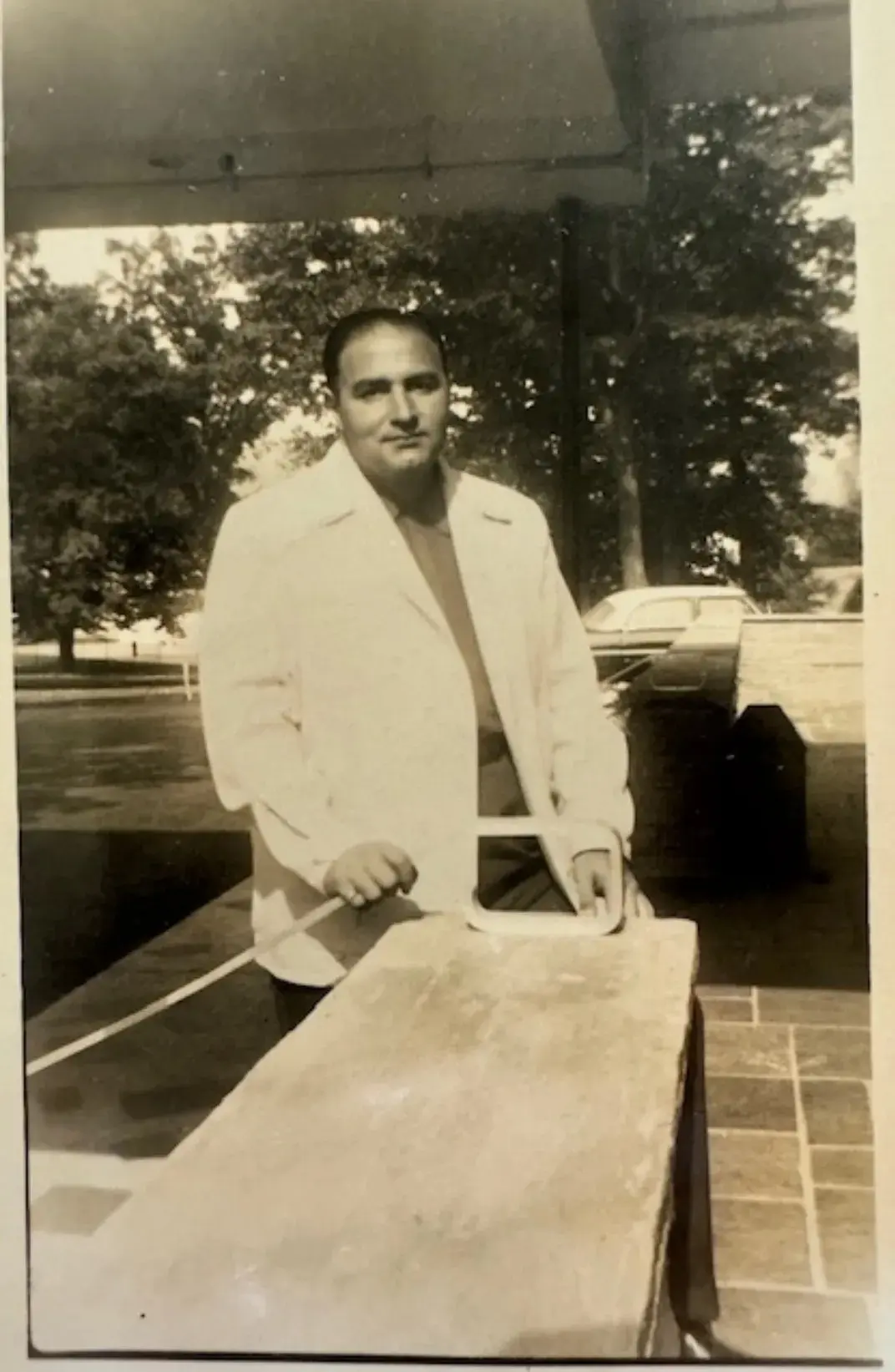
Serota revealed that Speedy was his mother’s sibling and his absolute favorite uncle. Born in 1942—the exact year Speedy shipped out—Serota remembered the soldier’s eventual return as one of the defining moments of his early childhood. Soon after, Serota connected researchers with Karen Weber Figilis, a niece of the couple, who shared two priceless black-and-white photographs of Speedy and Frances, finally putting a face to the romantic prose.
Supporting Context & Metrics: The Mechanics of Wartime Mail
To understand the sheer volume of Speedy’s correspondence—averaging roughly 100 letters per year, or one communication every three to four days—one must view it against the broader administrative backdrop of the Second World War.
As Lynn Heidelbaugh, a curator at the Smithsonian’s National Postal Museum, notes, mail served as the single most critical morale channel for front-line personnel. Recognizing this psychological lifeline, the United States government actively encouraged military personnel to write home, subsidizing operations by supplying free stationery and waiving standard postage fees.
High-Frequency Communication: A comprehensive 1944 government survey revealed that active-duty service members dispatched mail roughly six times per week, utilizing a mixture of long-form letters, short postcards, and single-page V-Mail formats.
Geographic Spread: Speedy’s letters traced the agonizingly slow advance of the Allied forces across the European and North African theaters. The archive reflects dispatches originating from Sicily, England, France, Belgium, Germany, Czechoslovakia, and North Africa.
Survival Discrepancy: The survival rate of letters sent from the front lines heavily outpaced those sent to soldiers. Families at home could securely file away incoming mail, whereas service members constantly on the move frequently had to discard non-essential paper goods to lighten their load.
Official Statements & Archival Insights
The emotional weight of the Weber archive has drawn high-profile commentary from historians, cultural figures, and institutional leaders:
Michael Case, Archivist and Historian:
"We get a lot of donations, but usually it’ll be a photo or two, or a postcard, or a pin, or a button… When I read through the box, I really felt like I started to know Speedy Weber. It’s an everyday guy—not a general, no one famous—just doing his job and loving and being emotional and screwing up occasionally."
Jennifer Passey, VP of Communications at the USO:
"We’re putting the letters back out there as people are talking about this movie… We would love for anyone who may know more about Speedy or his wife, Frances, to reach out to us."
Arthur Serota, Speedy’s Nephew (Age 84):
"He was generous and just had this natural warmth that emanated from him… Frances was classy, clearly the brightest of all the aunts and uncles."
Inside the Letters: Humor, Despair, and History
Speedy’s letters offer an intimate window into the duality of a soldier’s existence: the mundane administrative frustrations mixed with the terrifying theater of total war.
Whimsical Affection and Playful Banter
Even before leaving American soil, Speedy relied on sharp wit to bridge the physical gap. On October 15, 1942, he joked:
"In your letter, you asked me if there was anything I want that I can’t get out here. Well, there most certainly is. I want you. So if you wrap yourself into a package and mark it fragile, I’m pretty sure it will come down to me in good order."
He showered Frances with an eclectic array of eccentric pet names, ranging from traditional choices like "Dearest" and "Darling" to whimsical monikers such as "Legs,""Knucklehead,""Shape," and "Meatball."
Witnessing History: The Cross-Channel Invasion
Following his likely arrival in France shortly after June 6, 1944, Speedy penned an awe-struck account of the cross-channel invasion fleet. Writing on June 14, 1944, he described the scene as the dawn of history:
"It was quite thrilling and exciting to be able to be there when the curtain went up on the biggest show in the world… When I was on my way across the channel, I felt just as safe as if I were in your arms, because as far as the eye could see, there was nothing but ships of every description."
Military Realities and Demotions
Speedy’s letters were not entirely heroic; they also chronicled the bureaucratic absurdities of military life. In early 1945, he casually informed Frances that he had been stripped of his rank, dropping from a private first class down to a private:
"I suppose you want to know why I was reduced. So do I. I must admit that a reason was given, but I think, and so does everyone else, that the reason is pretty flimsy." He quickly reassured her: "Frances need not worry about him ‘going any lower than private, because there is no smaller grade than private.’"
Future Outlook: Unresolved Mysteries and Archival Legacy
Following the conclusion of hostilities, Speedy and Frances successfully rebuilt a quiet civilian reality in New York. Speedy pursued a career as a truck driver, while Frances managed operations at a local U.S. Post Office. Though they never had children, they eventually retired to Florida, where they lived out their remaining years together. Speedy passed away at age 78, followed by Frances at 87; today, they rest side-by-side in a joint plot at a Jewish cemetery.
Despite the genealogical breakthroughs achieved by Matthew Brown, Joe Heim, and surviving relatives Arthur Serota and Karen Weber Figilis, the mystery surrounding the archive remains incomplete:
The Donor Identity: Archivists still do not know who boxed up the 300 letters and dropped them off at a New York USO office in 2022. The prevailing theory suggests a descendant or estate clearer discovered the trove during a home cleanout and recognized the USO letterhead.
Frances’s Perspective: Only two of Frances’s letters survived within the collection, leaving her side of the dialogue largely untold. Furthermore, historians remain puzzled as to why several of Speedy’s letters appeared to have remained unopened.
As institutions increasingly digitize private wartime correspondence, collections like Speedy Weber’s serve an invaluable educational function. They strip away the sterile abstraction of textbook timelines, replacing grand troop movements with the ink-stained anxieties of a 23-year-old soldier writing to his wife in the Bronx, wondering when—or if—he would ever see home again.

/https://tf-cmsv2-smithsonianmag-media.s3.amazonaws.com/filer_public/fe/a4/fea4733a-0d55-495d-8871-35601a376f66/gettyimages-2186736524.jpg)
/https://tf-cmsv2-smithsonianmag-media.s3.amazonaws.com/accounts/headshot/Ellen_Wexler.png)
:focal(1500x1000:1501x1001)/https://tf-cmsv2-smithsonianmag-media.s3.amazonaws.com/filer_public/fe/a4/fea4733a-0d55-495d-8871-35601a376f66/gettyimages-2186736524.jpg)
/https://tf-cmsv2-smithsonianmag-media.s3.amazonaws.com/filer_public/94/0d/940dfb2b-7f54-4ad0-8162-d1b5b15d54bc/gettyimages-2186736369.jpg)
/https://tf-cmsv2-smithsonianmag-media.s3.amazonaws.com/filer_public/cc/06/cc0606eb-e5e8-41a8-842c-d31e30c1c266/gettyimages-2287835789.jpg)
/https://tf-cmsv2-smithsonianmag-media.s3.amazonaws.com/filer_public/95/2a/952a9cc4-a2ba-4d8c-ae2e-c7c7a0e4a418/louis_speey_weber_20260608_104427_gmail.jpg)

Comments
Facebook App ID not configured. Please add it in the Customizer.