
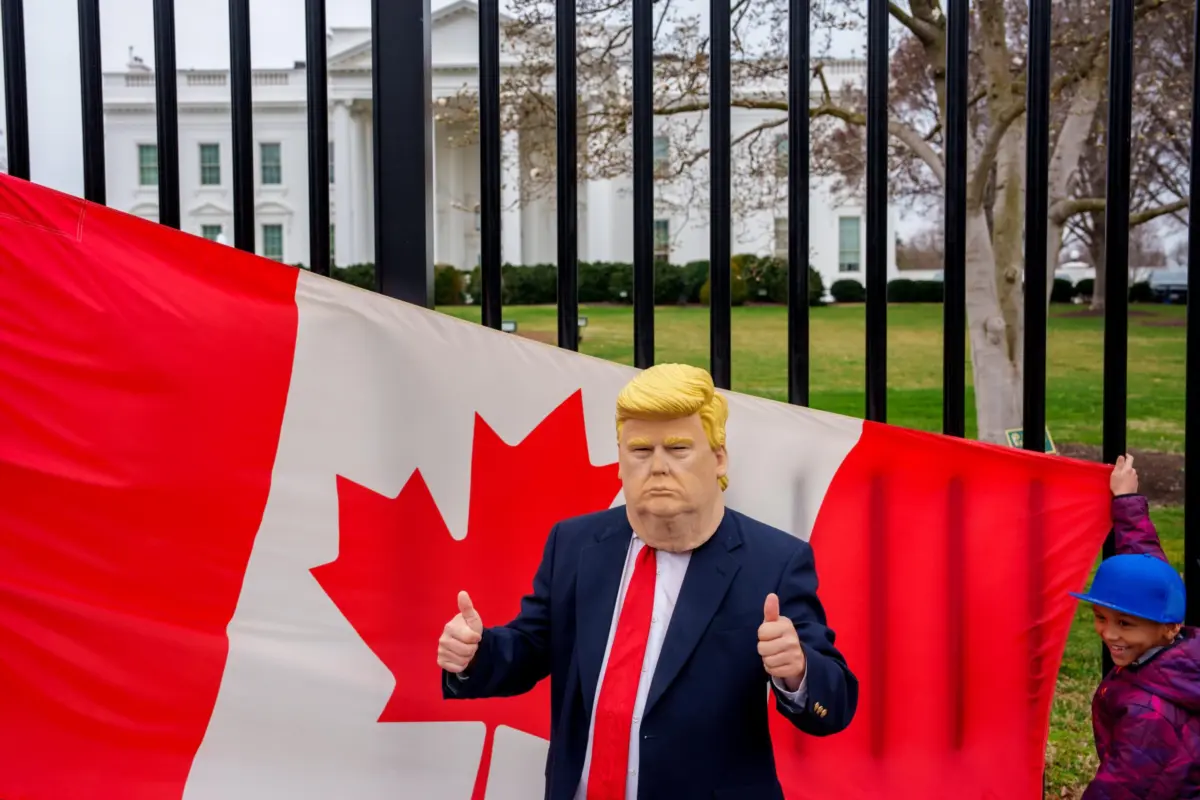
LONDON, Ontario — In the realm of modern international relations, major trade disputes are typically born of quantifiable friction: currency manipulation, predatory industrial subsidies, intellectual property theft, or surging imports that devastate domestic manufacturing. They are driven by strategic blueprints, championed by influential lobbying coalitions, and justified by orthodox economic theory or populist voter appeals.
Yet, as Washington and Ottawa plunge headlong into a bitter and economically ruinous trade war, the entire conflict defies conventional logic. There is no ideological think tank plotting its course. There is no major corporate lobby demanding this protectionist upheaval. There is no electoral groundswell cheering on the economic devastation of America’s staunchest ally.
Instead, trade experts, political scientists, and veteran strategists from across the political spectrum are left staring at a stark, unprecedented reality: this trade war exists for one reason and one reason alone. It is happening because Donald Trump, and Trump alone, wants it to.
Read Also
Executive Overview
The escalating economic conflict between the United States and Canada has crossed from protectionist posturing into surreal geopolitical theater. On Monday, President Donald Trump threatened a fresh round of 50 percent tariffs targeting Canada’s highly integrated automotive industry—a move guaranteed to fracture supply chains and inflict catastrophic economic damage on both sides of the border. By Tuesday morning, the rhetoric had devolved further into public musings about renaming Lake Ontario "Lake America" simply to spite Canadians.
Throughout this escalation, Trump and Vice President JD Vance have leaned heavily into their running "jokes" about absorbing Canada as the 51st state.
While the White House’s behavior has generated palpable fury on the ground in Canada, the conflict is anomalous by Trumpian standards. Usually, even the most unorthodox foreign policy maneuvers favored by the administration possess a constituency—whether a faction of congressional hawks, a roaring voting bloc ahead of midterms, or a coordinated network of populist intellectuals.
Yet, when analysts trace the origins of this northern trade war, they hit a brick wall. There is no ideological or business coalition pushing for this fight. Even populist figures sympathetic to economic nationalism are sounding alarms, while crucial Republican constituencies, fearful of a midterm backlash in border states, watch the unfolding economic brinkmanship with undisguised dread.
Detailed Chronology of an Escalation
To understand how Washington and Ottawa arrived at this precarious juncture, it is necessary to examine the rapid acceleration of diplomatic friction over the past two years.
The Spark: Late 2024 to Early 2025
The animus began almost immediately after Trump’s return to the White House in November 2024. Piqued by lingering personal grievances and an assertive Canadian political landscape, the president began publicly feuding with then-Prime Minister Justin Trudeau, dismissively referring to him as "governor" and casually floating the concept of Canada as America’s 51st state.
Less than two months into his term, Trump bypassed normal diplomatic channels and slapped Canada with a sweeping, historically unprecedented 25 percent across-the-board tariff. Investigative reports from outlets like The Washington Post at the time revealed a startling vacuum: there was no comprehensive policy paper, no intellectual godfather, and no industry trade association backing the move. It was pure executive fiat.
The Carney Interlude and the Illusion of Peace
Tensions cooled somewhat after Mark Carney assumed the Canadian prime ministership, campaigning largely on an anti-Trump platform. For a brief period, cooler heads appeared to prevail. The incendiary talk of annexing Canada receded, and formal trade negotiations commenced.
By the Tuesday prior to the current collapse, optimism had peaked. Trump himself declared that a breakthrough trade deal had been reached, prompting the temporary postponement of tariff implementations. The relief, however, was fleeting.
The Friday Breakdown
By Friday, the fragile diplomatic architecture shattered. Investigative tick-tocks from The New York Times and other major publications laid bare why the deal collapsed: the U.S. administration had attached exorbitant, surrender-style conditions to the agreement. Specifically, Washington demanded direct oversight over Canada’s sovereign tariff rates with third-party nations and the unilateral right to reimpose American tariffs at will.
Canada’s refusal to sign away its basic economic sovereignty triggered an immediate, furious response from the Oval Administration, culminating in Monday’s tariff threats and Tuesday’s absurd territorial provocations.
Supporting Context & Metrics: Economics, Politics, and Power
To fully grasp the recklessness of the current trade war, one must examine the profound mismatch between the administration’s stated goals and the objective economic and political realities.
The Economic Mismatch
For decades, the U.S. and Canada have managed bilateral trade disputes—ranging from softwood lumber to dairy quotas—through structured, institutionalized negotiation processes. These disputes never spiraled into total economic warfare because they represented a minuscule fraction of combined Gross Domestic Product (GDP).
Furthermore, North American manufacturing is deeply integrated. The auto sector, in particular, relies on parts crossing the border multiple times before a vehicle is fully assembled. Imposing a 50 percent tariff on Canadian autos does not simply penalize a foreign competitor; it functions as a self-inflicted tax on domestic American assembly plants. Even the United Auto Workers (UAW)—a union that has historically backed targeted protectionist measures—condemned the proposed auto tariffs outright.
The Political Peril
Politically, the strategy defies comprehension. American voters have consistently disapproved of blanket tariffs on Canadian-made goods, recognizing them as inflationary drivers that raise the cost of everyday consumer items, energy, and construction materials.
With midterm elections looming, congressional Republicans are sounding the alarm. Several pivotal Senate races are unfolding in states directly bordering Canada. Any tariff-induced price spike in these regions threatens to supercharge the Democratic Party’s core midterm message regarding economic affordability and cost-of-living pressures.
"If I were Senate Majority Leader John Thune, I’d be very pissed at Trump right now," notes Adam Carlson, a senior pollster at Zenith Research.
Official Statements and Expert Perspectives
The lack of institutional backing for the trade war has left policy analysts and political historians searching for rationalizations where none exist.
-
Kim Clausing, Trade Economist at UCLA:
"This has never been a particularly well-thought strategy. I think that the biggest, most coherent explanation is that this is about power."
-
Phil Magness, Economic Historian:
"I really do think it is Trump’s idiosyncrasies that caused him to settle on Canada. Others in the administration are going along with it, but there was no prior ideological blueprint for a full-scale trade war with Ottawa."
-
Michael Lind, Populist Pundit and Author of "The Madness of Trump’s Canada Trade War":
Writing in UnHerd, Lind—who previously penned prominent defenses of targeted tariffs—panned the current escalation against Canada as an irrational departure from coherent economic nationalism, noting that the crusade lacks any foundational support among serious populist economic theorists.
Future Outlook: The Dangers of Whim-Based Governance
The U.S.–Canada trade conflict serves as a glaring case study in the inherent risks of governance driven by individual impulse rather than strategic interest.
Whether Trump’s obsession stems from lingering bitterness over past real estate disputes, personal dynamics with high-profile Canadian figures, or a real estate developer’s legacy-driven desire to redraw North American borders on a map, the practical outcome remains deeply dangerous.
By demanding the effective vassalization of Ottawa rather than negotiating a mutually beneficial trade pact, the White House is willing to sacrifice vital geopolitical alliances and risk its own congressional majority. As the trade war grinds forward, it leaves behind a fractured economic landscape and a permanently strained relationship between two nations historically bound by geography, commerce, and shared democratic values.





Comments
Facebook App ID not configured. Please add it in the Customizer.