
Executive Overview
In an era where public spaces are increasingly monitored yet profoundly disconnected, the sanctity of personal boundaries remains a fragile illusion. For prominent public figures, the loss of anonymity is an accepted cost of celebrity; however, the crossing of lines into intimidation, non-consensual surveillance, and targeted harassment is a violation that transcends fame.
Recently, acclaimed Pakistani television actress, presenter, and digital creator Hina Altaf found herself at the center of this unsettling reality. While traveling on a commercial flight, Altaf experienced a distressing episode of persistent harassment by a fellow passenger who allegedly subjected her to intrusive, unremitting stares. Rather than suffering in silence or dismissing the event as an isolated nuisance, Altaf chose to leverage her considerable social media platform to document the ordeal in real-time, sparking a fierce, necessary dialogue across South Asia regarding women’s safety, public accountability, and the insidious nature of everyday voyeurism.
This incident is far more than a fleeting celebrity anecdote. It serves as a stark case study in the broader sociological phenomenon of entitlement in shared public spaces. By publicly sharing footage of the offender—who brazenly continued his invasive behavior even after realizing he was being recorded—Altaf illuminated a dark truth about how women navigate the world. Furthermore, her pointed commentary regarding her own attire effectively dismantled the archaic, victim-blaming tropes that so often weaponize what a woman wears to justify predatory behavior.
Read Also
As conversations surrounding passenger safety, airline accountability, and digital advocacy continue to evolve, Altaf’s experience adds to a growing catalog of resistance led by women in the public eye who refuse to normalize intimidation. This report offers a comprehensive examination of the incident, its structural context within the broader entertainment and travel ecosystems, and the urgent imperative for systemic change in how public harassment is policed, prevented, and condemned.
Detailed Chronology of Events
The unsettling sequence of events unfolded at 35,000 feet, transforming a routine commercial flight into an environment of psychological discomfort for the prominent media personality. While the exact airline and flight route have been kept private to protect her immediate travel logistics, the timeline of the occurrence can be reconstructed through the digital breadcrumbs and direct statements shared by Altaf via her official Instagram stories.
The In-Flight Encounter
As documented by the actress, the journey began routinely enough until Altaf became acutely aware of a male passenger seated within close proximity who was fixated upon her. In modern public transit, casual glances are common; however, as the minutes stretched into hours, the nature of the man’s gaze shifted from inadvertent observation to deliberate, unapologetic staring.
According to Altaf, the individual maintained an unwavering, predatory visual fixation that ignored all social cues of discomfort or avoidance. The persistence of the gaze created an escalating atmosphere of intimidation. In confined environments such as airplane cabins—where passengers are physically restricted and escape is impossible—such aggressive surveillance can quickly transition from annoying to psychologically distressing.
Real-Time Documentation and Defiance
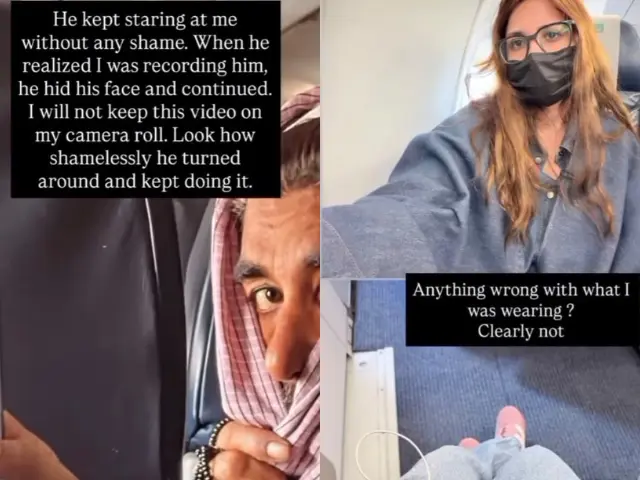
Recognizing the escalating tension and the absence of immediate intervention by cabin crew, Altaf made the conscious decision to document the behavior. Pulling out her smartphone, she recorded a video clip of the male passenger.
Crucially, the footage captured a brazen escalation: upon realizing that he was being filmed, the individual momentarily shielded his face, only to resume his intrusive staring once he believed the moment had passed. This defiance highlighted a profound sense of impunity. In her captions accompanying the video, a visibly frustrated Altaf wrote:
"He kept staring at me without any shame. When he realised I was recording him, he hid his face and continued. I will not keep this video on my camera roll. Look how shamelessly he turned around and kept doing it."
Challenging the Narrative of Blame
Anticipating the predictable, regressive commentary that frequently plagues women who speak out against harassment, Altaf preemptively dismantled potential victim-blaming narratives. Alongside the video evidence, she published a photograph of herself seated inside the aircraft. Dressed in a modest, highly comfortable grey travel ensemble, accessorized with prescription glasses and a black protective face mask, her appearance was entirely ordinary and practical for air travel.
Beneath this image, Altaf issued a rhetorical challenge to societal double standards:
"Anything wrong with what I was wearing? Clearly not."
By strategically coupling the video of the perpetrator with a snapshot of her own unassuming travel attire, Altaf exposed the absurdity of holding women accountable for the predatory actions of others. The core issue, as her narrative underscored, was not the wardrobe of the victim, but the profound lack of boundaries and basic decency exhibited by the offender.
Supporting Context & Metrics: The Anatomy of Public Harassment
To fully grasp the gravity of Hina Altaf’s in-flight experience, one must examine the broader socio-cultural landscape regarding women’s safety in public spaces, particularly within Pakistan and the broader South Asian region. Harassment in transit—ranging from staring and verbal catcalling to physical groping—remains an underreported yet pervasive crisis that affects women across all socioeconomic strata.

The Travel and Transit Dilemma
Commercial aviation is often perceived as a secure, regulated bubble insulated from the dangers of the outside world. However, airlines and airports are micro-societies where systemic biases and cultural attitudes toward women are frequently mirrored. Confined seating arrangements, dim lighting during long-haul flights, and delayed response times from cabin crews create an environment where low-level harassment—such as non-consensual staring, invasive photography, and boundary-testing spatial encroachment—can flourish with impunity.
According to global travel safety metrics and gender advocacy reports:
- Over 70% of women report experiencing some form of harassment, ranging from staring to physical intimidation, while utilizing public transport or commercial travel hubs.
- Under 20% of these incidents are formally reported to authorities or transit staff, largely due to systemic skepticism, fear of retaliation, or the exhausting burden of proof placed upon the victim.
- Digital Voyeurism: The ubiquity of smartphones has introduced a terrifying new dimension to transit harassment, where women are frequently photographed or recorded without consent for malicious online dissemination or private voyeuristic gratification.
A Pattern of Brave Disclosure
For Hina Altaf, speaking out against inappropriate behavior is part of a broader personal and professional ethos characterized by accountability and resilience. With a career spanning well over a decade, Altaf has transformed from a popular video jockey and television host into a seasoned drama actress known for critically acclaimed roles in serials such as Dil-e-Jaanam, Aatish, Dil-e-Gumshuda, and Rabba Mainu Maaf Kareen. Her visibility in the entertainment industry has given her a massive digital footprint, which she frequently utilizes not merely for self-promotion, but as a megaphone for social consciousness.
This incident is not the first time Altaf has leveraged her platform to dismantle predatory behavior. In May 2026, the actress made headlines when she courageously spoke out about an unsettling, unsafe encounter on a television drama production set. In that instance, Altaf detailed how the actions of an individual during filming compromised her sense of security. Rather than enduring the hostile environment for the sake of the project, she actively removed herself from the set and formally escalated her grievances to the relevant production house.
Her willingness to consistently draw back the curtain on workplace toxicity and public harassment establishes her as a vital voice in modern Pakistani media—a figure who refuses to trade her dignity for professional compliance or social decorum.
Official Statements and Industry Reactions
The public disclosure by Hina Altaf unleashed a massive wave of digital solidarity across Instagram, X (formerly Twitter), and various entertainment portals. Fans, fellow industry professionals, and gender rights advocates quickly rallied behind the actress, amplifying her message and demanding heightened vigilance from public institutions and service providers.
Public and Peer Solidarity
Social media users flooded comment sections and dedicated forums with messages of support, commending Altaf for her refusal to internalize shame or remain silent. Prominent figures within the Pakistani entertainment fraternity echoed her sentiments, emphasizing that the burden of ensuring safety in public spaces must never fall upon the targeted individual.
Industry analysts noted that public figures speaking out about micro-aggressions like persistent staring helps demystify behaviors that are often dismissed as "harmless quirks." By labeling the behavior as what it truly is—harassment and intimidation—Altaf and her supporters have helped redefine the threshold of acceptable conduct in shared spaces.
The Silence of Corporate Carriers
Despite the viral nature of the post and widespread media coverage, commercial airlines and civil aviation authorities have been slow to issue formal policy updates addressing passenger-on-passenger psychological harassment. Critics point out that while airlines maintain stringent protocols for physical safety and bomb threats, interpersonal boundary violations—such as non-consensual staring, verbal intimidation, and spatial crowding—often fall into a regulatory gray area.
Advocacy groups are increasingly lobbying for airlines to adopt zero-tolerance policies regarding passenger harassment, including mandatory pre-flight safety briefings that explicitly outline behavioral codes of conduct, alongside swift, punitive measures for offenders, such as placement on domestic and international no-fly lists.
Future Outlook: Reclaiming Public Space and Accountability
Hina Altaf’s in-flight ordeal and subsequent public stand serve as a critical inflection point for discussions surrounding women’s safety, digital accountability, and the corporate responsibilities of transport providers. As we look toward the future, several vital imperatives emerge to ensure that public spaces—whether digital, corporate, or airborne—become truly safe for everyone.
1. Strengthening Institutional Protocols
Airlines, transport networks, and public institutions must move beyond reactive public relations strategies and institute proactive, rigorous frameworks against harassment. This includes:
- Comprehensive training for cabin crews and customer-facing staff to recognize, de-escalate, and penalize psychological harassment and boundary violations.
- Transparent reporting mechanisms that allow passengers to register complaints mid-journey without fear of public embarrassment or logistical retaliation.
- The enforcement of strict "no-fly" policies for individuals documented engaging in predatory or harassing behavior toward fellow travelers.
2. Dismantling the Culture of Victim-Blaming
Altaf’s rhetorical challenge—"Anything wrong with what I was wearing? Clearly not"—must become a foundational tenet of cultural education. Societal conditioning that links a woman’s safety to her clothing, behavior, or physical location must be systematically dismantled through media literacy, legal reform, and cultural dialogue. Harassment is exclusively the fault of the harasser; no external factor can ever serve as a mitigating justification.
3. The Power of Digital Advocacy
In an age where institutional support often lags behind lived realities, digital platforms have become the ultimate equalizer. By recording, documenting, and broadcasting predatory behavior, victims and allies are creating an immutable public record of accountability. While digital naming-and-shaming carries its own complex legal and ethical debates, it remains an undeniably powerful tool for individuals who feel failed by traditional systems of justice.
Conclusion
Hina Altaf’s courage in exposing an uncomfortable, predatory flight experience transcends the boundaries of celebrity gossip. It is a microcosm of the daily reality navigated by women worldwide, highlighting the pervasive sense of entitlement that many men feel over women’s bodies, time, and attention in shared spaces. By refusing to stay silent, by challenging regressive notions of dress and behavior, and by shining a glaring light on the mundane horrors of public voyeurism, Altaf has once again proven that her voice is as formidable off-screen as her presence is on-screen. Her ordeal is a clarion call for airlines, legal systems, and society at large to wake up, speak out, and demand a world where safety and dignity are non-negotiable human rights.





Comments
Facebook App ID not configured. Please add it in the Customizer.