
Executive Overview
On October 8, 2026, the Swedish Academy announced that the Nobel Prize in Literature has been awarded to the distinguished Canadian poet, translator, essayist, and classicist Anne Carson. Recognized globally as one of the most intellectually rigorous and formally daring writers of the late 20th and early 21st centuries, Carson was honored by the Nobel Committee for “her bold and inventive oeuvre that, in playful dialogue with the classical tradition, has created new forms for contemporary literature.”
The announcement has sent waves of profound celebration through the international literary community, where writers, scholars, and publishers have long viewed Carson as a towering influence. For over three decades, Carson has bridged the ancient world and the postmodern era, operating as both a tenured professor of classical antiquity and a radical structural innovator. Her work resists easy categorization, effortlessly sliding across genres—poetry, verse novel, essay, theatrical script, and visual art book.
Read Also
This prestigious accolade places Carson in the pantheon of literature’s highest achievers, capping a career defined by profound philosophical inquiry, emotional devastation, and structural playfulness. In response to the historic win, cultural institutions worldwide—including The Poetry Society in the United Kingdom, which hosted Carson for its landmark Annual Lecture in 2013—have begun unearthing archival lectures, reviews, and rare texts to celebrate a writer who has fundamentally altered how modern readers experience verse and translation.
Detailed Chronology: A Portrait of the Artist as a Classicist and Iconoclast
Early Life and Academic Foundations (1950–1980s)
Anne Carson was born in Toronto, Ontario, in 1950. Growing up in a Canada shaped by shifting mid-century cultural landscapes, Carson developed an early and intense fascination with the ancient Greek and Roman worlds—a passion that would become the gravitational pull of her entire literary output.
She pursued her academic training at St. Michael’s College at the University of Toronto, where she earned her B.A. (1974), M.A. (1975), and eventually her Ph.D. (1981). Her doctoral studies included a period at St Andrews University in Scotland, where she immersed herself deeper into the linguistic and structural intricacies of ancient Greek literature.
For more than thirty years, Carson balanced a rigorous career as a professor of classics—teaching at institutions such as Princeton University, McGill University, the University of Michigan, and New York University—with her creative output. This dual existence as academic scholar and avant-garde poet imbued her writing with an encyclopedic command of mythology, philosophy, and classical philology, always filtered through a fiercely contemporary sensibility.
Breakthrough and the Invention of New Forms (1986–2000s)
Carson made her publishing debut with Eros the Bitweet (1986), a groundbreaking work of nonfiction and literary criticism that examined the Greek concept of glypikros (sweet-bitter) desire. The book established her signature critical voice: lyrical, philosophically dense, and deeply psychological.
However, it was her 1998 masterpiece, Autobiography of Red: A Novel in Verse, that catapulted her to international renown. Reimagining the ancient Greek fragment of Stesichoros about the monster Geryon and his defeat by Herakles, Carson transposed the myth into a contemporary setting, featuring a red-winged adolescent discovering love, photography, and alienation. Written in lucid, evocative verse, Autobiography of Red demonstrated Carson’s unique ability to make ancient myths bleed with modern psychological urgency.
Throughout the late 1990s and 2000s, Carson released a torrent of critically acclaimed works that further defied genre boundaries. These included Men in the Off Hours (2000), The Beauty of the Husband (2001)—which made literary history as the first collection by a woman to win the prestigious T.S. Eliot Prize—and Decreation: Poetry, Essays, Opera (2005).
The Visual and Material Turn (2010s–Present)
In the second half of her career, Carson pushed the materiality of the book to its absolute limits. In 2010, she published Nox, a heartbreaking, elegiac book-object created in memory of her late brother, Michael. Distributed as a accordion-fold facsimile of a handmade scrapbook containing photographs, dictionary entries, translations, and handwritten fragments, Nox redefined how grief could be physically mapped on the page.
Her subsequent works, such as Red Doc> (2013)—a sequel of sorts to Autobiography of Red set in an icy, post-war contemporary landscape—as well as the multi-format poetry box Float (2016) and the eclectic essay collection Wrong Norma (2024), cemented her status as an irreplaceable literary visionary.
Supporting Context & Metrics: Awards, Bibliography, and Scholarly Impact
Comprehensive Accolades and Honors
Before capturing the Nobel Prize in Literature in October 2026, Carson’s shelf already groaned under the weight of the literary world’s most distinguished honors. Her journey through the awards circuit reflects sustained, generational critical acclaim:

- T.S. Eliot Prize (2001): Awarded for The Beauty of the Husband: A Fictional Essay in 29 Tangos.
- Griffin Poetry Prize: Won on two separate occasions, cementing her status as a titan of Canadian and international verse.
- MacArthur Fellowship (2000): The famed "Genius Grant," providing unrestricted support for her creative and academic endeavors.
- Guggenheim Fellowship: Supporting her pioneering cross-disciplinary research and writing.
- Princess of Asturias Award for Literature (2020): One of the Spanish-speaking world’s highest cultural honors, recognizing her lifelong contributions to universal literature.
- Lannan Literary Award & Pushcart Prize: Recognizing individual poetry and non-fiction achievements.
Complete Major Bibliography
Carson’s catalog is characterized by intellectual curiosity and structural inventiveness. Key titles include:
- Eros the Bittersweet (1986)
- Short Talks (1992)
- Glass, Irony and God (1995)
- Plainwater: Essays and Poetry (1995)
- Autobiography of Red (1998)
- Men in the Off Hours (2000)
- The Beauty of the Husband (2001)
- If Not, Winter: Fragments of Sappho (2002)
- Decreation (2005)
- Nox (2010)
- Red Doc> (2013)
- Float (2016)
- Norma Jeane Baker of Troy (2019)
- Wrong Norma (2024)
Forthcoming Releases
The literary world shows no sign of exhausting its appetite for Carson’s work. Two major new titles are scheduled for publication shortly after her Nobel win:
- Beware the Man Whose Handwriting Sways Like a Reed in the Wind (Scheduled for February 2027)
- Highlights of Colonialism (Scheduled for November 2027)
Classical Translations and Dramatic Works
Beyond her original poetry and essays, Carson is celebrated as a master translator of ancient Greek drama, rendering antiquity with a stark, modern idiomatic clarity. Her celebrated translations include Sophocles’ Elektra and Antigone, alongside Euripides’ Bakkhai and Iphigenia Among the Taurians.
Her theatrical reach expanded into radio and experimental performance in March 2026, when her one-act radio play I Don’t Do Innocents was produced by the renowned international physical theatre company Complicité.
Official Statements and Archival Resonance
The Nobel Committee’s Citation
The Swedish Academy’s official statement released on October 8, 2026, underscored the radical nature of Carson’s artistic project:
"The Nobel Prize in Literature for 2026 is awarded to Anne Carson for her bold and inventive oeuvre that, in playful dialogue with the classical tradition, has created new forms for contemporary literature."
The citation highlights how Carson refuses to treat the classical past as a dusty museum exhibit. Instead, she approaches antiquity as a living, breathing laboratory where contemporary anxieties regarding love, trauma, technology, and identity can be tested and recast.
The Poetry Society and British Institution Responses
In the United Kingdom, cultural institutions closely tied to Carson’s literary history responded immediately to the news. The Poetry Society, which has championed Carson’s work for decades, highlighted her profound legacy within British literary circles.
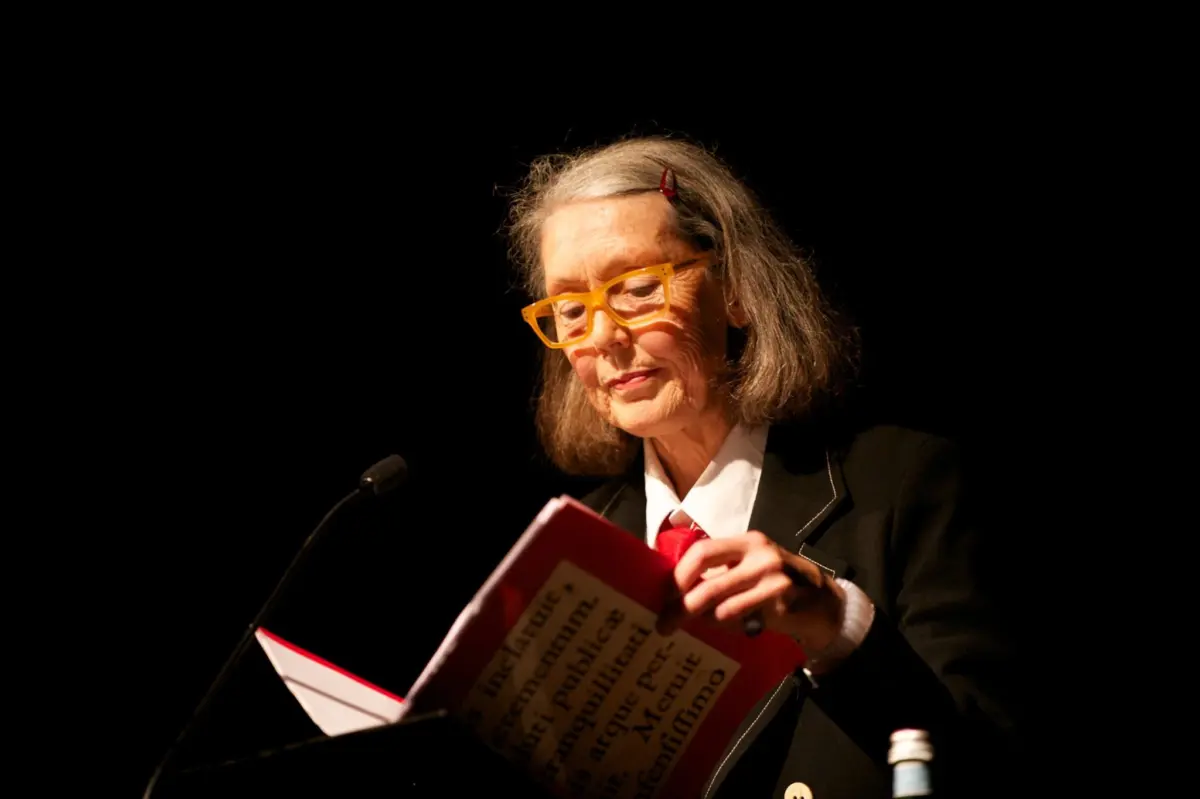
In September 2013, Carson delivered The Poetry Society Annual Lecture (concurrently presented as the Kenneth Allott Lecture at the University of Liverpool) at the British Museum in London. Titled "Stammering, Stops, Silence: On the Method and Uses of Untranslation," the lecture investigated the generative failures of translation—the deliberate gaps left when words refuse to travel across languages. Originally printed in The Poetry Review, the lecture has been made freely available online by The Poetry Society in celebration of her Nobel Prize.
Furthermore, Carson’s work continues to resonate across generations of readers. Poems by Carson featured prominently in the Winter 2023 issue of The Poetry Review. In Autumn 2026, as part of The Poetry Society’s T.S. Eliot Prize Young Critics programme, emerging critic Cal O’Reilly published a widely praised analysis of Carson’s 2001 Eliot Prize-winning collection, The Beauty of the Husband, proving that her work maintains an urgent, magnetic pull on teenage and twenty-something readers encountering her verse for the first time.
Future Outlook: The Enduring Legacy of an Unclassifiable Mind
The awarding of the 2026 Nobel Prize in Literature to Anne Carson marks a historic pivot for the Swedish Academy, signaling a formal acknowledgment that the boundaries between poetry, classical scholarship, and avant-garde visual art are increasingly porous. For decades, traditionalists argued over whether Carson was "too academic" for poetry or "too lyrical" for the academy. The Nobel Prize resolves that debate definitively: Carson is precisely what literature needs in an era of fractured communication—a thinker who demands intellectual rigor while offering visceral, emotional release.
As the publishing world prepares for her upcoming 2027 releases—Beware the Man Whose Handwriting Sways Like a Reed in the Wind and Highlights of Colonialism—the global literary ecosystem is re-evaluating her entire backlist. Universities, translation seminars, and poetry workshops are currently rewriting their syllabi to grapple with the structural innovations pioneered in Nox and Autobiography of Red.
Anne Carson’s Nobel Prize is not merely a recognition of a prolific career; it is a validation of difficulty, risk, and the belief that poetry can still alter the structural architecture of human thought. In honoring Carson, the Nobel Committee has honored a writer who proved that to look backward into the ancient Greek lexicon is the only truly radical way to step forward into the future of literature.




Comments
Facebook App ID not configured. Please add it in the Customizer.