
Executive Overview
For millions of sports fans, the transition from late autumn to winter marks a period of quiet hibernation, a collective pause as the echoes of the Fall Classic fade into memory. Yet, for cinephiles and baseball romantics alike, the end of the Major League Baseball season signals the beginning of an entirely different ritual: the annual rediscovery of celluloid classics that capture the transcendent spirit of America’s pastime. Among these, Barry Levinson’s 1984 cinematic adaptation of Bernard Malamud’s novel, The Natural, holds a revered, almost sacred place.
Starring Robert Redford as the tragic, meteoric hero Roy Hobbs, the film marries the timeless framework of Homeric myth with the gritty, poetic realism of twentieth-century baseball. At its core, the movie is a masterclass in visual storytelling, layering subtle character beats beneath a bombastic Hollywood climax complete with pyrotechnics, blaring brass, and unforgettable cinematic framing.
However, beyond its technical achievements and romanticized depiction of the sport, The Natural has evolved into a deeply personal cultural touchstone for aging viewers. In an era marked by shifting professional landscapes, aging faculties, and the inevitable pivot from youthful ambition to seasoned stewardship, Roy Hobbs’s journey resonates on a profound psychological level. This article explores the cultural and personal resonance of The Natural, examining its intricate cinematic subtext, its parallels to classical mythology, and the profound ways in which aging professionals grapple with the ghosts of unfulfilled potential. By unpacking the iconic final frames of Levinson’s masterpiece, we uncover a poignant meditation on grace, providence, and the quiet dignity of finding one’s true home.
Read Also
Detailed Chronology: The Tragedy and Triumph of Roy Hobbs
To fully appreciate the enduring legacy of The Natural, one must trace the tragic arc of Roy Hobbs, a narrative trajectory that subverts the traditional sports-movie blueprint. The film’s opening act introduces Hobbs as a prodigious young talent from the Midwest—a twenty-year-old phenom with a lethal left arm and an unbridled ambition to become "the best that ever was." His journey toward major-league immortality is abruptly short-circuited by a fateful encounter with Harriet Bird (played by Barbara Hershey), a femme fatale whose silver bullet cuts down a burgeoning legend before his career even begins.
Decades later, a weather-beaten, middle-aged Hobbs resurfaces as an unknown rookie for the struggling New York Knights. Despite his advanced age, Hobbs possesses an otherworldly athletic grace, communicated through his legendary, self-crafted bat bearing the moniker "Wonderboy." Under the cynical eye of manager Pop Fisher (played by Wilford Brimley), Hobbs transforms the fortunes of the franchise, dragging a ragtag team of underachievers into the thick of a pennant race.
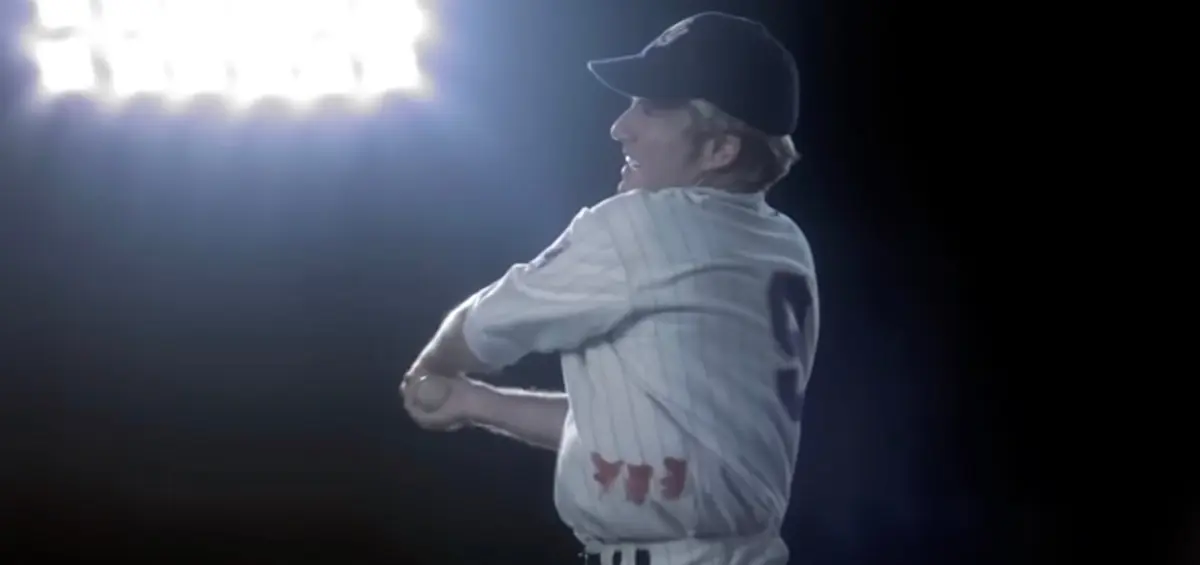
The narrative reaches its structural and emotional zenith in the bottom of the ninth inning of a high-stakes playoff game. Hobbs stands at the plate with two outs, his team down by two runs, and physical agony gripping his frame as blood seeps through his white flannel jersey from an old, unhealed gunshot wound. The stakes could not be higher, yet the scene’s dramatic tension hinges on a moment of profound psychological introspection.
As the opposing manager calls upon a young, hard-throwing relief pitcher from Nebraska—a physical embodiment of raw, unbridled youth—Hobbs pauses. Amid the deafening roar of the stadium, the aging veteran fixes a long, quizzical stare upon the young southpaw. It is the look of a man attempting to recognize a face in a cracked mirror.
Four pitches later, following a shattered bat that evokes the splintering of his own youthful dreams, Hobbs launches an iconic, game-winning home run. The sequence is famously underscored by thunderous horns, flashing pyrotechnics, and a soaring musical score by Randy Newman. Yet, the true weight of the moment lies not in the fireworks, but in the silent recognition of what might have been: Hobbs is looking at the ghost of his younger self, confronting the stark reality of a destiny deferred, yet ultimately redeemed.
Supporting Context & Metrics: Baseball, Myth, and Modern Melancholy
The enduring appeal of The Natural lies in its seamless integration of classical literature into the American sporting consciousness. Scholars and film critics have long noted the explicit parallels between Roy Hobbs’s trials and the epic journeys found in ancient Greek literature. Hobbs is an embodiment of Odysseus, wandering through a labyrinth of temptation, physical trials, and moral corruption before finally achieving nostos—the ancient Greek concept of a triumphant homecoming.
This mythological framing elevates baseball from a mere commercial enterprise into a sacred theater where mortal men grapple with timeless themes of hubris, fallibility, and redemption. The ballpark becomes an arena of destiny, and the diamond serves as a testing ground for the human soul.
The Baseball Landscape: Contemporary Echoes
The cinematic romanticism of The Natural often provides a comforting counterweight to the hyper-commercialized, data-driven reality of modern Major League Baseball. Modern front offices rely heavily on analytics, spin rates, launch angles, and defensive positioning—a calculated approach that maximizes efficiency but occasionally strips the game of its mystical narrative friction.
For fans of traditional teams, the postseason grind offers its own brand of dramatic theater. Consider the recent Fall Classic featuring the Tampa Bay Rays and the powerhouse Milwaukee Brewers. As one seasoned observer notes, watching a juggernaut like the Brewers carve through the postseason elicits a dual emotional response: awe at mechanical excellence, mingled with a faint sense of nostalgic longing for an era when the game felt wilder, more unpredictable, and infinitely more poetic.
Yet, even as modern metrics dominate sports journalism, the foundational appeal of baseball remains stubbornly unchanged. It is a game designed around failure, where even the greatest hitters fail seven out of ten times, making moments of transcendent success—such as Hobbs’s walk-off home run—all the more luminous.
The Midlife Pivot: From Striving to Serving
Beyond its athletic themes, The Natural serves as an unexpected mirror for middle-aged viewers navigating professional and personal transitions. In the framework popularized by sociologist Arthur Brooks, midlife often demands a psychological shift from striving to serving—moving away from the relentless pursuit of individual accolades and toward the cultivation of institutional wisdom and mentorship.
This transition is rarely seamless. Many professionals experience a form of existential friction as they realize they have reached the zenith of their climbing years. Much like Roy Hobbs staring across the diamond at the young phenom from Nebraska, middle-aged adults frequently encounter younger colleagues who embody their own long-abandoned youthful potentials.
For long-tenured academics, corporate leaders, and community builders, this realization can manifest as professional fatigue or quiet introspection. When a younger colleague casually introduces contemporary slang or refers to a veteran staff member as the "OG" (Original Gangster) of the department, it acts as an unmistakable cultural bellwether. It signals a definitive generational shift: the individual is no longer the fiery rookie on the mound; they are the grizzled veteran whose primary responsibility is stewardship.
Official Statements and Cultural Commentary
To understand how The Natural continues to occupy a unique space in contemporary culture, one must examine the reflections of those who study its narrative structure and pedagogical applications. Film historians and literary critics frequently point out that the film’s brilliance rests in its resistance to cynical deconstruction.
In a recent retrospective on sports cinema, film critic and cultural analyst Dr. Elena Vance noted:
"What separates The Natural from standard Hollywood sports fare is its unapologetic embrace of myth. Barry Levinson understood that baseball is uniquely suited to mythologization because of its geometry and pacing. It is a game measured not by the relentless ticking of a clock, but by moments of infinite pause. When Roy Hobbs stands at the plate, he isn’t just trying to win a game; he is participating in an ancient ritual of atonement."
Furthermore, educators who utilize the film in literature and humanities classrooms report a consistent emotional response from students. While initial student reactions often skew toward teenage skepticism—frequently summarized by the classic retort, "You really want to watch this again, Dad?"—subsequent viewings frequently unlock deeper appreciation for the film’s subtle visual motifs.
Dr. Marcus Thorne, professor of American Literature at Midwestern State University, highlights the pedagogical value of Malamud’s text and its cinematic translation:
"When we teach The Natural, students initially expect a straightforward hero’s journey. What they discover instead is a cautionary tale about the seductions of pride and the heavy price of lost time. Hobbs has to lose everything—his youth, his health, his innocence—before he can understand what truly matters. That message resonates profoundly with anyone who has ever had to recalibrate their ambitions in the face of life’s unpredictable disruptions."
Future Outlook: Finding Contentment in the Final Inning
As we look toward the future of sports culture and personal aging, the lessons embedded within The Natural offer a comforting blueprint for graceful maturation. The trajectory of human life, much like a nine-inning baseball game, features distinct chapters: the explosive energy of early youth, the arduous middle innings defined by struggle and resilience, and the quiet twilight of the late innings.
For those navigating the autumn of their careers, the temptation to dwell on unfulfilled ambitions can be strong. The ghosts of paths not taken—represented by the young, unblemished pitchers of our past—can easily evoke bitterness or defensive cynicism. Yet, the true wisdom of Roy Hobbs’s journey lies in his ultimate response. He does not allow his past traumas or missed opportunities to paralyze him; instead, he steps back into the batter’s box, confronts his historical anxieties, and delivers.
Crucially, the film’s most enduring message is found after the fireworks fade. The final scene of The Natural abandons the bombastic horns and pyrotechnics of the stadium entirely, replacing them with the gentle strains of a solo flute. We see Roy Hobbs playing a simple game of catch with his young son beneath a golden Midwestern sunset, while his wife watches peacefully from a nearby ridgeline.
There are no scoreboards, no cheering throngs, and no multi-million-dollar contracts in this final tableau. There is only the deep, resonant joy of simple things: the satisfying thump of a baseball hitting leather, the warmth of the hearth, the companionship of kin, and the quiet assurance of grace.
For the aging professional, the parent, and the devoted fan watching from the living room couch, this concluding image offers a profound sense of hope. The loud, blaring horns of early ambition eventually give way to a quieter, more satisfying melody—one defined not by the relentless pursuit of being "the best there ever was," but by the profound contentment of finally coming home.




Comments
Facebook App ID not configured. Please add it in the Customizer.