
The literary landscape of October 2026 brings forth an exceptional selection of translated fiction, nonfiction, and poetry, capturing the shifting socio-political anxieties, historical reckonings, and deeply personal griefs defining the modern era. Curated by critic Tobias Carroll, this month’s watchlist spans various languages, geographical regions, and literary forms, offering readers profound insights into how global writers confront authoritarianism, institutional erasure, and the endurance of human memory.
From the devotional ecstasies of classical Indian poetry newly rendered in contemporary English to biting essays on modern misogyny, and from chillingly prescient speculative futures in China to haunting memorials of European fascism and South American dictatorship, these six works share a common thread: they refuse to let history, identity, or suffering go unexamined.
This report provides a comprehensive examination of the October 2026 releases featured on the watchlist. It outlines the specific cultural contexts, publisher motivations, critical reception, and broader thematic resonances of each title, providing an authoritative guide for scholars, translators, and global literature enthusiasts.
Read Also
Detailed Chronology & Book Profiles
1. Blue Like My Beloved by Mirabai
- Translator: Chloe Martinez
- Publisher: New Directions
- Format & Details: Poetry | 96 pages | ISBN 9780811240437 | US$16.95
Background and Genesis
Mirabai, the celebrated sixteenth-century Hindu mystic poet and devotee of Lord Krishna, has captivated spiritual seekers and poetry enthusiasts for centuries through her passionate, defiant vernacular songs (bhajans). In Blue Like My Beloved, poet-translator and scholar Chloe Martinez draws upon decades of rigorous academic study and linguistic immersion to assemble a definitive English-language collection. Rather than offering a dry scholarly translation, Martinez pairs Mirabai’s most widely celebrated works with lesser-known pieces, creating an arc that captures the full emotional and spiritual spectrum of the mystic’s life.
Critical & Translatorial Perspective
As Martinez notes, Mirabai’s seemingly plainspoken and folksy Braj Bhasha dialect conceals profound technical complexity. The verse is heavily layered with polyvalent terminology, intricate sonic and metrical designs that transcend simple rhyme schemes, and complex mythic codifications meant for initiated Krishna devotees.

Reviewers and publishers alike have noted the surprising accessibility and contemporary resonance of the collection. New Directions compares the collection’s enduring brilliance to luminaries like Rumi and Sor Juana Inés de la Cruz. Critics point out that Martinez’s translation mirrors the emotional directness of modern pop songwriting—albeit one directed toward an omnipotent, divine subject rather than a flawed mortal. Lines such as "Mira’s sold into the Mountain Lifter’s hands. / People say she’s ruined" (from "Mira’s Hooked") emphasize a fierce independence, pitting radical devotion against societal condemnation.
2. The Man with Many Names by Georgi Gospodinov
- Translator: Angela Rodel
- Publisher: Liveright
- Format & Details: Fiction | 240 pages | ISBN 9781324097310 | US$27.99
Background and Genesis
Following his historic International Booker Prize win for Time Shelter, Bulgarian author Georgi Gospodinov returns with The Man with Many Names, a sweeping compendium of forty short stories gathered over three decades of literary production. Translated expertly by Angela Rodel, the volume blends material from previous, harder-to-find English translations (such as those by Alexis Levitin and Magdalena Levy) with fresh editorial curation.
Thematic Scope and Reception
Set primarily in and around a fading, melancholic Bulgaria, the collection explores public infrastructure, bureaucratic absurdities, the peculiarities of language, and the physical spaces of everyday life, from train stations to public restrooms.
Publishers Weekly highlights the volume’s charm and distinctiveness, noting that Gospodinov’s signature intelligence, humor, and deep affection for his compatriots remain on full display. The stories tread the delicate boundary between noir-influenced punchiness and philosophical meditations on mortality and identity. As the narrator of the story "A Miracle Story" observes—in a line that serves as an unofficial epigraph for the entire collection—"A miracle is a very personal thing."
3. China +100
- Editor: Xueting C. Ni
- Translators: Xueting C. Ni, Jack Hargreaves, Yahia Ma, Gigi Chang, Christopher MacDonald, Judith Huang, Andrew Rule, and Mel Etvolare Lee
- Publisher: Comma Press
- Format & Details: Fiction | 192 pages | ISBN 9781917093217 | US$20.95
Background and Genesis
As the latest installment in Comma Press’s acclaimed +100 speculative fiction series, China +100 brings together a diverse cohort of contemporary Chinese writers and translators. Edited by Xueting C. Ni, the anthology uses speculative frameworks to interrogate the intergenerational and societal reverberations of the 2019 global outbreak, alongside imagined future epidemiological crises.

Stylistic Diversity and Imagery
The anthology spans a vast stylistic and tonal range, moving from transhumanist performance art to lawless cyberpunk dystopias. Common motifs include concrete-devouring superfungi, deep-space viral outbreaks, slum clearances masked as quarantine protocols, and viral rumors that mutate faster than pathogens.
Notable highlights include Dan Shi’s "Fire" (translated by Yahia Zhengtang Ma), which features striking imagery of artificial flower fields, and Anna Wu’s "Archaic Dust" (translated by Christopher MacDonald), which conceptualizes visible, atmospheric viruses. The collection captures a society reckoning with rapid technological, biological, and sociological transformations over the coming decades.
4. Visceral by María Fernanda Ampuero
- Translator: Frances Riddle
- Publisher: Feminist Press
- Format & Details: Nonfiction | 184 pages | ISBN 9781558613737 | US$17.95
Background and Genesis
Ecuadorian writer María Fernanda Ampuero, a leading voice in the contemporary Latin American gothic renaissance, shifts her focus from fiction to personal essay in Visceral. Translated by Frances Riddle, the collection functions simultaneously as analytical critique, confessional diary, and psychological horror story.
Core Themes and Critical Resonance
In the opening essay, Ampuero reflects on the global rise of far-right politics and attacks on women’s rights, explaining her turn to literature: "As always, when I can’t understand, when my insides twist with rage over injustice to the point I feel I might faint, I turn to literature."
Drawing inspiration from horror pioneers like Mary Shelley as well as contemporary peers like Mariana Enríquez, Ampuero examines the daily realities of navigating a misogynistic world in a woman’s body. In essays such as "Asphyxiation," she writes with brutal clarity: "Every time I hear about the triumph of the far-right parties, I think of how the race to the top of the pyramid of democracy is, in fact, a boot stomping on our wombs, our loins, our minds." The collection tackles colonialism, patriarchy, and the psychic damage inflicted by societal beauty standards.

5. Kaddish by Radu Vancu
- Translator: Sean Cotter
- Publisher: Zephyr Press
- Format & Details: Poetry | 176 pages | ISBN 9781938890406 | US$19.00
Background and Genesis
Romanian poet Radu Vancu’s Kaddish, translated by Sean Cotter, is a work of profound historical empathy and mourning. The collection is written from the perspective of Miklós Radnóti, the Hungarian Jewish poet murdered by Nazi forces during a forced march in May 1944 and tossed into a mass grave. Radnóti’s final notebook was recovered from his exhumed remains in 1946, preserving some of the twentieth century’s most haunting Holocaust poetry.
Urgency and Paradox
Vancu channels this historical trauma into a modern poetic meditation on war, mortality, and art. A recurring refrain anchors the collection: (Just because I write these poems / doesn’t mean I am alive). Translator Sean Cotter emphasizes that Vancu’s work issues an uncompromising demand: that all culture actively confront the realities of fascism, murder, and institutional inhumanity—a message of alarming relevance in the modern political climate.
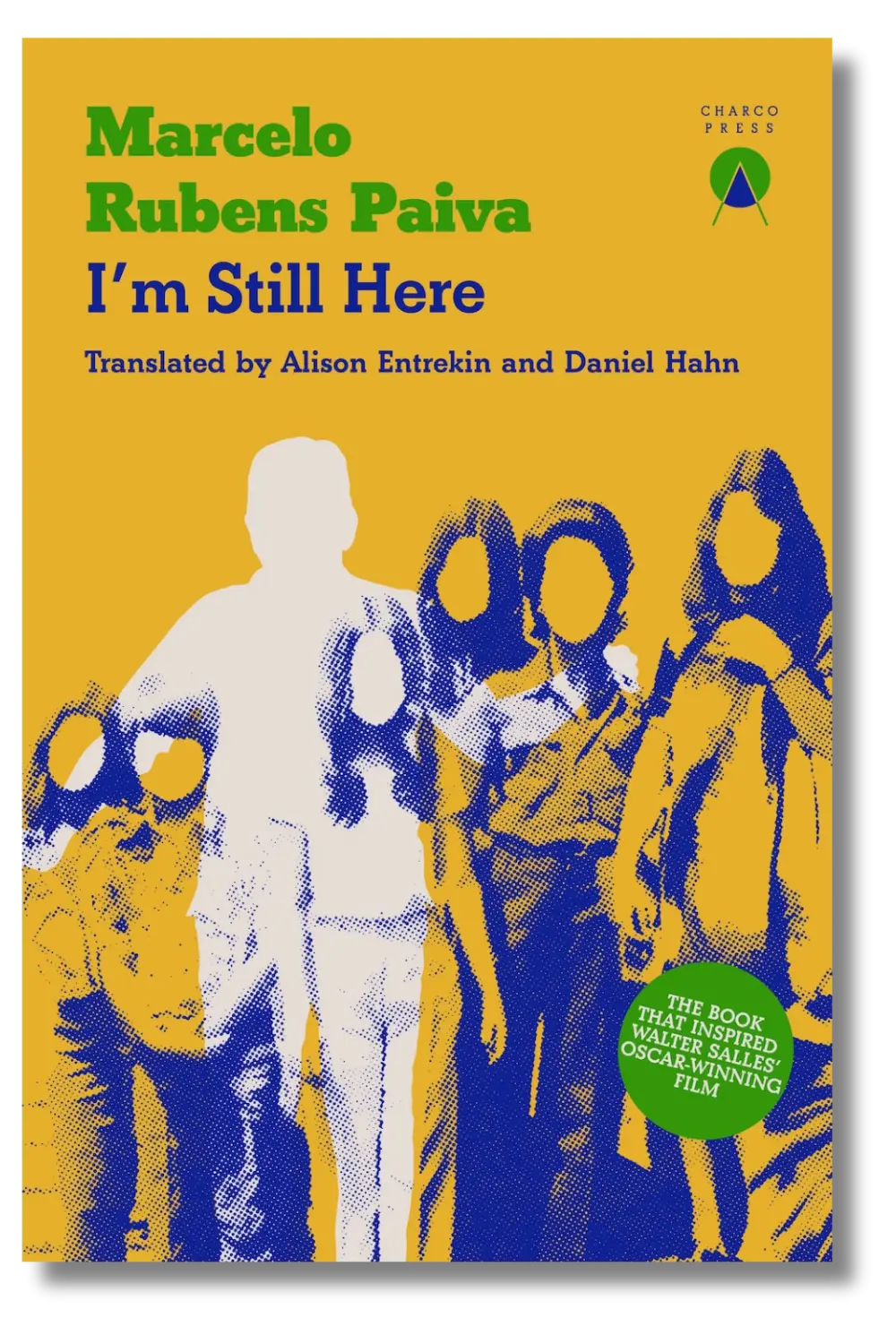
6. I’m Still Here by Marcelo Rubens Paiva
- Translators: Alison Entrekin and Daniel Hahn
- Publisher: Charco Press
- Format & Details: Nonfiction | 272 pages | ISBN 9781917093217 | US$17.95
Background and Genesis
Originally published in Portuguese as Ainda Estou Aqui, Marcelo Rubens Paiva’s celebrated 2015 memoir arrives in a new English translation by Alison Entrekin and Daniel Hahn via Charco Press. The book chronicles the author’s family history against the backdrop of the Brazilian military dictatorship and the disappearance of his father, Rubens Paiva, a former congressman tortured to death by the regime.
The Interplay of Personal and National Memory
As noted by Alexander Durie in Time, Paiva initially set out to record his family history as his mother, Eunice Paiva, began slipping into Alzheimer’s disease in her eighties. Eunice had spent decades transforming herself into an influential human rights lawyer and activist, eventually successfully lobbying for laws to formally acknowledge the deaths of the regime’s victims and secure state accountability.
The memoir is filled with striking paradoxes. Paiva writes bitterly, "I must express my gratitude to the Brazilian military: thank you for not having killed my mother." By intertwining his mother’s cognitive decline with the systemic amnesia of the Brazilian state, Paiva creates a multi-layered exploration of memory, trauma, and justice.

Supporting Context & Metrics
| Title | Author | Translator / Editor | Genre | Publisher | Page Count |
|---|---|---|---|---|---|
| Blue Like My Beloved | Mirabai | Chloe Martinez (Tr.) | Poetry | New Directions | 96 |
| The Man with Many Names | Georgi Gospodinov | Angela Rodel (Tr.) | Fiction | Liveright | 240 |
| China +100 | Various | Xueting C. Ni (Ed.) | Fiction | Comma Press | 192 |
| Visceral | María Fernanda Ampuero | Frances Riddle (Tr.) | Nonfiction | Feminist Press | 184 |
| Kaddish | Radu Vancu | Sean Cotter (Tr.) | Poetry | Zephyr Press | 176 |
| I’m Still Here | Marcelo Rubens Paiva | Alison Entrekin & Daniel Hahn (Tr.) | Nonfiction | Charco Press | 272 |
The geographic distribution of this release cycle highlights the growing market vitality of independent presses specializing in international literature—such as New Directions, Charco Press, Comma Press, Feminist Press, Zephyr Press, and Liveright. By prioritizing works from Bulgaria, China, Ecuador, Brazil, Romania, and classical India, these publishers continue to bridge linguistic divides and expand the horizons of Western readership.
Official Statements & Publisher Insights
-
New Directions on Blue Like My Beloved:
"In Blue like My Beloved, the poet-translator and scholar Chloe Martinez… has compiled a selection of Mirabai’s poetry that includes her greatest hits alongside lesser-known poems. The collection spans the range of Mirabai’s moods and themes in a vibrant poetry of intimacy and visionary perception…"
-
Feminist Press on Visceral:
"What does it mean to move with a woman’s body through a misogynistic world? María Fernanda Ampuero, one of the greatest writers of the new wave of Latin American gothic fiction, answers this question in this personal essay collection…"

-
Charco Press on I’m Still Here:
"When Marcelo Rubens Paiva was eleven years old, his father was tortured to death by the Brazilian dictatorship. Twenty-five years later, his mother, Eunice, helped usher into law a way for the families of the regime’s victims to finally have their deaths formally acknowledged…"
Future Outlook
The October 2026 literary slate signals several vital trends in translated and independent publishing:
- The Resurgence of Historical Witness: Works like Radu Vancu’s Kaddish and Marcelo Rubens Paiva’s I’m Still Here underscore an urgent demand for literature that bears witness to historical atrocities—fascism, totalitarianism, and state-sponsored violence—at a time when democratic norms face renewed global stress tests.
- Hybrid Forms and Confessional Critique: Authors like María Fernanda Ampuero are breaking down traditional genre barriers, blending personal essay, memoir, horror tropes, and political analysis to articulate contemporary feminist anger and resistance.
- Speculative Geopolitics: Anthologies like China +100 demonstrate how science fiction and speculative futures serve as vital laboratories for examining societal trauma, technological acceleration, and public health crises across cultural borders.
As these six titles enter the global marketplace, they invite readers not merely to escape into alternative realities, but to engage more deeply with the complex historical and ethical realities shaping our shared present.



Comments
Facebook App ID not configured. Please add it in the Customizer.