
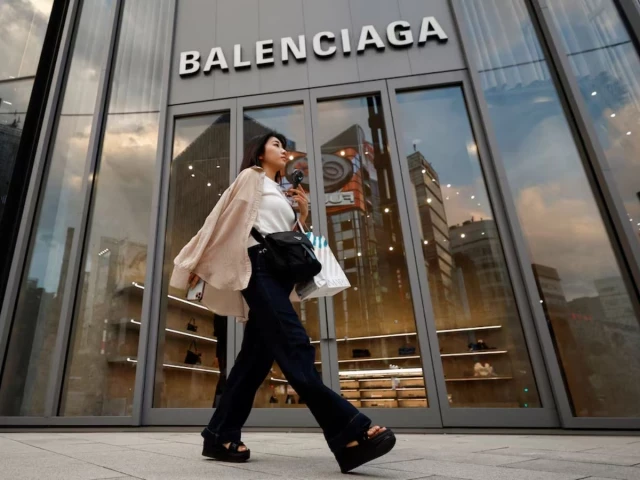
PARIS/LONDON — In a move signaling a seismic shift in global luxury fashion, French luxury conglomerate Kering has announced the appointment of acclaimed British-Jamaican menswear designer Martine Rose as the new Creative Director of Balenciaga. Rose succeeds Pierpaolo Piccioli, whose tenure at the storied Spanish-heritage house lasted a fleeting 16 months.
This appointment is far more than a routine creative swap. It marks the third major leadership shake-up across Kering’s portfolio within a single month, unfolding against the backdrop of a bruising three-year financial and cultural slowdown that has disproportionately battered the group’s crown jewel, Gucci. Spearheaded by newly installed Chief Executive Officer Luca de Meo, this aggressive corporate and creative restructuring is a desperate, calculated bid to drag Kering’s marquee labels out of a prolonged slump, recalibrate their brand identities, and re-engage an increasingly elusive, culture-driven consumer base.
Executive Overview: The Anatomy of a Luxury Crisis
For decades, the luxury sector operated on an assumption of perpetual, unyielding growth. Fueled by a post-pandemic spending boom and unprecedented appetite in Asian markets, high-end conglomerates enjoyed staggering valuations. However, the last three years have revealed deep vulnerabilities within legacy business models. Kering—parent to brands including Gucci, Saint Laurent, Balenciaga, and Alexander McQueen—has felt this systemic shock more acutely than most of its peers, such as LVMH or Hermès.
Read Also
The core of Kering’s malaise lies in a dangerous over-reliance on single-brand dominance (primarily Gucci) and a series of creative missteps that failed to pivot alongside shifting consumer values. As younger, digitally native shoppers experience economic fatigue and trend fatigue, luxury brands have found themselves caught in a stylistic chasm: unable to rely safely on past heritage tropes, yet missing the cultural pulse required to generate genuine viral excitement.
Enter Luca de Meo. Tasked with engineering a turnaround, the CEO has wasted no time dismantling the previous administrative and creative status quo. By unseating legacy designers and installing figures rooted firmly in subcultural authenticity and modern street culture—typified by the appointment of Martine Rose at Balenciaga—Kering is signaling a radical strategic pivot. The message to the market is unambiguous: heritage must be married to street-level relevance, or risk obsolescence.
Detailed Chronology: The Anatomy of Kering’s Fall and Rebirth
To understand the weight of Martine Rose’s appointment, one must trace the rapid-fire sequence of events that have convulsed Kering’s executive suites over the past several years, culminating in October and November’s unprecedented leadership purge.
The Demna Era and the Apex of Streetwear
To contextualize Balenciaga’s current trajectory, one must look back at the decade-long tenure of Demna (who now leads Gucci). Taking over Balenciaga in 2015, Demna fundamentally upended the house’s codes. He injected a dark, dystopian, and deeply ironic aesthetic that weaponized internet culture, irony, and utilitarian sportswear. His runway shows featured mud pits, simulated snowstorms, and political statements, while commercial ventures produced viral phenomena—most notably the chunky, distressed “Triple S” sneaker and exaggerated silhouettes that defined 2010s fashion.
Under Demna, Balenciaga captured the zeitgeist and generated massive commercial returns. However, the aesthetic eventually hit a saturation point. By the time Demna shifted internally to take the helm at Gucci under de Meo’s new mandate, Balenciaga was in desperate need of a fresh creative vocabulary that could balance shock-value innovation with wearable, sophisticated commercial execution.
The Short-Lived Piccioli Experiment
In an attempt to pivot the brand toward a more traditional, haute couture-centric elegance, Kering tapped former Valentino creative director Pierpaolo Piccioli. Known for his mastery of breathtaking color palettes, ethereal evening gowns, and romantic classicism, Piccioli’s appointment was heralded by some as a mature, elevated direction for Balenciaga.
However, the marriage proved ill-fated. Piccioli, appointed before de Meo’s comprehensive corporate overhaul, delivered a starkly different vision from the brand’s gritty, modern roots. Over his brief 16-month tenure, he presented just three ready-to-wear collections and a single haute couture line. Critical reception was deeply mixed; fashion critics questioned whether Piccioli’s refined, delicate sensibility could ever truly mesh with Balenciaga’s industrial, avant-garde DNA.
Following his departure, Piccioli released a characteristically gracious statement on Instagram: "Life is a journey and each chapter exists to make way for the next," thanking his atelier teams for their dedication. Yet, behind the polite rhetoric lay the reality of a strategic mismatch that Kering’s leadership could no longer afford to sustain.
The Domino Effect: Saint Laurent and Alexander McQueen
Piccioli’s exit is merely one domino in a cascade of departures that has left Kering’s creative stable in a state of unprecedented flux.
In October, Anthony Vaccarello stunned the fashion world by resigning after a decade leading Saint Laurent. Vaccarello had successfully maintained Saint Laurent’s status as a sleek, hyper-sensual commercial powerhouse, making his departure a severe blow to Kering’s second-biggest brand. As of mid-November, Kering has yet to name a successor for Saint Laurent, leaving industry insiders speculating wildly about who might step into the Parisian fashion house.
Simultaneously, the British label Alexander McQueen found itself unanchored following the departure of Sean McGirr, who stepped down after a short and turbulent run. With Balenciaga, Saint Laurent, and Alexander McQueen all undergoing structural or leadership vacuums concurrently, de Meo’s restructuring is arguably the most aggressive operational overhaul in modern luxury history.
Supporting Context & Metrics: The Numbers Behind the Overhaul
The urgency driving Kering’s board room is rooted in cold, uncompromising financial data. For three consecutive years, the group’s financial performance has lagged behind industry benchmarks, dragging down stock prices and triggering deep investor anxiety.
- The Gucci Anchor: Gucci historically accounted for the lion’s share of Kering’s revenues and operating profits. However, a sharp cooling in demand for its maximalist aesthetic, combined with a sluggish recovery in key Asian markets (particularly mainland China), caused revenues to plummet. In recent quarters, Gucci’s sales drops hit double digits, exposing Kering’s dangerous over-dependence on a single brand.
- Margin Compression: As sales declined, fixed costs, retail rents, and aggressive marketing expenditures remained high, severely compressing Kering’s operating margins. This forced the parent company to implement cost-cutting measures, rationalize its supply chains, and critically evaluate underperforming creative teams.
- The Shift in Consumer Demographics: Market research indicates that Millennials and Generation Z—who now represent the vast majority of luxury consumption—are prioritizing experiential luxury, quiet luxury, or hyper-niche subcultural authenticity over traditional logo-driven goods. Legacy houses that fail to authentically speak to these subcultures risk irrelevance.
It is within this volatile financial ecosystem that Martine Rose enters Balenciaga. Her mandate is not simply to design clothes, but to engineer a cultural reclamation that translates directly into retail conversion.
Official Statements and Industry Reactions
The announcement of Martine Rose’s appointment has sent shockwaves through the global fashion community, eliciting praise, surprise, and intense analytical scrutiny.
Martine Rose, 45, represents a departure from the traditional European academy-trained couturier. Born in Croydon, south London, of Jamaican descent, Rose launched her eponymous menswear label in 2007 out of a modest London market stall. Over nearly two decades, she has built a cult-like following through designs heavily inspired by 1990s rave culture, reggae soundsystem heritage, and British working-class streetwear. Her ability to blend high and low fashion—collaborating with industrial giants like Nike and skate royalty Supreme—has made her a darling of the contemporary fashion underground. Crucially, Rose previously spent three years working at Balenciaga as a consultant under Demna, granting her an intimate understanding of the brand’s internal mechanics and corporate culture.
Upon her appointment, Rose remarked:
"It is a true privilege to be appointed Creative Director of Balenciaga, a House with an extraordinary heritage and a fearless creative spirit. I am excited to build upon this legacy and explore new territories with the incredible teams in Paris."
Kering CEO Luca de Meo underscored the strategic rationale behind selecting a designer known for her underground credibility rather than traditional haute couture pedigree:
"Martine’s connection to the new generation and her instinctive understanding of culture bring a new dimension to the House. In an era where authenticity is the ultimate currency, Martine possesses a rare vision that bridges raw cultural subversion with sophisticated design. We are confident she will lead Balenciaga into a vibrant new chapter."
Industry analysts have responded with cautious optimism. Unlike Piccioli’s classical approach, Rose’s DNA aligns seamlessly with the irreverent, street-informed history that made Balenciaga a commercial juggernaut under Demna. However, translating a critically revered independent London menswear brand into the commercial machine of a multi-billion-dollar global luxury house presents monumental operational hurdles.
Future Outlook: Can Kering’s Gamble Save Its Luxury Empire?
As Martine Rose prepares to debut her inaugural collection for Balenciaga, the stakes for Kering could not be higher. The next twelve to twenty-four months will serve as an ultimate stress test for Luca de Meo’s turnaround strategy.
Several critical questions remain unanswered:
- Can Rose Balance Commerciality and Subversion? While Rose’s independent label is celebrated for its uncompromising, niche aesthetic, Balenciaga requires a global retail footprint that appeals to high-net-worth consumers across Europe, the Americas, and Asia. Balancing her edgy, subcultural roots with the mass-market accessibility required by a global luxury house will be her greatest challenge.
- Who Will Fill the Remaining Vacancies? Kering’s stabilization plan cannot rest on Balenciaga alone. The urgent need to appoint visionary successors at Saint Laurent and stabilize Gucci under Demna means that the group’s leadership must act with surgical precision. Any misstep in these upcoming appointments could further destabilize investor confidence.
- The Macroeconomic Environment: Beyond internal creative leadership, Kering remains at the mercy of broader macroeconomic forces—specifically consumer sentiment in China, inflationary pressures in Western economies, and shifting global trade dynamics.
Ultimately, Kering’s aggressive series of leadership shake-ups represents a bold acknowledgment that the old playbook of luxury is dead. By betting on Martine Rose—a designer who operates at the intersection of community, culture, and disruptive design—Balenciaga and Kering are gambling that the future of luxury belongs not to those who preserve the past, but to those who dare to reinvent it from the ground up.





Comments
Facebook App ID not configured. Please add it in the Customizer.