
Executive Overview
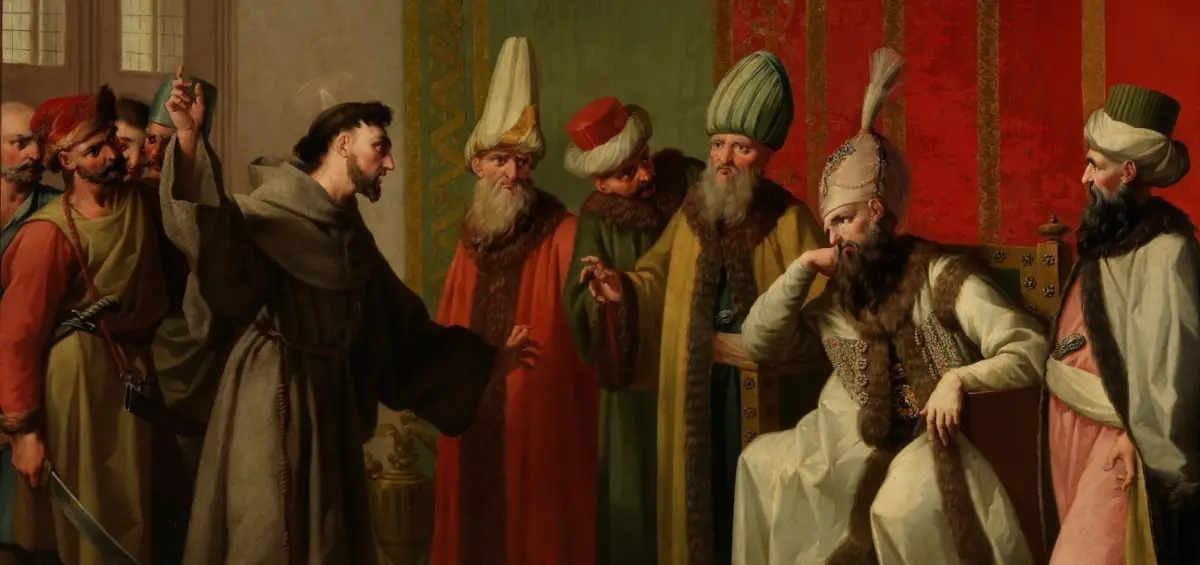
In his 2020 encyclical Fratelli Tutti, Pope Francis anchored his sweeping vision of global human fraternity in a historical parallel: the legendary thirteenth-century meeting between Saint Francis of Assisi and the Egyptian Sultan Malik al-Kamil. According to the modern papal narrative, Saint Francis bypassed the violent, war-mongering Crusaders, crossed enemy lines unarmed, and embraced the Muslim leader in a spirit of boundary-transcending peace and universal brotherhood. Pope Francis then linked this historical episode to his own contemporary diplomacy—specifically his 2019 meeting in Abu Dhabi with Ahmad Al-Tayyeb, the Grand Imam of Al-Azhar, where the two leaders signed the historic Document on Human Fraternity for World Peace and Living Together.
Yet, a rigorous examination of both medieval history and modern geopolitics reveals a stark disconnect between these hagiographic narratives and reality. Historical sources from the thirteenth century—most notably the eyewitness accounts of Bishop Jacques de Vitry—demonstrate that Saint Francis did not travel to Egypt to broker a secular peace or validate pluralism. He journeyed across enemy lines with a singular, fervent objective: to preach the Gospel to the Sultan, call him to repentance, and secure his baptism, believing that the eternal salvation of the Sultan and his court was at stake. Far from condemning the Crusades or promoting modern interreligious dialogue, Saint Francis operated out of an unwavering evangelical zeal and extraordinary fortitude.
Similarly, the modern partnership between Pope Francis and Grand Imam Al-Tayyeb rests on problematic foundations. While celebrated in secular and progressive Catholic circles as a triumph of bridge-building over the rigid doctrinal exclusions of past pontificates, the alliance papers over Al-Tayyeb’s troubling record on human rights. Al-Tayyeb has consistently supported the Egyptian state under President Abdel Fattah el-Sisi—a regime characterized by widespread arbitrary detentions, attacks on freedom of expression, and severe discrimination against religious minorities and converts. Furthermore, Al-Tayyeb has endorsed traditional Islamic jurisprudence mandating severe penalties for apostasy, blasphemy laws, and the systemic disenfranchisement of religious groups like the Baha’is.
Read Also
By constructing an idealized, revisionist portrait of Saint Francis and partnering with compromised state-appointed religious figures, contemporary Church leadership risks offering a misleading paradigm of interreligious dialogue. This article investigates the historical record of Saint Francis in Egypt, evaluates the geopolitical realities of modern Vatican diplomacy with Al-Azhar, and explores what the true legacy of the Poverello of Assisi offers to contemporary believers.
Detailed Chronology: From the Fifth Crusade to the Abu Dhabi Declaration
To understand how modern papal teaching utilizes historical memory, it is necessary to trace the chronology connecting the thirteenth-century encounter in Damietta to the twenty-first-century signing in Abu Dhabi.
- 1219 (The Fifth Crusade): During the siege of the Egyptian port city of Damietta by Christian Crusader forces, Saint Francis of Assisi crosses enemy lines accompanied by fellow friar Illuminato. According to early historical accounts, Francis spends several days among the Muslim forces, seeking an audience with Sultan Malik al-Kamil, the nephew of Saladin.
- 1220 (Martyrdom in Morocco): Operating under the same missionary impulse that drove Francis to Egypt, five Franciscan friars—Berard, Peter, Otho, Accursius, and Adjutus—are dispatched to Morocco to preach the Gospel. They are publicly beheaded for refusing to recant their faith, establishing an early precedent for the high stakes of Franciscan missionary endeavors.
- Circa 1220–1224 (Bishop Jacques de Vitry’s Chronicles): Bishop Jacques de Vitry records the earliest reliable accounts of Saint Francis’s meeting with the Sultan in his letters and his later chronicle, Historia Occidentalis. De Vitry portrays Francis as a man consumed by zeal for the faith, preaching the Gospel directly to the Sultan and his followers, with the Sultan ultimately releasing him out of fear that his own soldiers might convert.
- December 31, 2010 (The Alexandria Bombing): A terrorist bombing at a Coptic Christian church in Alexandria, Egypt, kills over twenty people. In the wake of the tragedy, Pope Benedict XVI publicly calls attention to the persecution of Christians in the Middle East. Grand Imam Ahmad Al-Tayyeb responds by suspending Al-Azhar’s official dialogue with the Vatican, accusing the Pope of improper "interference."
- 2016–2022 (The Bergoglio-Al-Tayyeb Rapprochement): Following his election, Pope Francis makes the restoration of ties with Al-Azhar a central priority of his pontificate. Over a six-year period, Pope Francis and Grand Imam Al-Tayyeb meet on nine separate occasions, culminating in high-profile summits in Rome and Cairo.
- February 4, 2019 (The Abu Dhabi Declaration): Marking the eight-hundredth anniversary of Saint Francis’s encounter with Malik al-Kamil, Pope Francis and Grand Imam Al-Tayyeb sign the Document on Human Fraternity for World Peace and Living Together in Abu Dhabi, declaring that "God has created all human beings equal in rights, duties, and dignity."
- October 3, 2020 (Promulgation of Fratelli Tutti): Pope Francis signs his third encyclical, Fratelli Tutti, in Assisi on the vigil of the Feast of Saint Francis. The encyclical explicitly draws upon the Abu Dhabi declaration and frames Saint Francis’s journey to Egypt as a timeless archetype of interreligious friendship and pacifist outreach.
- July 2025 (The Case of Saeid Mansour Abdulraziq): Highlighting the ongoing human rights crisis in Egypt and Al-Azhar’s institutional posture, Saeid Mansour Abdulraziq is arrested under charges of terrorism and "contempt for Islam" after Egyptian authorities—backed by traditional religious rulings—repeatedly refuse to update his national identity card to reflect his conversion from Islam to Christianity.
Supporting Context & Metrics: Unpacking the Historical Record
The divergence between the historical Saint Francis and the literary creation found in Fratelli Tutti hinges on the interpretation of thirteenth-century primary sources. In the encyclical, Pope Francis cites the Saint’s Earlier Rule of the Friars Minor to suggest that Francis went among Muslims to practice a quiet, non-confrontational witness of love. The Pope quotes Chapter 16 of the Rule, noting that friars should not "engage in arguments or disputes, but to be subject to every human creature for God’s sake."
However, a complete reading of Chapter 16 reveals that Saint Francis outlined two distinct methods for his friars living among "Saracens and other nonbelievers." While the first method emphasized peaceful subordination, the second explicitly mandated direct verbal proclamation:
“Another way is to proclaim the word of God when they see that it pleases the Lord, so that they believe in the all-powerful God—Father, and Son, and Holy Spirit—the Creator of all, in the Son who is the Redeemer and Savior, and that they be baptized and become Christians; because whoever has not been born again of water and the Holy Spirit cannot enter into the kingdom of God.”
The Witness of Jacques de Vitry
The most authoritative contemporary witness to the encounter between Francis and Sultan Malik al-Kamil is Jacques de Vitry, Bishop of Acre, who was present at the siege of Damietta. In his letters written in late 1219, De Vitry describes Francis as "so inflamed with zeal for the faith that he did not fear to cross the lines to the army of our enemy."
In his subsequent 1224 chronicle, Historia Occidentalis, De Vitry elaborates on the encounter: when Francis was captured by Saracen outposts, he boldly declared, "I am a Christian. Take me to your master." Brought before the Sultan, Francis preached the Christian faith for several days. According to De Vitry, the Sultan listened attentively but ultimately sent Francis back to the Christian camp under armed protection, fearing that the eloquence of Francis’s preaching might induce some of his own soldiers to convert—an act of apostasy punishable by death under medieval Islamic law.
Crucially, none of the early historical texts portray Francis as a critic of the Crusades or a champion of modern pluralistic coexistence. His motivations were entirely supernatural: he sought the conversion of the Sultan and his court to the Catholic faith, driven by the conviction that eternal salvation was impossible outside of Christ and baptism.
Official Statements and Ecclesiastical Divergence
The shift in papal rhetoric regarding Islam and interreligious dialogue over the past two decades marks one of the most significant theological developments in the modern Catholic Church.
Under Pope Benedict XVI (Cardinal Joseph Ratzinger), the Holy See maintained a cautious, doctrinally rigorous approach to non-Christian religions. This posture was exemplified by the 2000 declaration Dominus Iesus, issued by the Congregation for the Doctrine of the Faith, which reaffirmed the uniqueness and salvific universality of Jesus Christ and the Catholic Church. Benedict’s willingness to publicly address the persecution of religious minorities in the Middle East—such as his forceful condemnation of the 2010 Alexandria church bombing—prioritized the defense of suffering Christian populations over diplomatic niceties with state-sponsored Islamic authorities.
In contrast, Pope Francis has pursued a paradigm of active engagement and symbolic bridge-building, frequently bypassing institutional tensions to foster direct personal relationships with high-ranking Muslim clerics. Commenting on the release of Fratelli Tutti, prominent Catholic intellectuals noted the stark generational shift. Writing in Commonweal, theologian Massimo Faggioli contrasted the atmosphere surrounding Fratelli Tutti with the hostile reception faced by Cardinal Ratzinger’s initiatives two decades prior, celebrating the new era of dialogue inaugurated by Pope Jorge Mario Bergoglio.
However, this diplomatic optimism has drawn sharp critiques from both secular human rights monitors and religious observers. Imam Rashied Omar, a scholar at the University of Notre Dame’s Keough School of Global Affairs, has pointed out the structural pitfalls of partnering with Middle Eastern religious figures who function as "state apparatchiks":
“In the Middle East… religious leaders and institutions have been rendered state apparatchiks whose primary role is to buttress and provide religious legitimacy to state power. In almost all Middle East countries the highest Islamic religious authorities are state appointed, including the Grand Shaykh of Al-Azhar Islamic University, and most Friday mosque sermons are state sanctioned.”
Critics argue that by elevating Grand Imam Al-Tayyeb as a co-author of human fraternity, the Vatican has inadvertently lent its moral authority to a religious leader who—both through Al-Azhar and his alignment with the repressive government of Egyptian President Abdel Fattah el-Sisi—supports laws that systematically violate fundamental human rights, including freedom of conscience and freedom of worship.
Future Outlook: The Crisis of Model and Mission
As the Catholic Church navigates the complexities of twenty-first-century geopolitics, the tension between diplomatic pragmatism and unflinching moral witness will remain acute. The uncritical adoption of a pacifist, secularized Saint Francis in official teaching presents distinct challenges for the formation of the faithful.
- The Crisis of Masculinity and Witness: Presenting Catholic men with a false dichotomy—wherein historical models are restricted to either bloodthirsty, bigoted Crusaders or a pacifist Saint Francis who purportedly abandoned evangelization for dialogue—strips history of its complexity. The real Saint Francis offers a model of radical fortitude: a man who risked his life not to validate religious relativism, but to proclaim the Gospel at the highest personal cost.
- The Future of Christian-Muslim Dialogue: True interreligious dialogue cannot be built upon historical revisionism or the whitewashing of state-sanctioned oppression. For diplomatic initiatives like the Abu Dhabi Declaration to bear genuine fruit, the Holy See must balance high-level bureaucratic summits with persistent, courageous advocacy for persecuted religious minorities and converts in nations like Egypt.
- Recovering Historical Authenticity: The legacy of Saint Francis does not require myth-making. His willingness to cross enemy lines unarmed demonstrated extraordinary moral courage, but his mission was fundamentally evangelical. A mature engagement with his legacy requires acknowledging that love for one’s neighbor and fidelity to the apostolic mandate to preach Christ are not mutually exclusive.
Ultimately, the enduring relevance of Saint Francis lies not in his transformation into a modern advocate of secular pluralism, but in his total abandonment to the Gospel. As the Church looks toward the future, reclaiming the authentic historical witness of its saints remains essential for navigating an increasingly turbulent world without losing its spiritual bearings.




Comments
Facebook App ID not configured. Please add it in the Customizer.